






A familiar pattern is forming in crypto: once an asset gets a wrapper that feels normal, demand stops arriving in bursts and starts showing up on schedule. That idea drives a new 2026 outlook that argues regulated spot funds could become the dominant marginal buyer for the biggest networks.
The headline claim is straightforward. Bitwise ETFs could purchase more than 100% of the new annual supply of Bitcoin, Ethereum, and Solana in 2026, powered by broader institutional access and steady inflows.
How the report gets to more than 100%
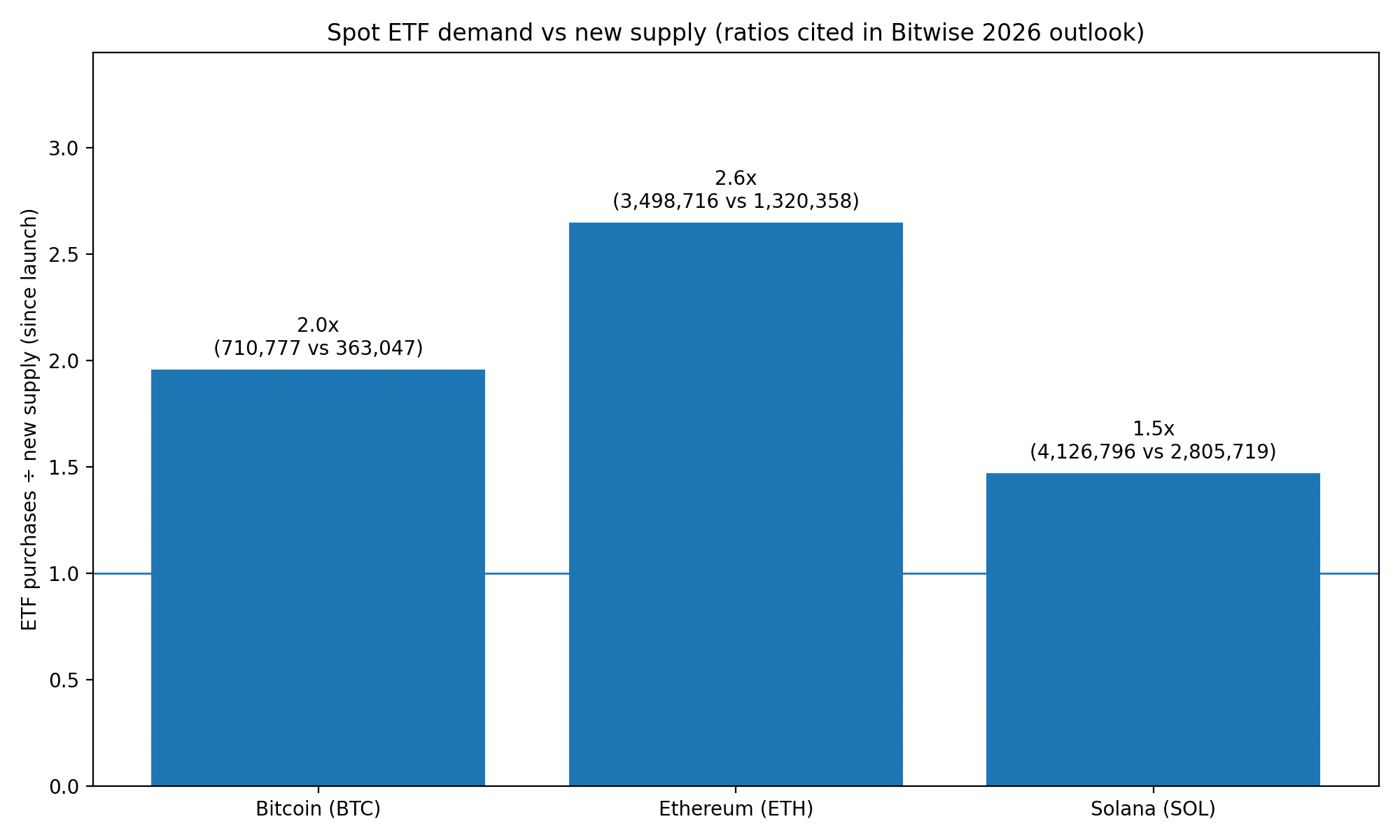
The report measures demand by looking at what spot products have already bought since launch, then compares that with how many new coins the networks produced, with Bitwise ETFs at the center of that comparison. For Bitcoin, it says U.S. spot funds bought 710,777 BTC since January 11, 2024, while the network produced 363,047 new BTC in the same window, a demand to supply ratio of 2.0x. The data in the table is marked as of December 5, 2025.
For Ethereum, it cites 3,498,716 ETH purchased versus 1,320,358 ETH newly issued, a 2.6x ratio. For Solana, it cites 4,126,796 SOL purchased versus 2,805,719 SOL newly issued, a 1.5x ratio, while noting that U.S. spot Solana ETFs launched on October 28, 2025, so the history is shorter. Bitwise ETFs appear in this data as an already active buyer.
The 2026 supply numbers: the inventory on the shelf
Forecasting demand can be messy, but forecasting new supply is easier. The report estimates that 2026 will bring roughly 166,000 BTC, 960,000 ETH, and 23,000,000 SOL of new supply. It adds that the Solana issuance estimate is reduced by 15% to reflect the network disinflationary schedule, which lowers new coin creation over time. For Bitwise ETFs, that is the ceiling on fresh inventory.
This is the hinge of the thesis. If Bitwise ETFs buy more than the new supply, the remaining coins have to come from existing holders, meaning price discovery shifts toward the willingness of long term holders to sell into a steady bid.
Why access and distribution are the catalyst
The outlook points to approvals of spot crypto ETFs at firms such as Morgan Stanley and Merrill Lynch, then argues that 2026 will be the first year most institutional investors can access crypto ETFs through familiar channels.
Institutions often allocate gradually and rebalance on calendars, so when that behavior runs through Bitwise ETFs and peers, demand can stay persistent even when headlines fade.
What indicators matter if the thesis is playing out
If the supply squeeze story is real, it should show up in numbers. One indicator is the gap between ETF net flows and estimated net issuance. Another is exchange balances and liquid supply, because coins that sit on venues are usually the easiest to sell.
Volatility is also useful context, and the report argues that Bitcoin volatility has trended down and even notes that Bitcoin was less volatile than Nvidia over a recent period, tying it to a broader investor base.

The report also builds in its own warning: strong demand does not guarantee higher prices, because existing holders can always sell coins they already own, and that selling can absorb inflows. Bitwise ETFs can tilt the setup, but they cannot remove profit taking.
The catch: supportive math is not a promise
More than 100% sounds decisive, but it is still only a forecast and flows can slow if macro conditions tighten, if risk appetite fades, or if policy hurdles return. The report itself frames the forecasts as conditional and not investment advice.
Conclusion
The clearest takeaway is structural. If Bitwise ETFs and the broader spot complex keep absorbing coins at a pace that rivals new issuance, scarcity becomes a measurable input that traders can monitor rather than a vague narrative. The path still depends on sellers, but the demand side is starting to look more like a standing order than a flash crowd.
FAQ about Bitwise ETFs
How can ETFs buy more than 100% of new supply?
They can absorb all newly issued coins and still buy from existing holders, which shifts ownership rather than creating new units.
Does this guarantee higher prices in 2026?
No. The report notes that existing holders can sell, and that selling can offset inflows, so price is never guaranteed.
What is the simplest metric to track this trend?
Comparing ETF net flows to estimated net issuance offers a clear view of whether demand is outrunning supply.
Glossary of key terms
New issuance is the number of new coins created over time through mining or validator rewards.
Net flows are the net dollars entering or leaving an ETF, which can translate into buying or selling of the underlying asset.
A disinflationary schedule describes a declining rate of new coin creation over time.
A marginal buyer is the buyer whose next purchase has the most influence on near-term price discovery.
Reference