






Current prices in the crypto market appear to be lifeless on the surface, but looking deeper at the charts, some patterns are whispering that altcoin season 2026 might be on its way. Dominance metrics have indicated structural stress that, if it continues to develop, might eventually provide room for outperformance in altcoins against Bitcoin or other major tokens.
This is based on recent weekly chart action for Bitcoin Dominance and USDT Dominance, along with sentiment readings that are at extreme fear.
Stablecoin Dominance Near Multi-Year Resistance
One of the first signs of altcoin season 2026 is to be found in stablecoin dominance and specifically looking at the chart for USDT dominance. The measure jumped to a level around 9%, which has become an important resistance area over the years and previously suggested turning points for market structure.
On the weekly time frame, once dominance for USDT entered that zone, there was a long upper wick and rejection on this structure showing that the supply in stable coins had been exhausted due to higher demand.
This means an investors’ defensive stance could be far behind when the selling has increased.
The RSI on the weekly timeframe has climbed to 78 during this phase meaning that the region is overbought. When an indicator like RSI moves into overbought territory at a longstanding resistance level, it can be interpreted as the market having crowded in on the defensive side of things and that reversal is near not because optimism has returned but because defensive flows have reached their highest levels.
In the past, USDT dominance rejections from equivalent levels have led to a rotation back into risk assets which is characteristic of an altcoin rotation.
Bitcoin Dominance Breakdown Holds Humble Room for Rotation
In addition to stablecoin signals, Bitcoin dominance has also shown important technical behavior. Bitcoin dominance showed a rising wedge pattern on the weekly chart, which often leads to topping sequences, and then broke down below the lower trendline.
The latest weekly close left BTC dominance hovering around the 58 percent mark, with a temporary halt possibly pointing to a move from the uptrend which had supported Bitcoin market cap share for most of the last cycle.
Momentum indicators such as the Moving Average Convergence Divergence (MACD) cooled as divergence lines eased lower while RSI ticked down from overbought territory.
These indicators are not concrete proof of a full rotation, but they do suggest waning dominance that has the potential to allow capital into altcoins, something many believe is necessary for there to be a real altcoin season next year 2026.
It is important to note that such patterns don’t promise a breakout immediately; instead, they set up the circumstances in which if follow-through action materializes, rotation becomes more likely.
Market Sentiment: Extreme Fear But Past Patterns Do Not Matter
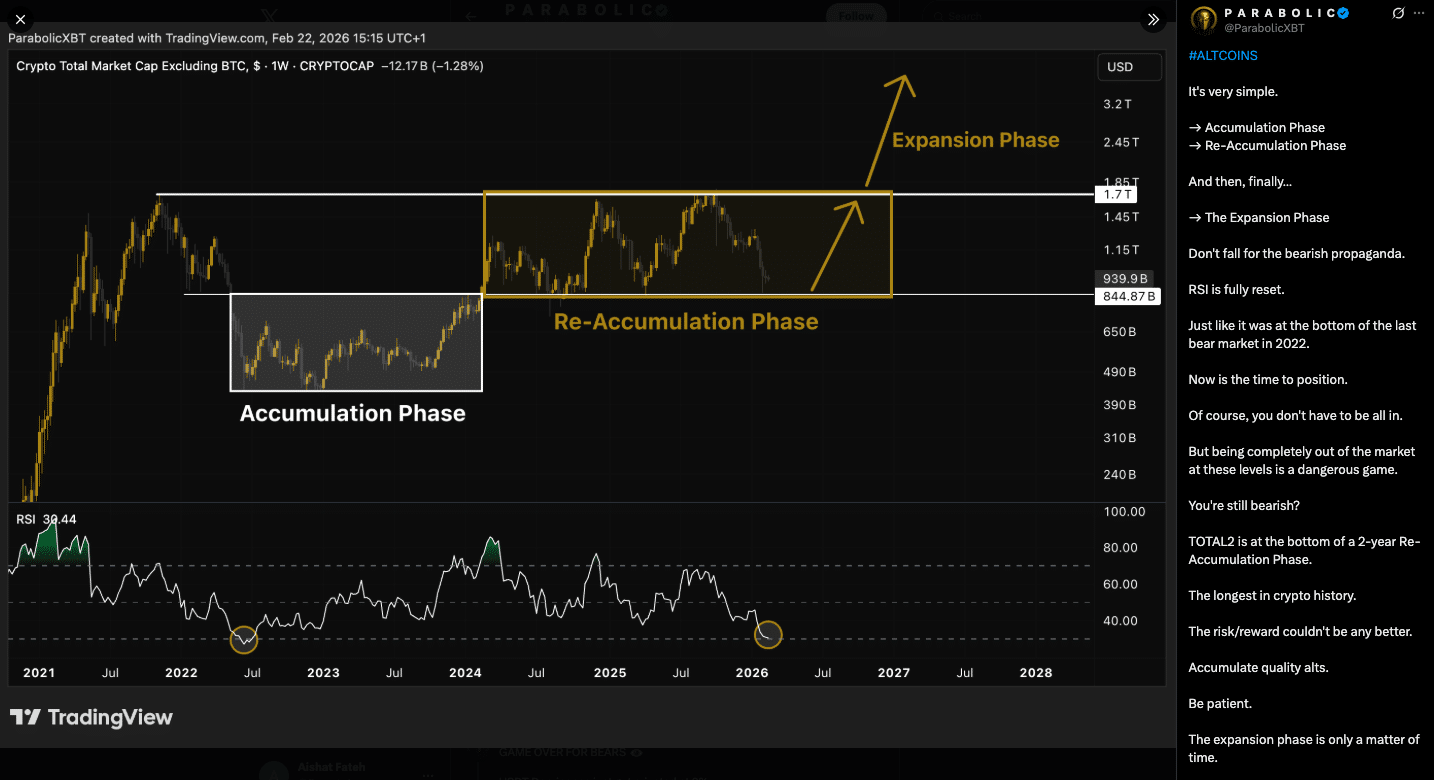
Market sentiment as measured by popular indicators such as the Fear & Greed Index has been at extreme fear levels in February. Bitcoin has tumbled hard off its peak of October 2025, which it trades well below, and the entire crypto sentiment has weakened along with price corrections.
Extreme fear does not really mean a final market top. Rather, it has tended to appear within spitting distance of major opportunity zones ahead of a big trend reversal especially when the structure argues for a resumption of flows into risk assets.
In this case, the emotional capitulation witnessed fits with those weakening dominance patterns, providing a possible potential for early altcoin rotation.
Altcoin Season Index Remains Low, But Early Signals Emerge
As of press time, the Altcoin Season Index remains low at levels that suggest markets are still bullish on Bitcoin and defensively positioned. According to data from CoinMarketCap, the index at 31% is far below levels at which an altcoin season is confirmed.
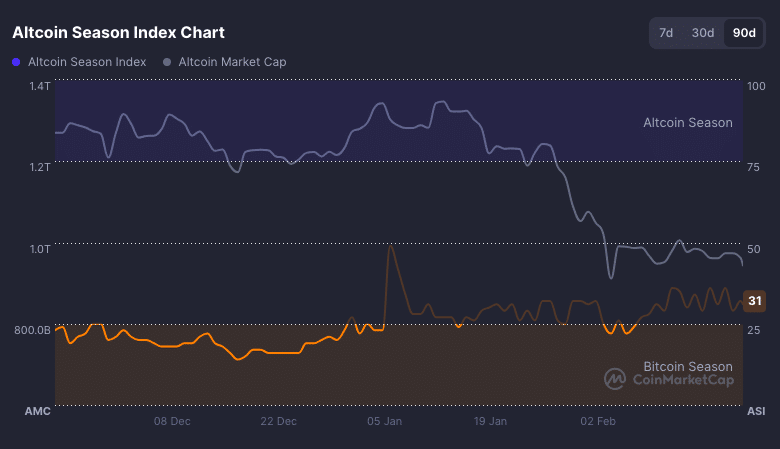
However, recent analysis including formations on the Others/BTC chart suggests early momentum setups similar to earlier cycles, whose markets have not yet made their way into big market outperformance.
Some analyst observing chart signals, including MACD crosses in altcoin aggregate charts, suggest rotation may develop if the criteria of dominance and sentiment continue to evolve.
In more straightforward terms, the market is at a “knife’s edge” right now. The technical setup is not yet a confirmed altcoin season but contains elements that could lead into one if weak dominance persists and liquidity begins moving into altcoins more broadly.
What Traders Are Watching Next
For altcoin season 2026, two conditions are the foundation of everything. USDT Dominance must weaken past a short-term rejection, a sign that defensive demand has given way into risk appetite.
BTC Dominance will need to remain under a trendline support line, meaning that Bitcoin does not hold the majority capital and altcoins can receive some more liquidity.
If both conditions hold, liquidity flow might start to rotate toward higher beta assets while rebounds in either dominance metric would probably reset narratives and delay a full blown out altcoin cycle.
Conclusion
The altcoin season 2026 isn’t here just yet, but the case for it is strengthening at the moment. Stablecoin dominance rejection around a major resistance and a breakdown in Bitcoin dominance may create the technical setup needed for capital to move into alts.
Extreme fear readings in sentiment metrics mean market pressure near potential turning points, not cycle peaks. However, the market is still on a knife-edge because dominance does need to drop some more and liquidity must flow into altcoins for the rotation to kick in.
Glossary
Altcoin Season Index: A calculated value indicating what percentage of top altcoins outperformed Bitcoin throughout a rolling period; values over 75 suggest an altcoin season.
BTC Dominance (BTC. D): What percentage of crypto market capitalization is Bitcoin? Diminishing dominance tends to precede altcoin scenarios.
Stablecoin Dominance (USDT.D): The proportion of the market cap that is being held in stablecoins; high proportions suggest that investors are in defensive mode.
RSI (Relative Strength Index): A momentum indicator that measures the extent of a recent price movement to determine whether a stock is overbought or oversold.
MACD (Moving Average Convergence Divergence) – A trend following momentum indicator that shows potential trend changes.
Frequently Asked Questions About Altcoin Season 2026
What is altcoin season 2026?
Altcoin season 2026 refers to a period when a number of Altcoins outperform Bitcoin in what would be a capital shift and market dominance takeover from Bitcoin and stablecoins into alternative tokens.
Has altcoin season 2026 already begun?
Not yet. Metrics like the Altcoin Season Index suggest Bitcoin still dominates. Structural data continues to point to the potential for rotation, however confirmation will only come with sustained dominant weakness and a more liquidity shift.
Why does stablecoin dominance matter?
When stablecoin dominance is high, it usually indicates investors’ defensive posture; meanwhile if resistance rejects, it could mean the capital flow cycles from the defensives to riskier assets.
Does Bitcoin dominance have to drop for altcoin season?
Yes. When Bitcoin dominance falls, it signals that altcoins are taking a larger portion of total market capitalization, which is a structural situation conducive to outperformance from altcoins.
What could confirm altcoin season 2026?
Persistent low levels of the stablecoin dominance and Bitcoin dominance in conjunction with a high Altcoin Season Index above historically relevant values would indicate a strong altcoin rotation.
References
AMBCrypto
MEXC
AInvest
CoinCodex
CoinMarketCap