

Following the aftermath of a $292 million KelpDAO exploit tied to LayerZero infrastructure, several major DeFi protocols have started to move billions in assets to Chainlink’s Cross-Chain Interoperability Protocol (CCIP). The resulting migration has pushed Chainlink network activity to record highs and increased demand for LINK tokens.
LINK has already rebounded from its $9 support zone after weeks of pressure. Can the rising adoption of Chainlink CCIP migration sustain a stronger recovery, despite the fact that the altcoin market is still under a lot of selling pressure?
KelpDAO Exploit Sparks a Chainlink CCIP Migration Wave
The Chainlink CCIP migration just accelerated after the KelpDAO exploit exposed major weaknesses in the security of cross-chain bridges.
The April attack ended up draining nearly $292 million in rsETH-linked assets and immediately forced several protocols to reassess how they were securing their bridge infrastructure.
KelpDAO itself later migrated from LayerZero and over to Chainlink CCIP Soon after, Solv Protocol, Kraken, Lombard Finance, and Re.xyz also abandoned their LayerZero systems in favor of Chainlink’s infrastructure. The migration volume has now become massive.
Recent reports estimate more than $4 billion in assets have already shifted toward Chainlink CCIP infrastructure since the exploit.
Kraken confirmed last week that Chainlink CCIP is going to be the exclusive cross-chain infrastructure for Kraken Wrapped Bitcoin and future wrapped assets. The exchange cited the enterprise-grade security and compliance standards provided by CCIP as the main reasons for the move.
The migration is being driven by security concerns and the need for institutional-grade infrastructure.

Chainlink Network Activity Has Hit Record Levels
The Chainlink CCIP migration has immediately translated into higher network activity.
Daily active addresses on Chainlink CCIP climbed up to around 80,400 during the migration period, higher than the previous record of around 67,000.
Santiment data also shows that overall Chainlink network activity has hit its highest level in eight months. Traders are paying attention because CCIP usage directly impacts LINK demand.
When protocols use CCIP infrastructure, the service fees get converted into LINK tokens, and that creates automatic buying pressure that is directly tied to network growth.
Since the migration wave started, over 500,000 LINK reportedly got added to Chainlink reserves representing nearly $5 million in buy volume. The reserve itself has now grown to around 3.66 million LINK, valued at around $35 million.
At the same time, exchange supply continues to tighten up.
Wallets holding between 100,000 and 10 million LINK have accumulated around 33 million LINK over the past month, according to reports.
So, that combination of CCIP demand, reserve accumulation, and whale buying is creating a growing supply pressure around LINK.
LINK ETFs and Institutional Demand Just Keep On Going
The Chainlink CCIP migration is also happening together with steady institutional demand for LINK exposure.
The Grayscale and Bitwise ETFs (GLNK & CLNK) have reportedly maintained positive inflows for more than five consecutive months without seeing a single outflow session. Together, the funds now control around 1.66% of LINK’s circulating supply.
Institutional interest around Chainlink infrastructure has also expanded beyond DeFi bridges.
Recent tie-ups with DTCC, Coinbase, AWS Marketplace, State Street, Galaxy, and tokenized asset platforms have supported Chainlink’s position inside real world asset and institutional blockchain.
While many cryptos are still pegged to speculative trading cycles, Chainlink’s growth is increasingly tied to blockchain adoption and tokenized finance systems.
Can LINK Sustain the Recovery?
Despite the bullish network data, LINK price action is still feeling the strain.
The token recently had a bounce after testing the $9 support and breaking above a descending resistance trendline. However, overhead supply continues limiting momentum near key resistance levels.
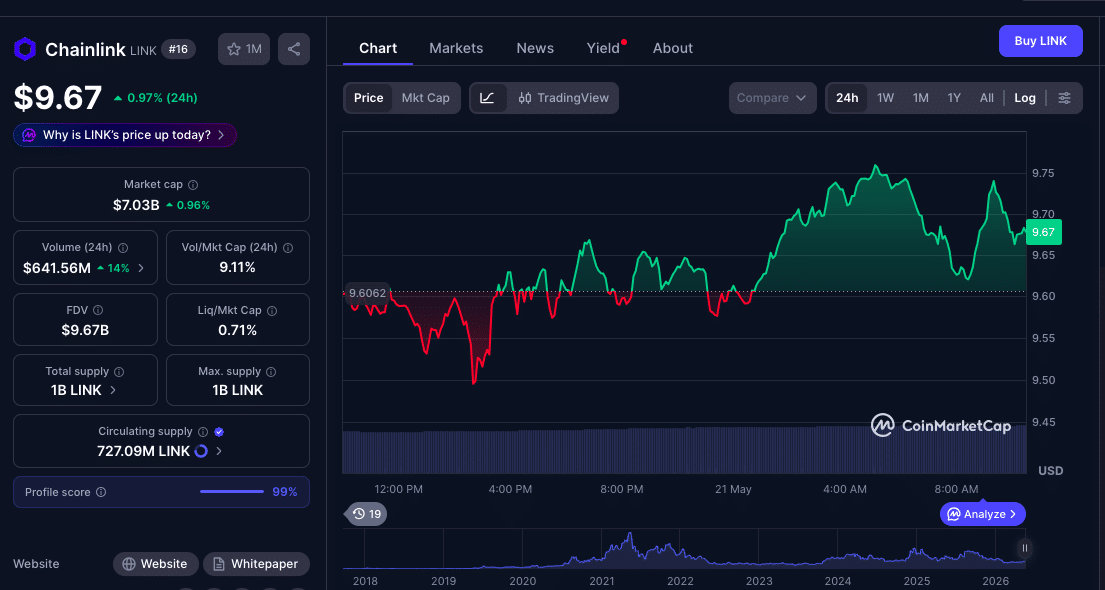
Traders are watching whether LINK can hold above the current support levels while migration-driven demand builds up.
If it can push above those near resistance zones, that could open up the much needed upside momentum. But if it breaks support levels, then lower support levels would come into focus.
So far, the market structure is changing in Chainlink’s favour. But, will that network growth be enough to push back against the overall market weakness.
Conclusion
The Chainlink CCIP migration has turned Chainlink into one of the biggest beneficiaries of the recent LayerZero security fallout.
Billions in assets are now moving to Chainlink infrastructure as protocols give bridge security and institutional-grade interoperability systems the priority.
The surge in activity is directly boosting LINK demand through reserve growth, fee conversions, whale accumulation, and ETF inflows.
LINK is still facing technical resistance right now, but the network growth around Chainlink has clearly strengthened over the last few weeks.
Glossary
CCIP: Chainlink’s Cross-Chain Interoperability Protocol – used for secure blockchain communication and asset transfers.
LINK: The token that runs on the Chainlink network.
LayerZero: A blockchain interoperability protocol used for cross-chain messaging and asset movement.
DeFi: Decentralized finance applications running on blockchain networks without traditional intermediaries.
ETF: An exchange-traded fund that lets investors get exposure to assets through regulated financial products.
Frequently Asked Questions About Chainlink CCIP Migration
Why is Chainlink CCIP activity spiking?
Chainlink CCIP activity surged after several DeFi protocols ditched LayerZero following the KelpDAO exploit.
Which protocols switched to Chainlink CCIP?
Protocols such as KelpDAO, Kraken, Lombard Finance, Solv Protocol and Re.xyz switched to Chainlink CCIP.
How does Chainlink CCIP migration impact LINK price?
CCIP fees get converted into LINK tokens, so as network usage grows, so does the direct buying pressure on LINK.
Are LINK ETFs still seeing inflows?
Yes. Grayscale’s GLNK and Bitwise’s CLNK ETFs have been reporting positive inflows for over 5 months now.
References