





The Aptos Foundation has proposed a number of adjustments aiming to transpose the APT economic model towards sustained deflation.
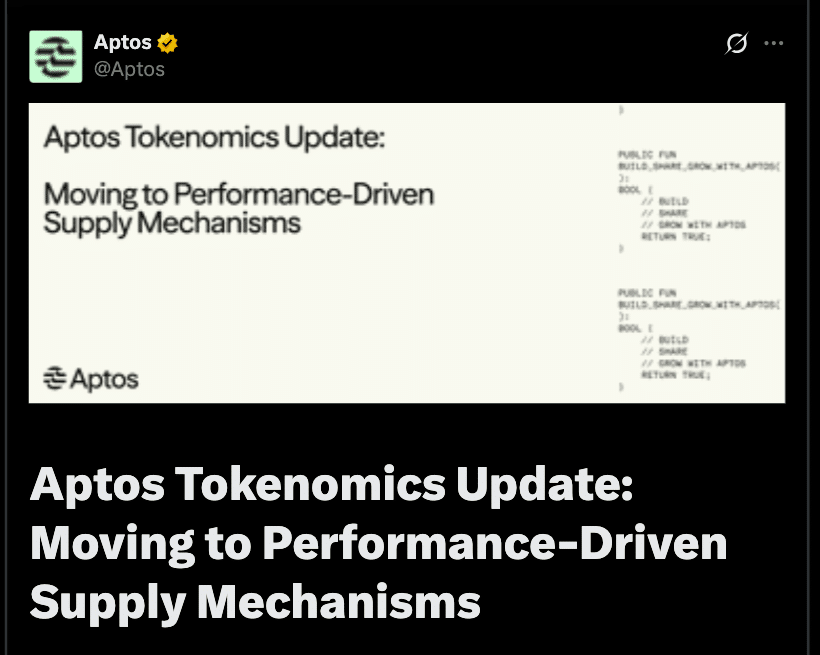
These changes come in the form of a strict supply cap of 2.1 billion tokens, reduced staking rewards, and a tenfold increase for gas fees, permanent locks on all issued tokens, as well as new performance-related reward mechanisms that tie future issuance to network usage.
They are intended to minimize the total issued tokens and bring a new life into how the Aptos tokenomics ecosystem is to distribute APT in the future.
Why This Aptos Tokenomics Update Matters
The Aptos tokenomics update is the result of several years of the network running on an inflationary, subsidy-driven economy to strengthen infrastructure and validators’ engagement during its early stages.
With the four-year token unlock cycle set to complete in October 2026, this is a moment to reassess the economy of APT, according to the foundation. At present, about 1.196 billion APT are circulating, with no hard cap on total supply.
According to the foundation, in a formal communication, this update “replaces bootstrap-era subsidy with mechanisms tied to transaction activity, establishing a framework where burns can exceed emissions as high-throughput applications scale.”
The goal is that network usage and value, not wide token transfers, should determine how much APT is generated and burned over time.
Main Features of the Aptos Tokenomics Update
One main component of the Aptos tokenomics rework involves a hard cap of 2.1 billion APT. After this cap is passed and implemented through governance, no more tokens would be created beyond that total. With about 904 million APT left within the cap, the foundation said it believes that the proposed reduction will limit indefinite issuance and provide more transparency to investors with a supply schedule.
The other big change is the slashing of annualized staking rewards from 5.19% to 2.6%. The foundation contends that this reduction would hardly compromise network security but will significantly reduce new token issuance in the market and reinforce incentives for long-term staking forms while helping balance block rewards.
This is in the interest of structuring staking economics for sustainable network development rather than continued heavy inflation.
Gas fees on Aptos which are paid in APT and permanently burned, would become a much stronger mechanism for token removal under the proposal.
The foundation would like to increase gas fees by ten times, though it also notes that even after the jump, stablecoin transfer costs would be low, about $0.00014 per transaction. This means that fee burns can increase with network usage without pricing users out of using the chain.
New Mechanisms to Burn and Reduce Supply
The Unit Protocol tokenomics update also adds new operations that are based on increasing the burn of APT beyond gas fees.
One of those is the Decibel, an on-chain DEX created on top of Aptos. Activity generated by Decibel such as trades, order matches and cancellations, will burn APT directly at high frequency throughput, more closely aligning the transaction volume with net supply reductions, the foundation said.
The additional action taken in the update is the proposal to permanently lock 210 million APT, meaning those units will not be available for future use. In contrast to typical staking lockups, these tokens would not be sold or recycled, and the foundation says the rewards it earns from such locked holdings will be applied to fund foundation activities.
The foundation is looking further into executing programmatic buybacks, or maintaining an APT reserve which would balance sales of tokens on the market by keeping a proportion of tokens bought and potentially burn them, or retain them for long-term treasury management. Specifics on how this would happen are still being hashed out, but it is an extension of a pledge to tighten supply.
How Institutional Adoption Is Affecting the Update
In its proposal announcement, the foundation also noted that institutional involvement in Aptos has expanded to see large amounts of capital being shipped on-chain by companies such as BlackRock, Franklin Templeton and Apollo.
The organization noted that the old model of unlimited emissions no longer aligns with an ecosystem that it is full of institutional high-volume activity and real-world assets, meaning a more sustainable tokenomic model is required in order to secure long-term network health.
This transition towards performance-based issuance where token rewards are more directly correlated with actual transaction throughput and economic utility can also be seen in other leading blockchain communities that shift away from inflationary bootstrap incentives to tighter supply structures as their ecosystems evolve.
Market Response and Next Steps
The Aptos tokenomics update announcement was met with mixed market reactions, as APT was priced at the $0.88 level and underwent a slight dip at the time when the news appeared, now settling at $0.87.
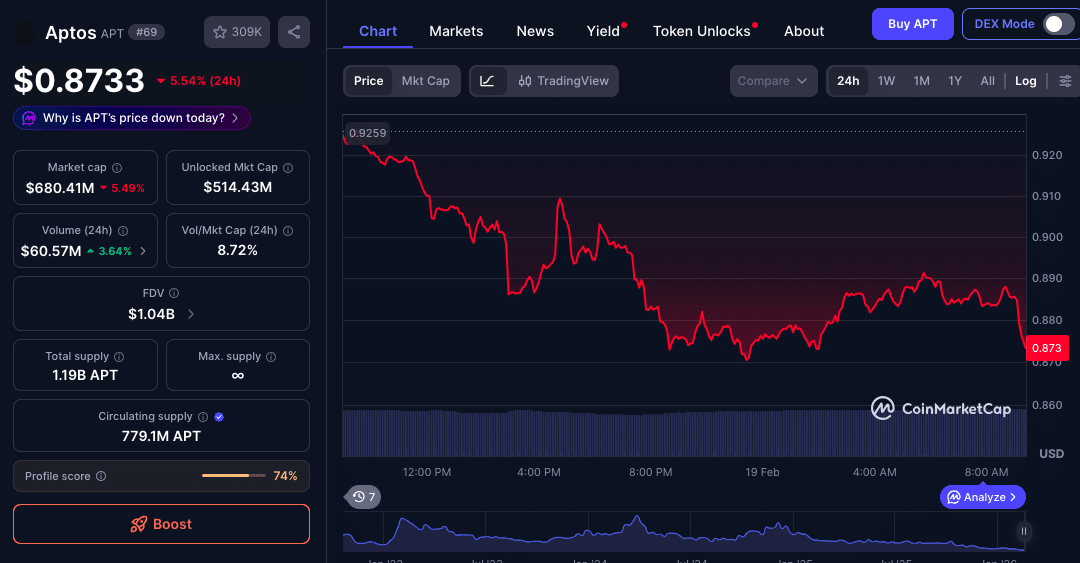
Some market participants say the price of the token has yet to show the long-term effects of an eventual supply cap and other structural changes, as current sentiment continues to be influenced by overall market dynamics.
Voting on governance proposals is expected in the coming weeks, and community feedback through proper channels will influence how things play out.
Conclusion
Through delivering a hard cap supply, decreasing staking emissions, increasing gas fees and linking the future rewards with network usage, the Aptos foundation has set its sights on transitioning APT toward permanent deflationary pressure as network utilization rises.
With institutional participation on the rise and the ecosystem maturing, this overhaul could also spell a change from early subsidy-based economics to performance-driven sustainability
Glossary
Aptos tokenomics update: Proposed model to redefine APT’s distribution and reward logic by relating issuance with the network activity and employing mechanisms for decline of total emitted supply.
Hard cap: The maximum number of tokens that will ever be created; Aptos is proposing a 2.1 billion APT cap.
Gas fees: Transaction fees paid in APT on the Aptos network, gas fees will be increased 10x and destroyed in the proposal.
Deflationary mechanism: An economic characteristic that decreases the total token supply, ie burns on gas fees or DEX activities.
Decibel: A fully on-chain DEX on Aptos which will burn tokens via high throughput transactions.
Frequently Asked Questions About Aptos Tokenomics
What is the fundamental purpose behind updating Aptos tokenomics?
It seeks to bring token supply into harmony with network usage, by reducing emissions through a hard cap, higher fee burns and performance-related issuance.
What is the limit of APT tokens?
The Foundation has suggested a 2.1 billion APT hard cap.
Will there be changes to staking rewards in the update?
Yes, staking rewards are suggested to be reduced from 5.19% a year down to 2.6%, under the solid impetus for long-term lock-up.
What happens to gas fees?
The gas fee will be raised 10 times more than that, with all fees burned, although low compared to many other blockchains.
Does this make APT deflationary immediately?
Not immediately. The proposed adjustments pave the road for deflation by reducing net issuance and increasing burns with network size growth.
References
AMBCrypto
AiCoin
Crypto Economy
Bingx Exchange