

Are you also concerned about whether Crypto Casinos Legal In USA or not? Crypto casinos do not hold state licenses in the U.S. today. Legal online casinos run in seven states and they accept U.S. dollar payment methods, not cryptocurrency. Offshore crypto casinos target Americans but operate without U.S. licenses and break state law.
Search interest for crypto casinos legal USA keeps rising. Many players see fast wallets, bonus-laden sites, and anonymous accounts. The picture looks simple. U.S. law makes it complex. This guide maps the rules in plain English and shows where things stand in 2025. It covers federal law, state rules, taxes, and security basics with current context.
The Quick Verdict
- Seven states offer legal, licensed online casinos: CT, DE, MI, NJ, PA, RI, WV. Licensed platforms in these markets use U.S. dollar payment rails, age checks, and geolocation. They do not support crypto deposits.
- Offshore crypto casinos market to Americans without state approval. Using them violates state law and exposes users to loss and no formal dispute process. State regulators continue to issue cease-and-desist orders.
How U.S. Law Treats Online Casinos And Crypto
Federal Rules Set the Floor
Banks and processors must block payments for unlawful internet gambling. UIGEA does not legalize or ban specific games. It pushes payment compliance and leaves “unlawful” to state and other federal law.
A 2021 appeals court decision held that the Wire Act covers sports betting, not iGaming like slots or table games. That decision removed a major cloud over state iCasino programs. Cross-border sports bets still face the Act.
If a business accepts and transmits convertible virtual currency, it likely acts as a money transmitter and must register as an MSB, run KYC, file AML reports, and keep records. Crypto gaming platforms that move customer funds fit this framework.
Crypto flows do not avoid sanctions. OFAC expects crypto companies to screen wallets, block sanctioned jurisdictions, and keep a risk-based program. Gaming operators that touch crypto must do the same.
The IRS treats digital assets as property. Winnings remain taxable income. Keep records of all wins and losses.
States Decide What Is Legal To Offer
The U.S. has no national online-casino license. Each state chooses whether to allow iGaming, and then licenses and audits operators inside its borders. The list remains short in 2025: CT, DE, MI, NJ, PA, RI, WV. Several other states still study bills.
Where Online Casinos Are Legal, And What That Means For Crypto
In the seven legal iGaming states, licensed casinos use USD payment methods such as ACH, cards, PayPal, and online banking. Major operators list those methods and do not list crypto. Regulators have not approved crypto as a payment method in these markets.
Legal iGaming States And Crypto Status (Sep 2025)
| State | Legal iGaming? | Primary Regulator | Do Licensed Sites Support Crypto Deposits? | Notes |
| Connecticut | Yes | Dept. of Consumer Protection | No. USD methods only today. | Tribal-state framework with approved platforms. |
| Delaware | Yes | Delaware Lottery | No. USD methods only today. | Long-running state-run model. |
| Michigan | Yes | Michigan Gaming Control Board | No. USD methods only today. | Active enforcement against unlicensed sites. |
| New Jersey | Yes | Division of Gaming Enforcement | No. USD methods only today. | DGE sets national benchmarks for testing and oversight. |
| Pennsylvania | Yes | Gaming Control Board | No. USD methods only today. | Strict geolocation and technical standards. |
| Rhode Island | Yes | RI Lottery | No. USD methods only today. | State launched iGaming in 2024. |
| West Virginia | Yes | WV Lottery | No. USD methods only today. | Remote, in-state play only. |
Security And Regulatory Context, With Recent Numbers
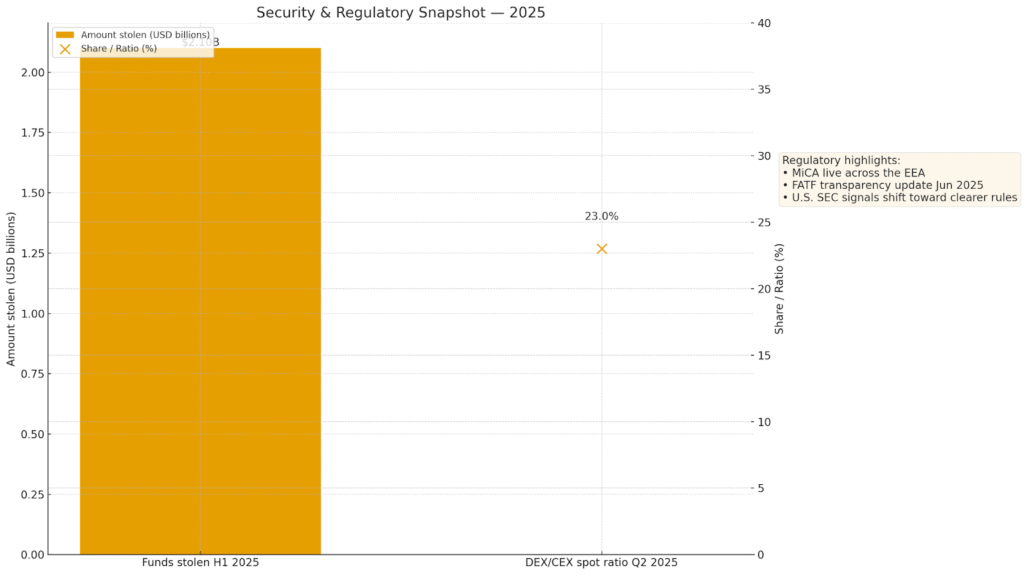
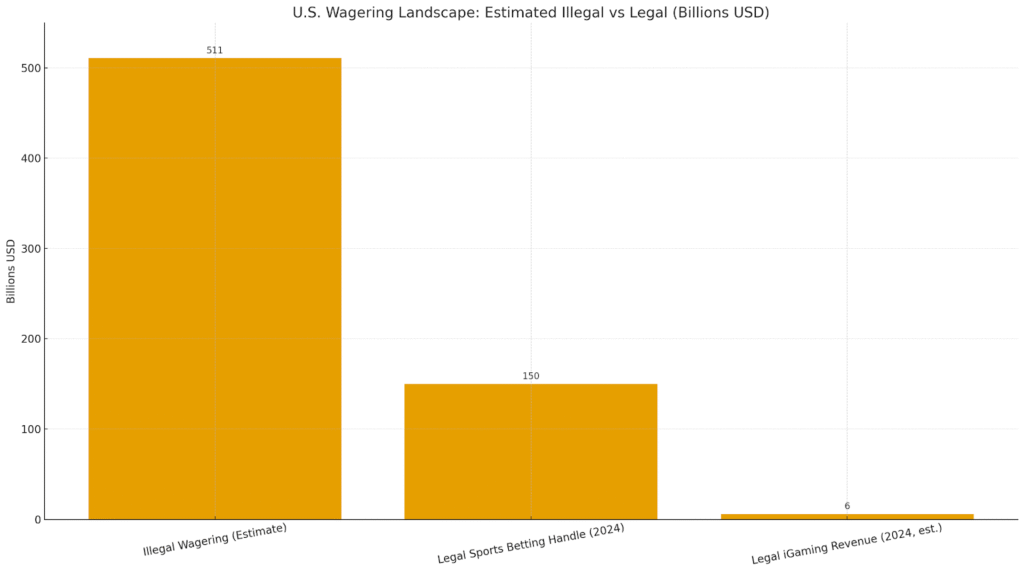
The Legal Market Grows. Commercial casinos set revenue records again in 2024. Legal sports betting handled well over $100 billion that year. Strong legal growth does not erase illegal play.
The Illegal Market Still Looms. Industry studies in recent years estimate hundreds of billions in annual illegal wagering across illegal iGaming, offshore sportsbooks, and gray-market machines. Many analyses suggest illegal operators still capture a large share of U.S. gaming revenue and have grown since 2022. That means billions in lost state taxes and fewer consumer protections.
Enforcement Continues. Michigan has sent waves of cease-and-desist letters to offshore casinos and unlicensed crypto-style sites. Other regulators track similar risks and warn residents.
Geolocation Is Serious. Legal sites must keep players inside authorized state lines. For example, Pennsylvania requires re-checks during each session and tighter controls near borders.
AML And Sanctions Apply To Crypto Flows. Any operator touching crypto must build compliance for KYC, suspicious activity reports, and sanctions screening. Licensed U.S. casinos build these controls. Offshore sites may not.
What Exactly Is A Crypto Casino?
Offshore Crypto-Only Sites
These platforms run outside the U.S. They take Bitcoin, stablecoins, or other tokens for deposits and withdrawals. They do not hold U.S. licenses. They often skip independent testing and lack formal dispute paths. State regulators treat them as illegal for residents.
Hybrid Sites That Convert Crypto To USD Behind The Scenes
Some analysts speculate about a model where a licensed site takes crypto, converts it to USD, then runs normal play. No regulator has approved this for mainstream operators as of September 2025. Public deposit pages for major casinos still show only traditional methods.
Sweepstakes And Social Casinos
Sweeps sites use two currencies. Gold Coins are for fun. Sweeps Coins can enter sweepstakes and redeem for cash or prizes. This model relies on sweepstakes law, not gambling law. It runs in most states with restrictions. It is not the same as a licensed online casino.
Risks To Weigh Before Placing A Wag
Before any bet, weigh legal, financial, and security risks. Offshore crypto casinos run without a U.S. license. Disputes may never get paid. Funds can freeze if wallets touch sanctions lists. Winnings are taxable, even in crypto. Prices can swing between deposit and withdrawal. Sites that skip geolocation or KYC are red flags. Phishing, fake apps, and bonus traps are common. Safer play sticks to licensed state sites and payment methods, which fits the rule behind the crypto casinos legal USA question.
Crypto Casinos Legal USA: What Players Should Check
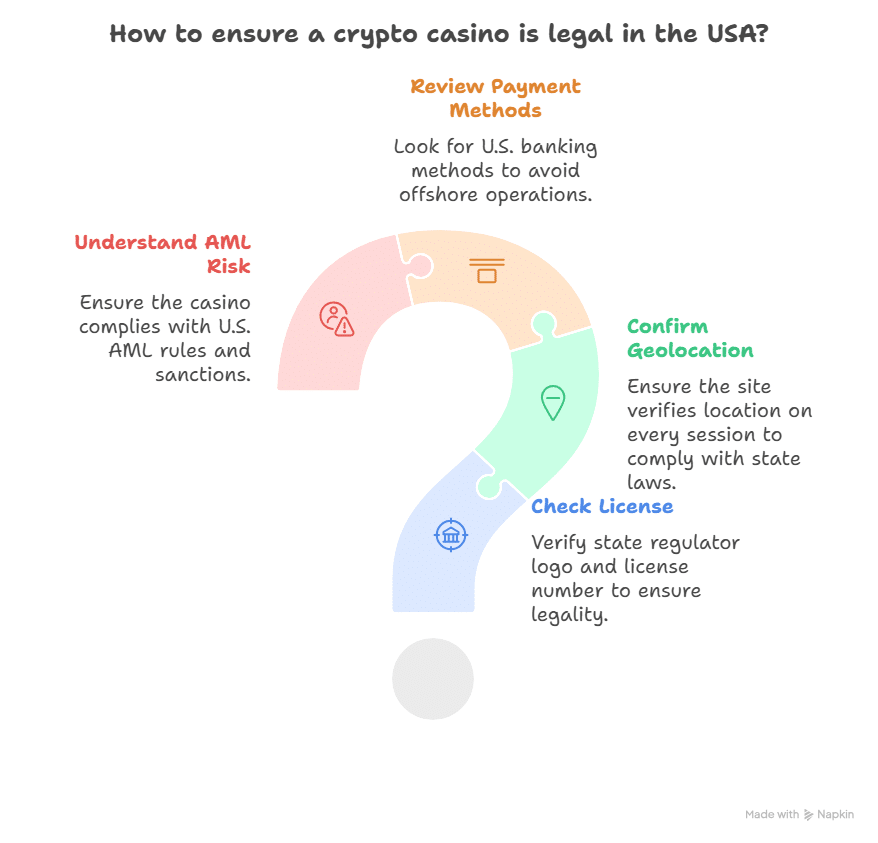
Check The License
Look for a state regulator logo and a clear license number. New Jersey’s DGE and Michigan’s MGCB show public lists and issue regular compliance updates. If a site lacks a state license, it is not legal in that state.
Confirm In-State Play And Geolocation
Legal sites verify location on every session. Pennsylvania codifies periodic re-checks and border-zone rules. If a site allows play from anywhere in the U.S. without geolocation, that is a red flag.
Review Payment Methods
Licensed platforms list U.S. banking methods. If a site pushes only crypto wallets and promises anonymity, it likely operates offshore and outside U.S. law. Public operator help desks make the difference clear.
Understand AML And Sanctions Risk
Crypto deposits do not bypass U.S. AML rules. FinCEN and OFAC expect screening, monitoring, and reports. Licensed U.S. casinos build these controls. Offshore sites may not.
States Moving Or Discussing iGaming Standards
Policy groups continue to publish model bills for new iGaming states. Recent proposals discuss tax bands between 15% and 25%, deposit rules, and strong oversight. Even in those plans, crypto payments do not appear as standard funding rails.
FAQ-Style Table: Legal iGaming Status And Crypto Today
| Question | Answer |
| How many U.S. states have legal online casinos? | Seven: CT, DE, MI, NJ, PA, RI, WV. |
| Do licensed U.S. online casinos accept crypto? | Not today. Operators list USD methods like ACH, cards, and PayPal. |
| Are offshore crypto casinos legal for U.S. players? | No. They operate without state licenses and face enforcement. |
| What federal laws matter most? | UIGEA for payments and the Wire Act for sports betting traffic. |
| Who enforces AML and sanctions rules for crypto? | FinCEN and OFAC. Programs must screen and report. |
Is Using Crypto Casinos Legal USA By State?
The phrase trips many readers. The legal test is not the token. It is the license. If a platform is licensed by a state regulator and listed on that regulator’s site, it is legal to use within that state. If it lacks that license and invites U.S. players, it is illegal to use, even if the site accepts crypto.
Risks To Weigh Before Placing A Wager
- No Formal Recourse Offshore. Unlicensed sites may ignore payout disputes. State regulators cannot help.
- Tax Exposure. Winnings remain taxable, including wins paid in crypto or redeemed sweeps prizes. Keep records.
- Sanctions And AML. Operators must screen wallets and block prohibited areas. Users can face frozen funds if a counterparty hits sanctions lists.
- Scale Of Illegal Play. The illegal market still captures a large share of U.S. gaming. That market lacks the audits, testing, and consumer safeguards in legal states.
Practical Checklist For Safe, Legal Play
- Verify The State License on the regulator’s site.
- Allow Geolocation and confirm in-state presence.
- Use Listed USD Methods only on licensed platforms.
- Set Limits and consider self-exclusion tools in states that offer them.
- Track Taxes and save records for wins and losses.
Conclusion
The phrase crypto casinos legal USA hides a simple rule. In the U.S., licenses decide what is legal, not payment tech. Legal online casinos run in only seven states and take USD methods. Offshore crypto sites call to Americans but lack licenses and protections. Smart players stick to licensed platforms, follow state rules, and keep clean records for taxes.
FAQs About Crypto Casinos Legal USA
Are crypto casinos legal in the USA right now?
Not in the licensed market. Legal online casinos operate in seven states and use USD methods. Offshore crypto casinos are illegal for U.S. residents.
Can a U.S. state approve crypto deposits later?
Possibly. Any change would require state regulator approval and full AML, KYC, and sanctions controls. No state has cleared broad crypto funding for licensed casinos today.
Are sweepstakes casinos the same as crypto casinos?
No. Sweepstakes use a dual-currency model under sweepstakes law, not gambling law. Some allow cash redemption after conditions. They do not replace a regulated iCasino.
Does the Wire Act ban online casino games?
No. A 2021 appeals ruling limited the Wire Act to sports betting. States can run iGaming within their borders.
Do players owe tax on crypto gambling wins?
Yes. The IRS treats digital assets as property. Gambling wins are taxable. Keep records and report.
Glossary
- Crypto Casino: An online casino that accepts cryptocurrency for deposits, wagers, or withdrawals.
- iGaming: State-licensed online casino games like slots and table games.
- UIGEA: A 2006 law that restricts payments for unlawful internet gambling.
- Wire Act: A law that bans interstate sports betting transmissions; a 2021 case limited it to sports.
- MSB: Money Services Business; many crypto handlers must register with FinCEN as MSBs.
- KYC: Know Your Customer checks used to verify identity and age.
- Geolocation: Tech that proves a player is inside the legal state.
- OFAC: U.S. sanctions authority that requires wallet and jurisdiction screening.
- Stablecoin: Crypto token designed to track a fiat currency like the U.S. dollar.
- Sweeps Coins: Sweepstakes tokens that can enter prize drawings and may be redeemed for cash under rules.
Summary
Crypto casinos do not hold U.S. state licenses in 2025. Legal online casinos operate in seven states: CT, DE, MI, NJ, PA, RI, and WV. These platforms list U.S. dollar payment methods, not crypto. Offshore crypto casinos target Americans but operate without U.S. licenses and violate state law. Federal rules still matter. UIGEA restricts payment processing for unlawful gambling, the Wire Act covers interstate sports betting, and FinCEN and OFAC require AML and sanctions controls for virtual currency activity. Regulators continue enforcement against unlicensed sites, while industry estimates suggest illegal operators capture a large share of U.S. gaming revenue. For safe play, verify the state license, accept geolocation checks, use listed USD methods, and keep records for taxes.