






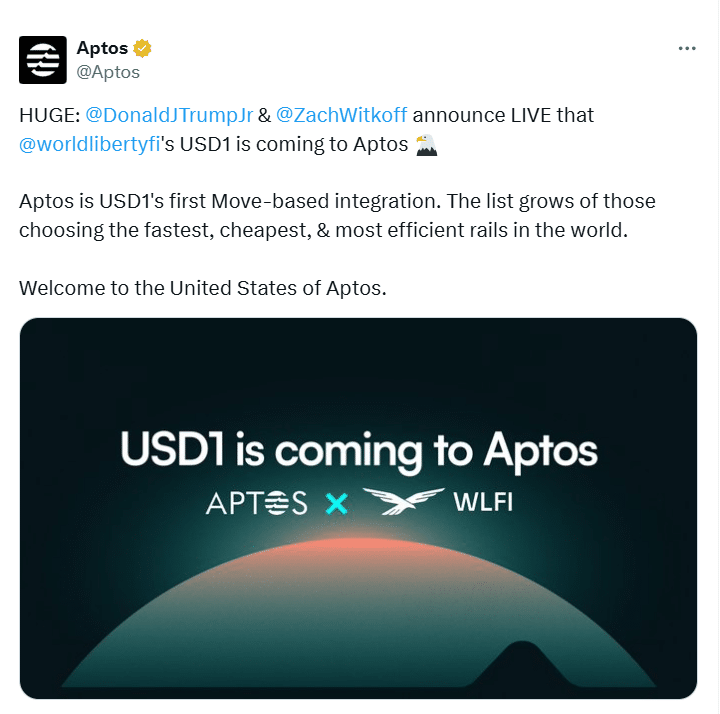
Donald Trump Jr. has thrown his weight behind the launch of USD1, a new stablecoin issued by World Liberty Financial (WLFI). The token is set to debut on the Aptos blockchain this October, with backing from wallets, exchanges, and DeFi protocols across the network.
The announcement adds fresh momentum to Aptos, while raising questions about whether USD1 can compete with giants like USDT and USDC.
A Political Name Meets a Technical Promise
Trump Jr. described the launch as an essential step for preserving U.S. dollar dominance in the digital age. “Stablecoins like USD1 will help ensure the dollar’s role in global trade remains unshaken, even in decentralized markets,” he told reporters. His comments drew both praise and skepticism, with some calling it a blend of political branding and crypto innovation.
WLFI CEO Zach Witkoff emphasized the practical side, noting that USD1 would be fully backed by reserves in U.S. dollars, Treasuries, and cash equivalents.
The company’s choice of Aptos, a high-speed Layer 1 chain, reflects its focus on low costs and scalability. Aptos reportedly processes transactions in under half a second, with fees “less than a hundredth of a cent,” according to Aptos Labs executives.
Why Aptos? The Tech Behind the Choice
While Ethereum remains the hub for stablecoins, Aptos offers a leaner, faster alternative. By building USD1 on Aptos, WLFI is positioning the token in an ecosystem that prides itself on throughput and efficiency. Partners such as Petra Wallet, Backpack, and major exchanges including OKX and Gate are expected to support USD1 from day one.
Liquidity pools are also lined up across Aptos-based DeFi platforms like Thala and Echelon, which will integrate USD1 into their markets. Analysts believe this could kickstart on-chain volume and provide Aptos with a competitive advantage in the stablecoin race.
Shortly after the news, Aptos’ native token APT jumped nearly 8 %, reflecting the market’s bullish reaction.
A Crowded Field with Heavyweights
USD1 is entering a crowded arena dominated by USDT and USDC, which together account for hundreds of billions in circulation. Both have entrenched liquidity on Ethereum, Tron, and beyond. WLFI’s challenge will be carving out a niche by focusing on speed, transparency, and political clout.
WLFI has also revealed broader ambitions, including a crypto debit card and tokenization of real-world assets such as real estate and energy. These initiatives, if realized, would use USD1 as the base settlement layer, further embedding it into financial infrastructure. Still, questions remain about whether the project might be exposed to regulatory hurdles or partisan scrutiny through its political association.
On X, Aptos Labs cofounder Mo Shaikh posted, “The future of stablecoins is about more than speculation, it’s about utility. Aptos is ready to support USD1 as a step toward scalable finance.” His statement highlights the growing view that stability, not volatility, will drive the next wave of crypto adoption.
Risks and Reality
Despite the optimism, challenges loom. Market concentration in a few wallets could create liquidity risks. Competing against established stablecoins will require more than political branding, it will demand transparency audits and deep integration across exchanges and payment systems.
Observers also note that WLFI must prove its reserves are fully verifiable. Without credible assurance, the stablecoin could struggle to gain trust in a market that has already seen collapses like TerraUSD.
Conclusion
The launch of USD1 on Aptos is more than a technical story, it is a collision of finance, politics, and blockchain. Backed by Trump Jr. and WLFI, the project promises speed, low fees, and reserve backing.
Whether this is the beginning of a serious challenge to existing stablecoins or another fleeting experiment will depend on execution, transparency, and adoption. For now, USD1 has placed Aptos firmly on the map in the global stablecoin race, and the world is watching to see if the gamble pays off.
FAQs
Q1: What is USD1 stablecoin?
USD1 is a dollar-backed stablecoin launched by WLFI, pegged 1:1 to U.S. dollars and issued on the Aptos blockchain.
Q2: Why did WLFI choose Aptos?
Aptos offers near-instant transactions with minimal fees, making it attractive for large-scale payments and DeFi integration.
Q3: How is USD1 different from USDT and USDC?
Unlike incumbents, USD1 seeks to leverage political visibility, speed, and future asset tokenization as its competitive edge.
Q4: What risks are associated with USD1?
Risks include competition with dominant stablecoins, regulatory scrutiny, and the need for transparent reserve audits.
Glossary of Key Terms
Stablecoin: A cryptocurrency pegged to a stable asset like the U.S. dollar to reduce volatility.
DeFi (Decentralized Finance): Blockchain-based financial applications that eliminate intermediaries.
Liquidity Pool: A collection of tokens locked in a smart contract to enable trading on decentralized exchanges.
Layer 1 Blockchain: A base blockchain protocol, like Ethereum or Aptos, upon which apps and tokens are built.
Tokenization: The process of representing real-world assets, such as real estate or bonds, as digital tokens on a blockchain.
Reserve Backing: Assets held to guarantee the value of a stablecoin, ensuring it can be redeemed 1:1.