

This article was first published on The Bit Journal.
Bitcoin’s price has been sliding ever since it reached highs of $126,000 in October 2025, and a number of analysts now consider the current downturn as a Bitcoin bear market trend, not a mere correction.
A combination of recent on-chain data, technical breaks of long-term averages and weakening institutional flows has come to indicate that Bitcoin is experiencing continuous selling pressure and shifts in demand.
Top analysts, such as CryptoQuant’s Julio Moreno say this bear market could continue into the third quarter of 2026 and reach further lows should certain fundamentals not turn around.
This even goes so far as to cast doubt on the four-year cycle expectations, with new models suggesting that liquidity waves not halving dates now drive Bitcoin’s moves.
What Defines the 2026 Bitcoin Bear Market
Typically, markets become bear markets when they fall at least 20% from prior highs and don’t recapture key long-term trend lines. Bitcoin breached that level months ago, tumbling about 41% from a peak in October 2025 to around $74,000 by early February 2026 and even way downward around $70,000 as at the time of writing.
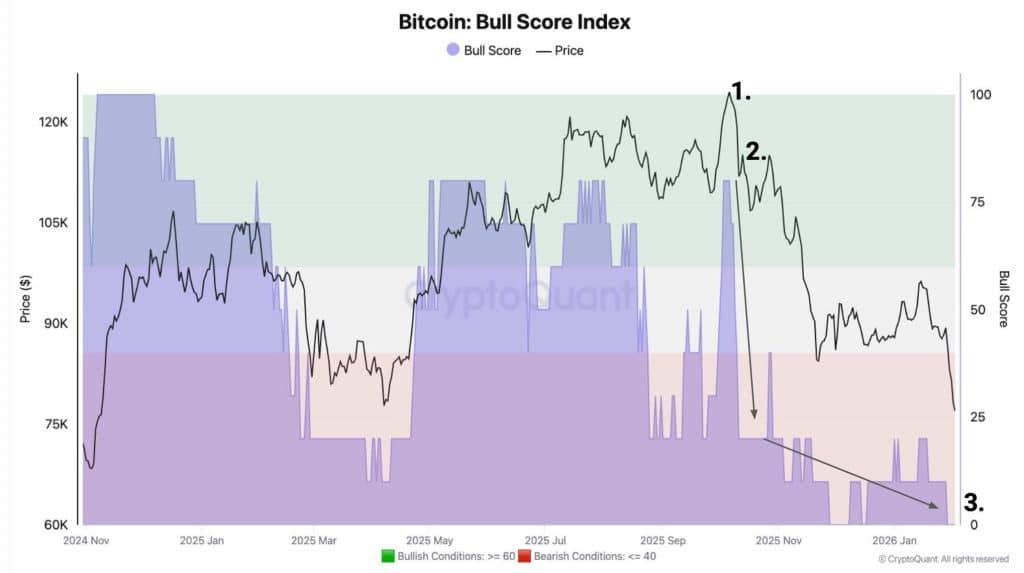
CryptoQuant’s Bull Score Index, a blend of on-chain health metrics recently plunged to zero, one of the most bearish readings imaginable, suggesting continued structural weakness.
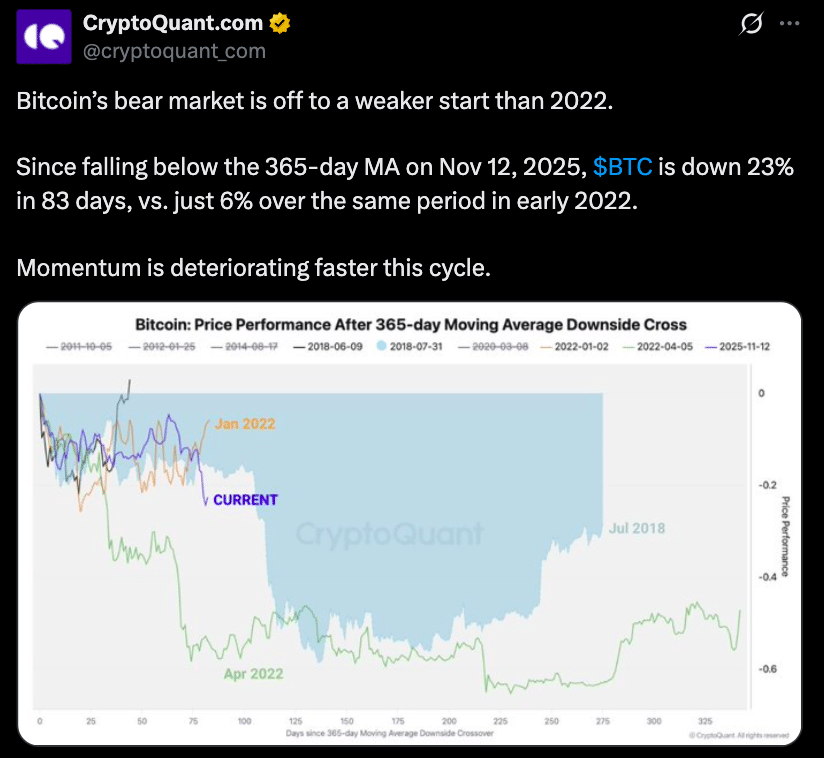
In addition, Bitcoin has dipped below its 365-day average for the first time since 2022, a technical level that analysts have often watched for changes.
Institutional demand has also reversed. U.S. spot Bitcoin ETFs, who were net buyers in the prior cycles, turned to be net sellers and have dumped tens of thousands of BTC.
The Bitcoin bear market is also supported by liquidity conditions. Supply growth of stablecoins which is an important source of capital for the crypto markets, has declined for the first time since 2023, and overall demand metrics have fallen to pieces.
The Coinbase Premium, which is in reference to U.S. spot demand, has been negative since mid-October 2025, locking in the idea that there is little buying interest.
Based on these conditions, CryptoQuant sees Bitcoin downside risk toward the $70,000 level, with a deeper decline toward $56,000 possible if Bitcoin fails to regain momentum.
What Analysts Are Seeing in Technical and On-Chain Metrics
Dropping below long-term averages such as the 200-day and 365-day moving averages is a sign of momentum changing. CryptoQuant notes that once the price breaks below these levels and does not retake them, they can act as resistance, making continuing rallies more difficult to attain. Head of research at CryptoQuant, Julio Moreno thinks these trend flips are a true bear jurisdiction.
Flows from institutions are another important signal. U.S. spot ETF inflows previously helped maintain upward momentum during bullish phases. But in 2026, these E.T.F.s have instead become sellers.
Analysts say sustained inflows, however, would be needed to indicate a change in trend out of bear territory.
Market liquidity signals such as stablecoin market cap growth also offer some context. The market often has additional buying power to work with when stablecoin supply is increasing. However, the recent moves indicate diminishing liquidity, which is a classic bear sign.
Technical crashes on derivatives markets as well as that a large proportion of Bitcoin addresses are in unrealized loss also contribute to the bearish sentiment.
These signs point out that the market’s structure at present looks like what has been witnessed at the beginning of previous bear markets.
What Analysts Are Saying About When and Under What Circumstances It Might End
The time the Bitcoin bear market 2026 will last depends on combination of various signals. There are generally three main signals that analysts will look toward to properly confirm a change:
Consistent price closes above long-term moving averages; a persistent presence of demand as seen through flows from institutions and normalization in risk appetite which lowers the need for downside hedging.
If demand picks up and some important indicators stop declining, a potential bottoming can occur as early as the third quarter of 2026, said Julio Moreno.
But until longer-term trends flip, he cautions that traders should approach any rallies with skepticism. As he puts it: “there will be price rallies…but don’t confuse that with the start of a bull market”.
Not all analysts agree on timing. Some contend that the bear may be shorter, lasting three to six months if demand stabilizes and selling is exhausted.
Others think the cycle is more liquidity driven than calendar-determined, that is, the bear may only really finish when money starts coming in and liquidity improves again, rather than when a date passes.
Unlike the bear markets of old that claimed as much as 70 percent or more in some cases, analysts say the current decline, which could go to as low as $56,000 as a deeper support level, would be smaller in percentage terms though no less structure-shattering if it ever happens.
Market Context in Early 2026
As of February 2026, Bitcoin looks sobering, and Price action and market signals remain grim. The asset is trading below major long-term trend lines, institutional demand metrics are solidly negative as well as liquidity.
All of this is why so many analysts now refer to this phase as a bear market rather than a correction.
This bear market however doesn’t resemble past cycles. While previous downturns have seen general selling and capitulation, the current market shows a blend of negative sentiment and continued longer-term buying. Surveys indicate that a majority of institutions still view Bitcoin as undervalued, even while acknowledging the bear context.
Conclusion
The Bitcoin bear market in 2026 has been forged on a combination of technicals, on-chain and demand metrics that distinguishes it from the typical pullbacks.
Low price below to long-term average, institutional flow reversals and reduced liquidity all fit what analysts would define as a bearish sign. There are differing projections for the duration of this, with most analysts suggesting that recovery will require clear signs of improvement in demand, liquidity and trend retake.
This market remains a bear market until these signals flip and traders should view short-term rallies with caution rather than an actual turning point.
Glossary
Bear market: Historically a period of time when an asset drops at least 20% from peaks and remains under pressure for months on end.
Bull Score Index: All-in-one metric derived from several indicators that measure the market health on-chain. Extremely low readings indicate bad market conditions.
365-day moving average: Very-long-term trend indicator; a portion of price being above it along with certain technical conditions, can usher in bullish regimes.
Coinbase Premium: A spread between the price of Coinbase and other exchanges as a proxy for spot U.S. demand.
Frequently Asked Questions About Bitcoin Bear Market
Has a Bitcoin bear market been declared?
A number of on-chain analytics providers, CryptoQuant amongst them, describe the prevailing market structure as bearish due to technical indicators such as trend breaks and weak demand metrics.
How long might this Bitcoin bear market persist?
It may carry on into mid or late 2026, some analysts have said, if certain critical indicators strengthen.
What would make this Bitcoin bear market go away?
Persisting price closes above long-term averages, fresh flows from institutions and a derivatives market that has transitioned from hedges to bullish may indicate the end.
Are institutions still buying Bitcoin?
Some companies are holding or increasing exposure, but US spot Bitcoin ETFs have swung to net selling so far in 2026, weakening demand signals.
Is this drawdown smaller than past cycles?
Yes. If Bitcoin falls to approximately $56,000 as a further support area, the drawdown is only 55%, less than the over 70% seen in previous bear markets.
References
CryptoRank
The Block
Cryptonews
TradingView
ChainCatcher