

In a recent discussion on X, a familiar debate in digital assets got a sharper frame: the problem is not only hackers, buggy code, or careless clicks. It is the gap between what a person means to do and what a system actually does when money moves at internet speed. Vitalik Buterin argues that closing that gap completely is not realistic, because human intent is complicated, context-dependent, and often only half-formed even in the user’s own mind.
That framing lands at a time when the industry keeps learning the same lesson the hard way. Many losses do not begin with broken cryptography. They begin with confusing permissions, spoofed interfaces, social engineering, and transactions that look routine until the final click turns them irreversible. For builders and everyday holders alike, the message is uncomfortable but useful: the goal is not perfection, it is reducing the ways crypto security can fail when it matters most.
Why crypto security and User Intent Are Inseparable
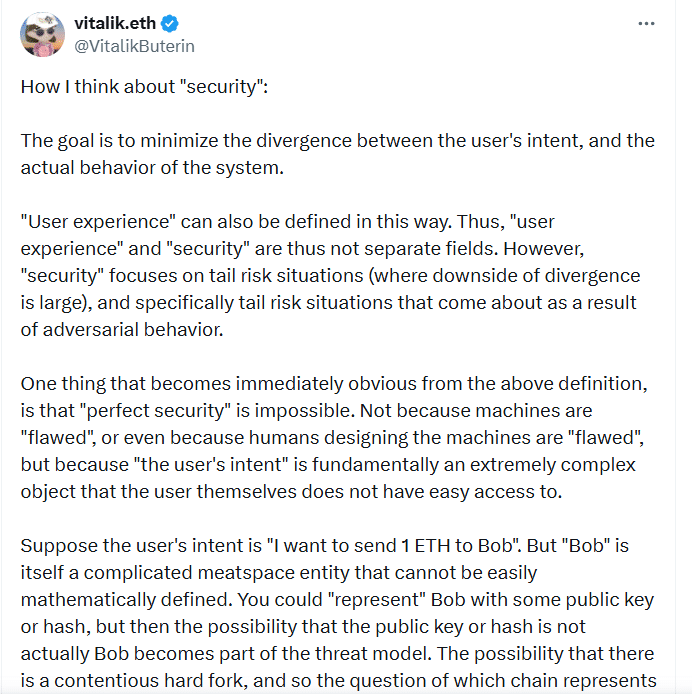
Vitalik Buterin describes security as minimizing the divergence between user intent and system behavior, not as a separate feature that gets sprinkled on at the end. In plain terms, if a wallet cannot reliably capture what the user meant, then even a technically correct transaction can still be a human error with permanent consequences.
He uses a simple example: sending 1 ETH to “Bob.” A blockchain can verify a public key and execute the transfer, but it cannot prove that the key truly represents “Bob” in the real-world sense the user intended. People rely on common sense, social context, and recognition cues, while software relies on formal definitions that can be tricked, imitated, or misunderstood. That is where crypto security runs into a hard ceiling.
The Privacy Trap That Makes the Problem Worse
The same logic extends beyond payments into privacy. Encrypting a message may protect the content, yet metadata like timing, frequency, and communication patterns can still reveal sensitive information. The tough part is that “how bad” a privacy leak is depends on context. A pattern that feels harmless to one person can be catastrophic to another, depending on geography, job risk, or personal circumstances.
This is one reason crypto security cannot be reduced to a single checklist. The user’s real objective is often a bundle of competing goals: move funds quickly, avoid mistakes, keep information private, and still stay in control. Software can optimize for one dimension and accidentally weaken another.
Redundancy Beats Perfection, Even If It Feels Boring
Instead of chasing a mythical “unbreakable” system, Vitalik Buterin emphasizes redundancy: multiple overlapping ways to express intent, so a single failure mode does not become a total loss.
This is the same philosophy used in aviation and modern banking. Planes do not rely on one sensor, and banks do not rely on one internal approval for high-risk transfers. In practice, strong crypto security increasingly looks like layered confirmation rather than a single “Are you sure?” popup that users learn to ignore.
Redundancy can come from several angles: smarter wallet warnings, transaction simulations that preview outcomes before signing, stricter handling of token approvals, and account designs that add friction only when behavior is unusual. The key is selective friction. Making every action painful trains users to click through alerts. Making risky actions harder, while keeping routine actions smooth, is where the real work sits.
What Indicators Actually Matter for Day-to-Day crypto security
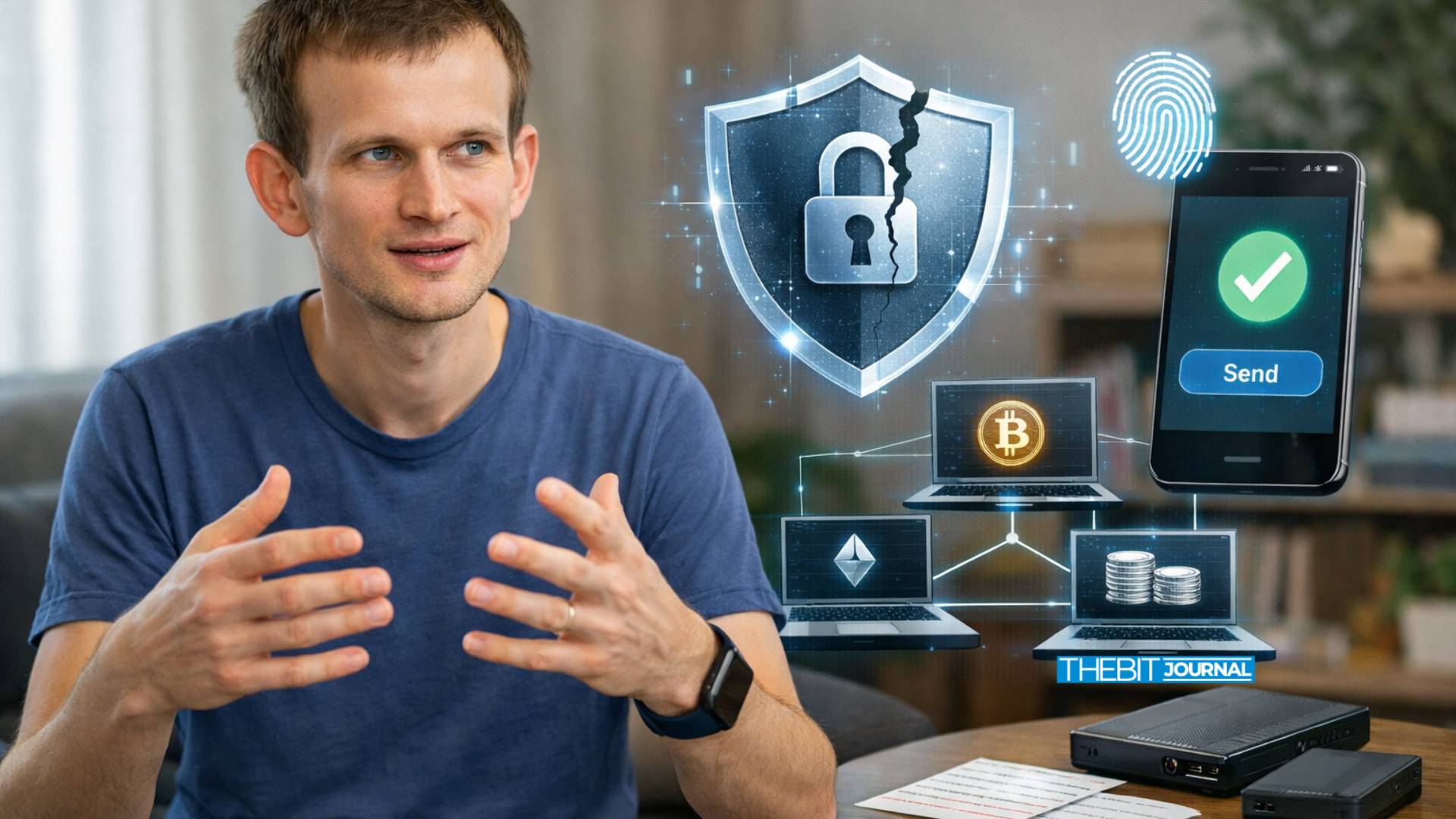
First, transaction previews and simulations are becoming a frontline defense, because they translate contract behavior into human-readable consequences. If a wallet can show what will change after a signature, the user gets a second chance to notice an approval that drains funds, a swap route that looks off, or a contract call that is not what it appears. This kind of preview is a meaningful crypto security upgrade because it targets the moment where intent and execution usually diverge.
Second, approval hygiene matters more than many people admit. Unlimited token allowances can turn one mistaken approval into a long tail of risk, especially when a malicious contract or compromised front end is involved. Tools that highlight allowances, flag unusual spend permissions, and encourage revoking unused approvals are not glamorous, but they reduce exposure measurably.
Third, recovery design matters. Multisignature setups, social recovery, and spending limits can prevent a single compromised device from becoming a total wipeout. Vitalik Buterin points to these as examples of layered intent checks: a second key, a trusted recovery path, or a limit that forces a pause when behavior looks abnormal. That is not perfect crypto security, but it is often the difference between a bad day and a life-changing loss.
Where AI Can Help, and Why It Should Not Be the Judge
Large language models come up as a potential “intent simulator,” meaning they can approximate common sense and detect when an action looks inconsistent with normal behavior. Vitalik Buterin argues that this can be useful as one more layer, especially if a model is tuned toward a user’s typical patterns. At the same time, he warns against letting AI become the single decision-maker for intent. If the AI is wrong, it becomes a new single point of failure, which is the opposite of redundancy.
So the realistic future of crypto security is not “AI will save everyone.” It is more like “AI can be another pair of eyes,” alongside simulations, confirmations, and hardened account designs.
The Hard Truth About Limiting Downside
A reply in the discussion pushed the idea further: redundancy protects against mechanical mistakes, but a user can still confirm the wrong thing multiple times. The natural temptation is to ask for strict downside limits regardless of intent. Vitalik Buterin’s response is blunt: truly bounding downside regardless of intent implies freezing funds forever, and that itself becomes the worst downside.
That is the trade-off the industry keeps circling. Users want freedom and safety at the same time. Systems can reduce risk, but they cannot remove the human element that makes financial autonomy valuable in the first place. That tension is exactly why crypto security remains an evolving discipline rather than a finished product.
Conclusion
The takeaway is not pessimism. It is focus. Vitalik Buterin is effectively telling builders and users to stop chasing perfect protection and start designing around how people actually behave: hurried, distracted, occasionally overconfident, and sometimes under attack.
Better crypto security comes from redundancy, clearer intent signals, and wallet experiences that make risky actions feel meaningfully different from routine ones. It is the unglamorous work of aligning human intent with irreversible systems, and it is where the next wave of consumer trust will be won.
Frequently Asked Questions (FAQs)
Why does Vitalik Buterin say perfect protection is impossible?
Vitalik Buterin argues that systems struggle to capture human intent with complete precision, and that gap will always create edge cases where actions do not match what the user truly meant.
What is the most practical improvement users can adopt today?
Using wallets and tools that provide transaction simulations, readable previews, and clear warnings around approvals can reduce avoidable mistakes and improve crypto security during real-world usage.
Does adding more confirmations always make users safer?
Not always. Extra steps can reduce mechanical errors, but too much friction can train users to ignore warnings. The goal is selective friction that increases checks only for high-risk or unusual actions.
Can AI stop scams and bad signatures?
AI can help flag suspicious behavior and act as an additional layer, but it should not be the only authority. A single AI gatekeeper can introduce new failure modes, so redundancy still matters.
Glossary of Key Terms
User intent: The real-world outcome a person is trying to achieve, including assumptions and context that may not be expressed cleanly in code.
Transaction simulation: A preview that estimates what will happen if a user signs a transaction, often showing token movements, approvals, or balance changes before execution.
Token allowance: Permission granted to a smart contract to spend a user’s tokens. Excessive allowances can increase exposure if a contract or interface is malicious.
Multisignature wallet: A wallet that requires more than 1 key to approve an action, reducing the risk that a single compromised device leads to total loss.
Social recovery: An account recovery approach that uses trusted parties or devices to restore access if a primary key is lost or compromised.
Disclaimer: This article is for informational purposes only and does not constitute financial, investment, or legal advice.
Sources