













Bitcoin has a funny way of humbling confident narratives, as one month, the market talks like everything hinges on a central bank decision. The next, price action ignores the headline and follows the cash. That shift has been showing up more clearly lately, with Bitcoin responding less to the usual policy chatter and more to liquidity conditions across the broader financial system.
This article explains why the market has started treating Rate Cuts as a side note, while treating liquidity like the main character. It also lays out the key indicators that matter, how to track them without turning into a full-time macro analyst, and how traders can avoid the common traps that show up when sentiment gets ahead of reality.
Why Bitcoin can move on cash flows, not headlines
For years, the simple story went like this: lower rates usually make borrowing cheaper, risk appetite rises, and Bitcoin tends to benefit. That relationship still matters over long stretches, but in shorter windows the market has been reacting more to whether money is actually available, not whether it is theoretically cheaper.
That is where the confusion starts as interest rates describe the price of money. Liquidity describes the amount of money moving through the system, and more importantly, where it is sitting. Those two can diverge, sometimes sharply. A market can hear Rate Cuts in a press conference while liquidity continues to drain quietly through other channels.
When that happens, Bitcoin tends to behave like a high-sensitivity asset. It does not need a dramatic catalyst. It needs a change in conditions that affects leverage, margin, and the appetite for risk. In a tight environment, traders reduce exposure fast, and Bitcoin’s volatility tends to amplify that move.
Rates and liquidity are cousins, not twins
Markets often talk about Rate Cuts as if they automatically mean more liquidity, but that is not guaranteed. Liquidity can tighten even when rates drift lower, especially if reserves are being pulled out of the system elsewhere.
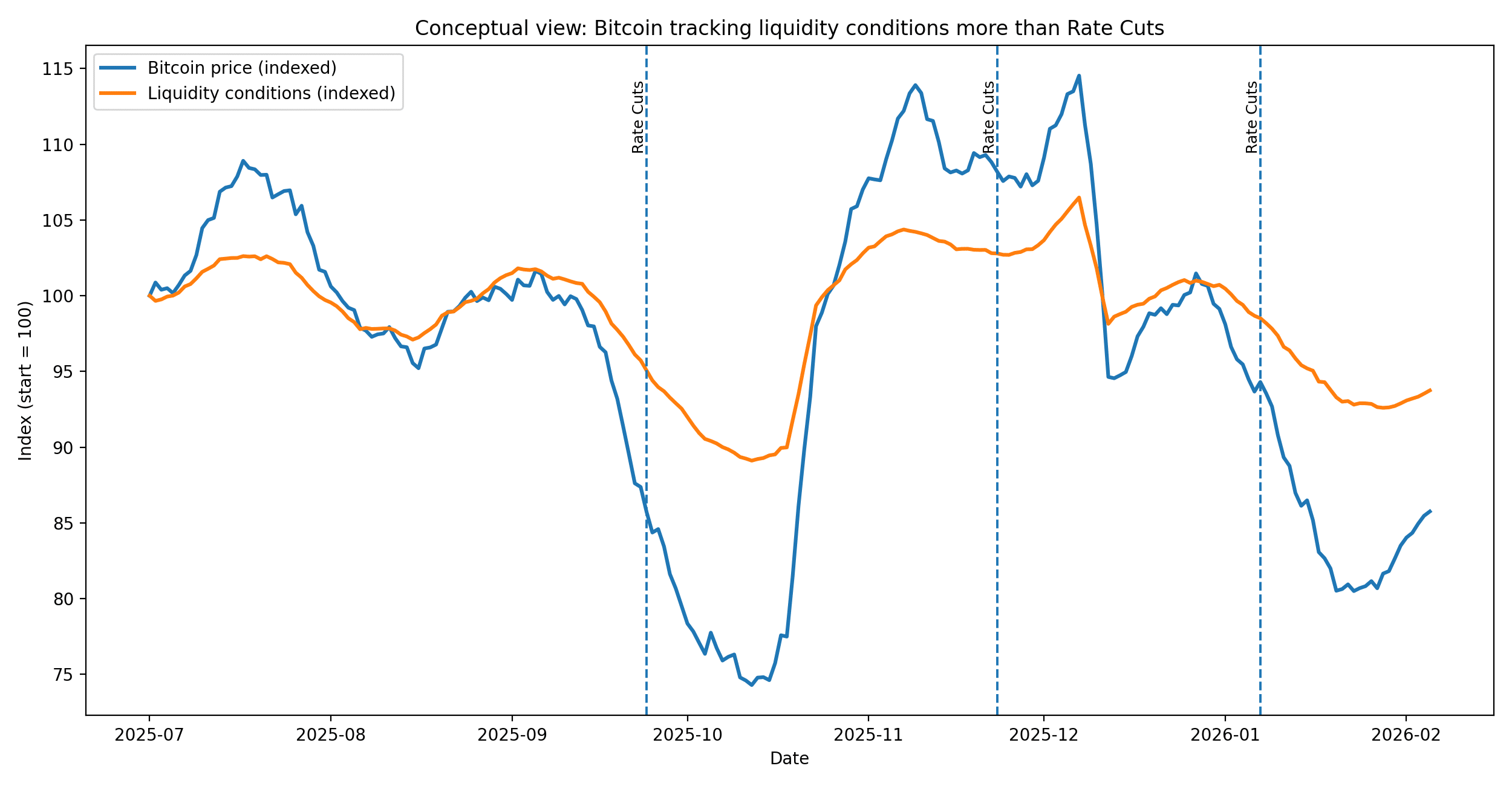 In practice, Bitcoin is reacting to the “plumbing,” not the podium. The system can look calm on the surface while the pipes are being turned down in the background. When that happens, it usually shows up first in assets that rely on risk capital and leverage, which is why Bitcoin often feels the shift early.
Rate Cuts and why they feel weaker this cycle
What changed in trader behavior
The market is not ignoring Rate Cuts out of stubbornness as it is adjusting because so much of the policy path is anticipated and priced before the decision arrives. When traders spend weeks positioning for Rate Cuts, the actual event can land with a shrug because the move has already been “spent” in advance.
There is also the context problem, as Rate Cuts that arrive because growth is slowing or risk is rising do not always spark a rally in volatile assets. In those moments, investors often prefer safety first, even if the cost of money is easing. That is why Bitcoin can fall alongside stocks and even metals during broad liquidity stress, regardless of the policy direction. (
The real drivers traders should watch
Bitcoin’s recent behavior makes more sense when the focus shifts away from a single policy lever and toward the moving parts that directly affect liquidity conditions. Three areas tend to matter the most.
The first is central bank balance sheet policy as when balance sheets shrink through tightening programs, reserves can gradually become scarcer. Early on, markets can absorb it, then suddenly conditions feel more constrained. The second is government cash management. When large cash balances are rebuilt, money can be pulled from the banking system, tightening liquidity conditions without a dramatic headline. The third is money-market mechanics, where certain facilities can absorb or release cash and make markets more sensitive to small shifts.
How to read the key crypto indicators in a liquidity-driven market
A liquidity-led tape changes what “matters” on a chart and on the dashboard. The indicators below are not magic, but together they help explain whether risk appetite is expanding or shrinking.
On-chain liquidity proxies often show it first. Stablecoin supply trends and exchange balances can hint at whether sidelined capital is returning or whether traders are de-risking. When liquidity conditions loosen, stablecoin activity often rises and trading depth tends to improve. When liquidity conditions tighten, spreads widen, order books thin out, and sudden drops trigger liquidation cascades.
Derivatives data becomes more important than usual. Funding rates, open interest, and liquidation prints can reveal whether the market is leaning too hard in one direction. In loose conditions, leverage builds quietly until something snaps. In tight conditions, even mild selling can trigger forced unwinds. Bitcoin does not need bad news for that, it just needs insufficient liquidity to absorb the pressure.
Correlation is another signal traders underestimate. When Bitcoin starts moving in sync with equities and other risk assets, it often suggests a shared driver, which is usually liquidity conditions rather than a crypto-only catalyst.

A practical “how to” checklist without the headache
A trader does not need to model global finance to respect liquidity. A clean routine can do most of the work.
First, the market should treat Rate Cuts as one input, not the whole forecast. If the narrative sounds too neat, the market is probably already priced for it. Second, liquidity conditions should be checked before trusting any breakout, especially after a long run of leverage building. Third, traders should watch for the mismatch: headlines suggesting relief while markets behave like stress. That mismatch is often the early warning.
Position sizing matters more when liquidity is tight. In loose conditions, price can drift and give traders time to adjust. In tight conditions, moves can gap and punish late reactions. Risk management is not glamorous, but it is the difference between staying in the game and watching a good thesis get crushed by timing.
Finally, time horizon should match the regime. Short-term moves have been reacting more to liquidity conditions, while longer-term value debates still care about macro direction, adoption, and broader narratives. Rate Cuts might matter in the long run, but near-term buying tends to require supportive liquidity.
Conclusion
Bitcoin is not “done” reacting to policy as it is simply reacting to the part that matters most in the moment. The market has learned that Rate Cuts can be loud, predictable, and often priced early, while liquidity conditions can be quiet, sudden, and far more decisive. That is why Bitcoin has started trading like a real-time gauge of financial conditions instead of a simple policy trade.
When the system has cash and risk appetite, Bitcoin tends to breathe easier. When cash tightens, it tends to feel the squeeze first. Traders who adjust their lens, and treat Rate Cuts as context while tracking liquidity conditions as a driver, usually make cleaner decisions and avoid the most common late-cycle mistakes.
Frequently Asked Questions (FAQs)
Why does Bitcoin sometimes fall even after Rate Cuts?
Bitcoin can fall after Rate Cuts when liquidity conditions are still tightening through other channels, or when the market interprets cuts as a response to economic stress and de-risks anyway.
What matters more right now, Rate Cuts or liquidity conditions?
In recent market phases, liquidity conditions have been the stronger short-term driver, while Rate Cuts still shape longer-term expectations and sentiment.
Which indicators help confirm liquidity conditions in crypto?
Traders often track stablecoin supply trends, exchange liquidity, derivatives leverage signals like funding and open interest, and cross-asset correlation to infer liquidity conditions.
Are Rate Cuts always bullish for crypto?
Rate Cuts can be bullish when they coincide with expanding liquidity and growing risk appetite. They can be neutral or bearish when liquidity conditions remain tight or when investors prioritize safety.
Glossary of key terms
Liquidity conditions: The availability and flow of cash and credit in the financial system, including how easily assets can be bought and sold without major price impact.
Rate Cuts: Central bank decisions that lower policy interest rates, affecting the cost of borrowing and influencing broader financial conditions.
Quantitative tightening (QT): A process where a central bank reduces its balance sheet over time, which can reduce reserves and tighten liquidity conditions.
Treasury cash balance: Government cash management that can drain or release liquidity into the banking system depending on whether balances rise or fall.
Funding rate: A periodic payment in perpetual futures markets that reflects whether traders are paying a premium to stay long or short, often used as a proxy for leverage pressure.
Disclaimer: This article is for informational purposes only and does not constitute investment, legal, or financial advice. Crypto assets are volatile, and readers should do independent research and consider professional guidance before making any financial decisions.
Source