







This article was first published on The Bit Journal.
During the early weeks of February 2026, there were two very different ends about store-of-value assets in the financial markets.
Gold exchange-traded funds saw record buying and pushed global holdings to new highs, while Bitcoin spot ETFs continued to bleed capital, suggesting that institutional money is still favoring traditional safe-havens over BTC.
The data from the market indicates that U.S. spot Bitcoin ETF outflows was about $1.9 billion last month, while total Bitcoin ETF assets dropped below $100 billion.
The contrast with gold is deep, particularly since gold ETFs posted large inflows and gold prices remained near fresh-record highs.
Gold’s Demand Rush: New Records and Buying Everywhere
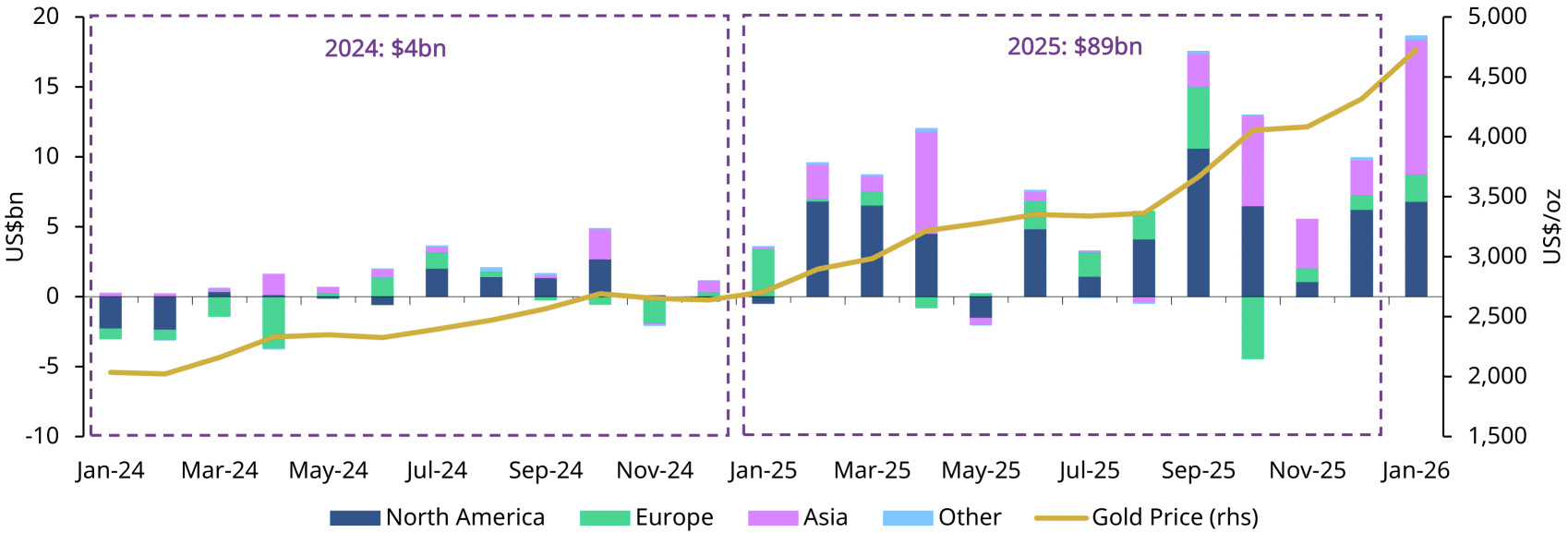
Gold’s return in 2025 and so far in 2026 has been nothing short of spectacular. Investment demand reached a record $555 billion in 2025 as physically backed gold ETFs took in 801 tons, lifting total holdings to more than 4,025 tons, an all time high, while assets under management doubled to roughly $559 billion, according to the World Gold Council. Only US gold ETFs added 437 tons approximately worth $280 billion.
January 2026 continued this trend. On the whole, world gold ETFs saw nearly $19 billion in net inflows, increasing global holdings to about 4,145 tons and taking assets under management to roughly $669 billion, according to official WGC numbers. The inflows were mainly driven by North America and Asia, Europe also reported meaningful net buying.
The rise has been fueled by a combination of investor demand, central bank purchases and concerns over macroeconomic stability. Central banks, led by the People’s Bank of China, continued to buy gold for a 15th month in order keep the metal as a core part of reserve portfolios at this time of high global debt and political tension.
Gold prices also reacted strongly. In January, gold surged by more than 14% as discount hunters and investors moved their assets into it.
Bitcoin ETF Outflows Persist as Price Volatility Lingers
On the other hand, Bitcoin saw persistent capital exiting from regulated ETFs even as price action fluctuated. Data shows that net U.S. spot Bitcoin ETF outflows was more than $1.9 billion in in January. These Bitcoin ETF outflows come despite BTC trading in the mid-$60,000s to low-$70,000s and are occurring amid heightened volatility across wider crypto market.
Other flow trackers also noted that the value of spot Bitcoin ETF holdings have dropped below $100 billion for the first time since April 2025, with investors taking money off the table and sales pressure on prices. On one active trading day in early February, spot Bitcoin ETFs had net outflows of around $272 million as the price dropped below $74,000.
There have been new inflows linked to short-term price action; for example, about $562 million in net Bitcoin ETF inflows on Feb. 2 at the time prices dipped, but those flows are still below late 2025 levels and shows that confidence remains delicate.
This constant rotation indicates the regulated institutional vehicles are still in no hurry allocating to Bitcoin at this point in time, on a macro perspective at least.
Price Action Shows Market Sentiment
The price of Bitcoin has also pointed out weakness in the wider market. BTC narrowly escaped dipping under $60,000 in early February, one of the deepest pullbacks since October 2025, only to settle back near $70,000.
The sell-off contributed to a $2 trillion drop in world crypto market value, amplified by volatility in traditional markets and waning institutional appetite.
Gold, by contrast, still behaved as a safe haven. Spot prices rebounded from earlier declines and began trading back above $5,000, supported primarily by ETF inflows and prevailing macro sentiment toward assets deemed to be stores of value in uncertain times.
The difference in performance and flows between gold and Bitcoin in the last year has been striking. Research reported that the Bitcoin-to-gold ratio which calculates how many ounces of gold one can buy with a single Bitcoin at its current value, declined by 50% throughout 2025, meaning gold outperformed on demand and relative value movement.

What This Means for Allocators and Markets
The different reactions in institutional flows and pricing mean that investors believe that gold and Bitcoin have different roles at the moment. The jump in demand for gold, especially through ETFs, shows how deeply gold is embedded into strategic reserve and portfolio diversification plans.
The ETF flows and central-bank purchases creates a kind of structural repositioning over a longer horizon.
This ongoing Bitcoin ETF outflows despite price volatility and some short-term inflows are an indication that investors are being particularly cautious of BTC, unsure as to whether it is a safe haven or long term reserve asset at the moment.
While the crypto is big and liquid, it seems traditional allocators are not ready to consider it as interchangeable with gold in terms of strategic collateral.
Some markets view these as a rotation, while others suggest this may instead mean a deeper reluctance by institutions to reallocate capital into riskier digital assets during periods of stress.
For Bitcoin to start seeing strategic demand like gold, sustained positive inflows into ETFs may be needed, coupled with clearer signs that macro hedging not short-term trading, is influencing allocation choices.
Conclusion
Gold continues to soar on one of the largest rallies in its history, breaking records in ETF holdings and demand. Bitcoin ETFs, on the other han,d still recorded persistent outflows from regulated platforms.
Despite price volatility and market resets, Bitcoin’s pattern in ETF flows suggests that it does, after all, seem to behave more like a risk-sensitive asset than a stable safe haven such as gold.
Gold, which is relatively supported by a central bank buying and strong ETF interest, still holds the store-of-value placement for many institutional investors.
Can Bitcoin flip the switch on investor perception and attract flows or will they continue to remain speculative?
Glossary
Bitcoin ETF outflows: Net outflows from exchange-traded products that hold Bitcoin, often pointing to weakening institutional demand.
Gold ETF inflows: Net new additions to funds that track physical gold, signalling investor demand for bullion.
Spot ETF: A fund that holds the actual basic asset (Bitcoin or gold), not derivatives.
Store of value: A good asset that does not lose purchasing power over time.
Frequently Asked Questions About Bitcoin ETF Outflows and Gold Inflows
Why are Bitcoin ETFs performing poorly?
Bitcoin ETF outflows have been experienced as institutional and some retail investors trim exposure, often in sight of macro pressure and price volatility.
Have gold ETFs seen inflows lately?
Yes. Global gold ETF inflows totaled a record of about $19 billion in January 2026, bringing holdings to record levels.
Is Bitcoin really a store of value now?
Though some advocates see Bitcoin in that light, recent flow data show that it still trades like a risk-sensitive asset rather than as the traditional safe haven of gold.
How does the price of Bitcoin compare to historical levels?
The price of Bitcoin plunged almost below $60,000 in February 2026 when the market was volatile but then stabilized to hover around $70,000.
Does gold outperform Bitcoin?
Gold’s price appreciation and demand for the ETF has outperformed Bitcoin in 2025 and early 2026, resulting in a reduced Bitcoin-to-gold ratio.
References
CryptoSlate
Informist Media
FinanceFeeds
Analytics Insight
World Gold Council