

This article was first published on The Bit Journal.
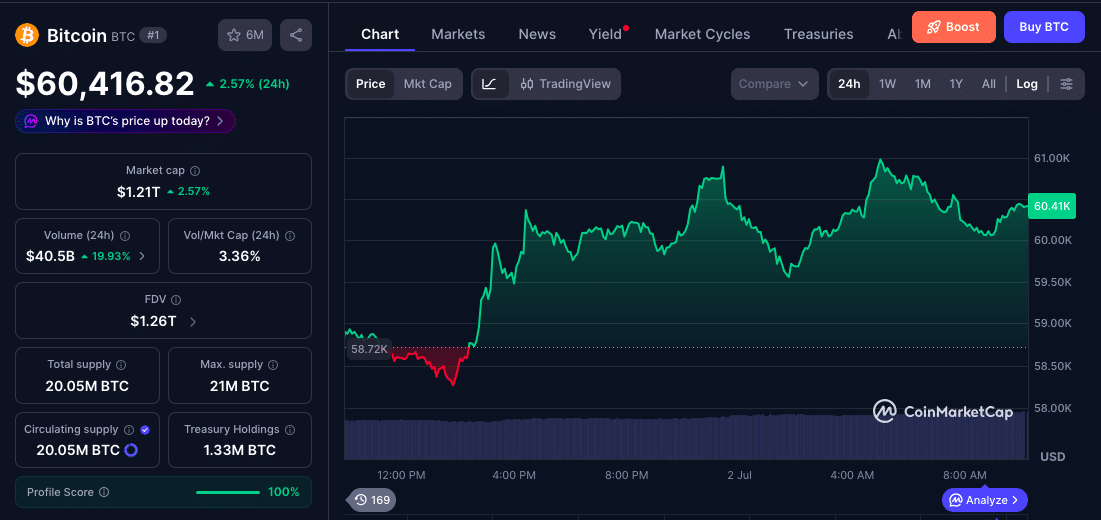
Bitcoin is showing signs of resilience after retaking the $60,000 level, against one of the most challenging institutional situations the market has faced since spot exchange-traded funds launched in the United States.
Bitcoin just recently pushed above $61,000 briefly, after bouncing back from a recent low near $57,700-$58,000. Still, the overall trend remains pretty cautious, as ongoing Bitcoin ETF outflows and an unsettlingly low volatility continue to weigh on market sentiment.
Industry data shows that US spot Bitcoin ETFs had their worst month on record in June, with about $4.5 billion exiting the products as investors got cold feet.
Bitcoin Price Holds Firm Despite Heavy Institutional Selling
The latest bounce has pushed Bitcoin back above the $60,000 level, a threshold that has acted as both a support and resistance throughout recent weeks.
While Bitcoin has made some progress over the last 24 hours, it is still a long way from its recent highs above $70,000. Looking at the data, Bitcoin’s 52-week trading range stretches from roughly $57,700 to $126,200, giving a sense of just how big this correction has been.
Bitcoin has managed to stabilize despite the ongoing institutional selling pressure. According to recent ETF data, June saw a net outflow of around $4.5 billion, the worst month on record and this was on top of an already weak start to the year. BlackRock’s IBIT reportedly accounted for a significant share of those withdrawals.
Analysts at Citigroup recently cut their Bitcoin forecast, citing concerns over negative ETF flows and weaker investor demand.
Bitcoin ETF Outflows Signal Investor Caution
The biggest reason behind recent price action remains Bitcoin ETF outflows.
After seeing such strong institutional adoption in 2024 and much of 2025, there is currently a marked change in behaviour from investors. Data suggests that more than $4.5 billion has flowed out of spot Bitcoin ETFs in June alone, with individual daily outflows running at hundreds of millions.
Across the wider market as well, investors are rotating their cash into traditional safe-haven assets, and sectors perceived to offer stronger growth opportunities, including artificial intelligence-related investments.
Reuters recently reported that ETF demand was dropping off, which is why the market is seeing downward revisions in Bitcoin price forecasts from all the major financial institutions.
However, there are some who think that these outflows are a sign of a market bottom as long as retail demand stays strong and can soak up all the selling pressure.
Volatility Compression Sets Up the Next Major Move
Another important development is Bitcoin’s unusually low volatility.
Both realized and implied volatility have fallen sharply, with seven-day implied volatility dropping toward 33%, one of the lowest readings of 2026.
Low-volatility environments often create a period of market indecision. Traders hesitate to take aggressive positions, leverage declines, and price movements become increasingly compressed.
But history shows us that these periods don’t last forever.
When volatility contracts for a really long time, markets often have a sharp breakout waiting in the wings once something triggers it, and that trigger can come from a variety of places such as upcoming US economic data, a Federal Reserve policy decision, or a sudden reversal in the outflow of money from Bitcoin ETFs.
Current derivatives positioning suggests traders are being cautious, but not actually bearish which reinforces the “wait and see” approach that is dominating the market right now.

Can Bitcoin Sustain Its Recovery?
So far, Bitcoin has been able to stay above $60,000 even though it has been losing investors at a record rate through ETF withdrawals which is definitely a boost for the bulls.
The market has moved on from being driven by retail speculation and now institutional products, ETF inflows and outflows, how the economy is doing and derivatives activity all play a role in figuring out the price.
If Bitcoin can get solid support above $61,000 and then manage to get back up to the $62,000 mark, analysts think the next target for Bitcoin could be $65,000. On the flip side, if the selling pressure comes back on, then another test of the $57,000-$58,000 support level is on the cards.
The next few weeks are really going to depend on whether the outflow of money from Bitcoin ETFs starts to slow down, and also whether the economy improves enough to get investors excited about investing in riskier assets again.
Conclusion
Bitcoin’s recovery above $60,000 is happening while institutional sentiment remains fragile.
Record outflows from Bitcoin ETFs, estimated at around $4.5 billion during June, are still weighing heavily on the market, and low volatility is making traders uncertain. Yet, Bitcoin has so far managed to avoid a deeper breakdown, which is a good sign that there’s still some demand.
ETF flows, macro developments and the market’s response to upcoming policy decisions are what traders are currently on the lookout for.
Glossary
Bitcoin ETF outflows: Money leaving Bitcoin exchange-traded funds through investor redemptions.
Spot Bitcoin ETF: This is an exchange-traded fund that directly owns Bitcoins in its portfolio, rather than futures contract.
Implied Volatility: This is a market estimate of how much the price of Bitcoin might move in the future, based on the prices of options contracts.
Realized Volatility: This is how much the price actually moved over a specific period.
Support Level: A price area where buying demand tends to prevent further declines.
Frequently Asked Questions About Bitcoin ETF Outflows
What are Bitcoin ETF outflows?
Bitcoin ETF outflows happen when investors pull their funds out of spot Bitcoin ETFs, forcing fund managers to redeem shares and potentially sell Bitcoin holdings.
How much disappeared from Bitcoin ETFs last June?
Around $4.5 billion got pulled out of US spot Bitcoin ETFs during June, the worst month on record for the whole space.
Why is Bitcoin holding above $60,000 despite investors pulling money out?
The retail demand, long-term holders and the general market holding up have all together been absorbing and soaking up the institutional selling pressure, stopping a more aggressive decline.
Why is low volatility important for Bitcoin?
When volatility stays low, it often ends up being the calm before a major storm because traders are just waiting for a good opportunity to build some trades within a narrow trading range.
What could help drive Bitcoin higher in July?
If the pace of outflows from ETFs starts to slow down, the economy starts looking better and the Federal Reserve signals are positive, then it could all help Bitcoin recover a bit stronger.
References