













This article was first published on The Bit Journal.
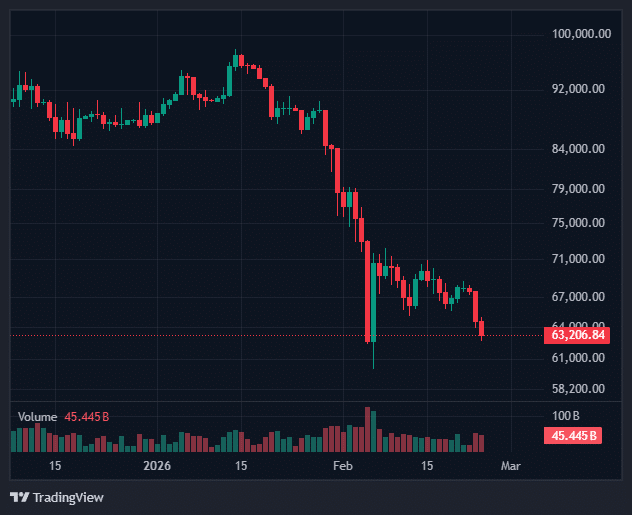
The Bitcoin price drop has jolted markets again, with BTC sliding under $63,000 during Asian trading hours and extending its weekly decline to nearly seven percent. Screens flashed red as traders reacted in real time, pushing the asset back toward levels last seen on Feb. 6 when price nearly touched $60,000.
According to the source, renewed concern over U.S. trade policy and growing AI jitters triggered the latest wave of selling. Bitcoin recently traded near $63,200 based on updated figures. The sudden Bitcoin price drop has placed major Bitcoin support levels under pressure and revived fears that further losses could follow.

Tariff Shock Rattles Global Risk Appetite Behind Bitcoin Price Drop
The market reaction began after President Donald Trump confirmed temporary tariffs would rise to 15 percent from 10 percent following a Supreme Court decision that struck down his earlier strategy. That legal reversal injected fresh uncertainty into trade policy, and investors responded quickly.
U.S. stocks fell as traders reassessed economic outlooks. Risk-sensitive assets, including crypto, followed suit. Matt Howells-Barby of Kraken said in comments published online that the move mirrors tariff-driven volatility seen in April 2025.
He noted that renewed geopolitical tension could remain bearish in the short term. His remarks highlight how macro headlines can trigger sharp Bitcoin price drop episodes when confidence weakens.
AI Jitters and the High-Beta Tech Link
The Bitcoin price drop also reflects a shift in investor psychology around artificial intelligence. AI-linked equities have sold off as investors reassess stretched valuations and growth expectations. When enthusiasm cools in high-growth sectors, speculative capital often retreats.
Bitcoin now trades like a high-beta tech proxy. During strong equity rallies, crypto attracts aggressive capital. When growth stocks wobble, crypto feels the chill first. Data trends show how risk assets tend to move together during tightening cycles. As AI optimism fades, demand for digital assets softens, amplifying the Bitcoin price drop and testing Bitcoin support.
COIN Slide Signals Institutional Spillover
The downturn extended to public crypto equities. Shares of Coinbase, known by the ticker COIN, declined alongside BTC. That slide signals institutional risk reduction rather than isolated retail selling.
When Wall Street trims exposure to crypto-linked stocks, the effect often spills into spot markets. Institutional portfolios hold both public equities and digital assets. A decline in COIN reinforces the broader risk-off tone and raises questions about how firmly Bitcoin support can hold under sustained pressure.

History Favors a Deeper Sell-Off Before Bottom
History offers a sober reminder. Bitcoin rarely finds a lasting bottom before the 50-week moving average drops below the 100-week moving average. This bear cross marked the final stages of major downturns in 2018 and 2022.
Right now, the market is far from that signal. The shorter-term average still sits well above the longer-term line. In past cycles, price often slid sharply before the crossover even appeared. That pattern suggests downside risk can stay elevated while the two averages remain apart, adding weight to concerns surrounding the current Bitcoin price drop.
Analysts speaking at Consensus Hong Kong pointed out that today’s structure looks similar to earlier pre-bear cross phases. In those periods, panic selling arrived before technical confirmation. Capitulation came first. The signal followed later.
In simple terms, history shows that deeper weakness often unfolds before charts confirm a bottom. Still, markets do not move by script. Past performance offers no guarantee of future results.
Conclusion
This Bitcoin price drop now brings sharp focus to Bitcoin support near $60,000. That level stands as the line between stabilization and another leg lower. If it breaks, analysts see room toward the mid-to-low $50,000 range. If it holds, confidence could slowly rebuild.
Markets rarely send clear signals before turning. The current setup echoes earlier cycles, yet every cycle carries its own twists. For students of finance, crypto builders, and professional analysts, steady risk management and close attention to Bitcoin support will matter more than bold predictions in the days ahead.
This article is for informational purposes only and does not constitute financial advice. Readers should conduct their own research before making investment decisions.
Glossary of Key Terms
Bitcoin Support: A price zone where buying interest has historically slowed or stopped declines.
Bear Cross: A signal that occurs when the 50-week moving average falls below the 100-week average.
High-Beta Asset: An investment that moves more sharply than the broader market.
Capitulation: A period of intense selling driven by panic before potential stabilization.
FAQs About Bitcoin Price Drop
Why did the Bitcoin price drop below $63,000?
Tariff uncertainty and AI stock weakness triggered a broader risk-off reaction.
Why is $60,000 important?
It represents major Bitcoin support that traders are closely monitoring.
What does the bear cross signal?
It historically marked prior bear market bottoms after heavy declines.
Could Bitcoin fall to $50,000?
Analysts suggest further downside remains possible if Bitcoin support breaks.
Sources/References