






This article was first published on The Bit Journal.
Tom Lee, executive chairman of BitMine Immersion Technologies and partner at Fundstrat, is at it again with a bold prediction: that Ethereum is in a “supercycle” like Bitcoin’s 100x run.
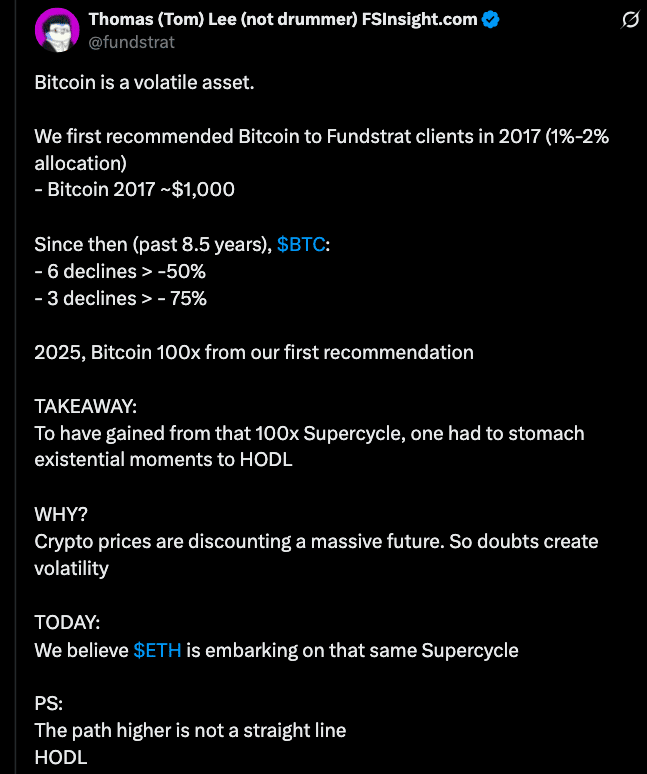
According to Lee, the volatility in crypto today is “discounting a massive future” and he’s telling investors to be patient.
Meanwhile, BitMine is backing his call with aggressive $ETH accumulation, buying hundreds of thousands of $ETH. Lee’s thesis about on-chain accumulation, institutional demand, and long-term utility of Ethereum is being debated across crypto communities and markets.
Ethereum Supercycle Thesis: What Tom Lee Is Saying
According to Tom Lee, Ethereum (ETH) is about to go through “that same supercycle” Bitcoin did and that was the reason why he recommended buying ETH. He pointed to Bitcoin’s past drawdowns, 6 greater than 50% and 3 over 75%, so volatility is the price you pay for long term gains.
Those who held through what he calls Bitcoin’s existential moments in the past will cash in bigly if Ethereum is, indeed, on that trajectory, he said.
He also cautioned that the way higher is not a straight line and any supercycle will be large drawdowns.
BitMine’s Ethereum Accumulation and Strategy
According to the company BitMine, hundreds of thousands of ETH have already been purchased. The fact is, BitMine got 379K ETH recently (worth nearly $1.5B), they are a strong holder of the market, and with so much belief in $ETH to keep it alive for good!
This haul is putting BitMine’s ETH treasury in the mega millions. They have since accumulated over 3.3 million ETH, representing 2.74% of Ethereum’s total supply in new data pools.
BitMine’s $ETH play isn’t all about holding; Lee and BitMine are absolutely betting against Ethereum not just as a commodity to be traded but also on the future of finance.
Why Lee Believes Ethereum Could Be Wall Street’s Next Backbone
Lee says Ethereum offers “fundamental use” that sets it apart from just another crypto asset. One of the big takeaways, he noted, is Ethereum and tokenization and real world assets. He thinks that the rise of stablecoins, tokenized assets, DeFi, and smart contracts will contribute to a long-term institutional-driven growth period for ETH.
In Lee’s mind, Ethereum is Wall Street’s next backbone. An obedient, impartial chain on which other institutions can build and transact. He also compares it to post-1971 finance that just as traditional finance moved past gold, Ethereum will eventually become the base for tokenized finance.
Market Reaction and Criticism
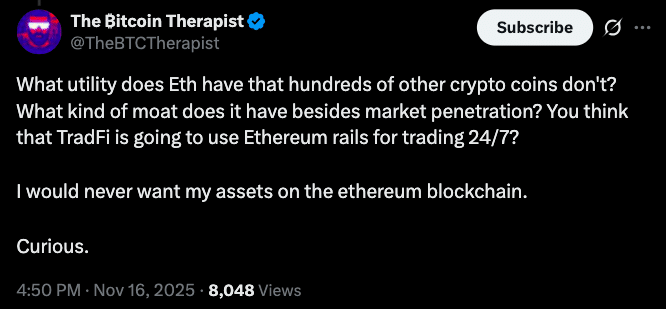
The attention on Lee’s Ethereum supercycle call has not been without its critics. Some critics wonder whether Ethereum actually has a moat vs other smart contract platforms.
A notable influencer, calling himself “The Bitcoin Therapist,” asked what value $ETH offers that “hundreds of other coins don’t.”
Others suggest that broad adoption from the traditional financial world is no sure thing, and Ethereum could lose its edge over scaling or competition.
Yet despite the cynicism, Lee’s call is supported by BitMine’s own capital commitment. No, his words have not just been mere lip service, its billions of dollars of accumulation in ETH.
Implications for Investors and the Ethereum Ecosystem
If Lee’s supercycle thesis happening in Ethereum, long term accumulation in ETH may actually be turning more agressive. BitMine isn’t the only one: Other crypto treasuries may follow too, if they have a multi-year bull thesis for Ethereum.
Use cases and infrastructure could take off, on chain. Lee is making the bet on real-world asset tokenization, DeFi explosion and stablecoin flows which will drive long-term ETH demand.
As Lee put it, huge drawdowns are part of the game. Investors who buy into the supercycle thesis should be prepared for big ups and downs.
Last but not least, institutional interest in Ethereum will grow – with companies such as BitMine leading the way! The fact that they’re buying at such a large scale is not just the behavior of believers, but will also make for a shortage if they continue to be aggressive buyers.
Conclusion
Tom Lee’s provocative statement about Ethereum kicking off a Bitcoin-style supercycle has caught the attention of people in crypto land.
Driven by BitMine’s huge ETH war chest in the making, that thesis involves Ethereum’s long term utility, institutional buying and token issuance.
And of course, while the critics ask; is $ETH even going to get to 100x like Bitcoin, Lee’s confidence buttressed by real capital deployment has re-sparked hope in an ecosystem searching for a new narrative.
Glossary
Supercycle: A bull market that lasts for a long time.
BitMine Immersion Technologies: A Former Publicly Traded mining company that now develops an ETH treasury.
Fundstrat: A research firm founded by Tom Lee.
On-chain accumulation: Buying and holding, according to on-chain data.
Tokenization: The process of turning an asset into a digital token on a blockchain.
Frequently Asked Questions About Ethereum Supercycle
What is Tom Lee referring to when he says “Ethereum supercycle”?
What he meant is that in his opinion, Ethereum is now at the start of a long trend upward fueled by institutional demand for Ether and for applications on Ethereum’s blockchaiain; real world assets, stablecoins and the smart contract economy not unlike Bitcoin’s 100x cycle.
Why is BitMine buying so much $ETH?
BitMine is buying up $ETH aggressively because they share Lee’s long term vision on Ethereum. Their buys support their plan to create a large ETH treasury.
Is Lee saying Ethereum will go up 100x like Bitcoin?
No, he’s not predicting a price repeat of 100x. His “supercycle” is about long term compounding and utility not a guaranteed 1:1 price repeat.
What are the main risks to Lee’s supercycle thesis?
Primary risks include slow adoption, competition from other smart contract chains, scaling problems or absence of institutional momentum.
How should regular investors respond to this supercycle thesis?
For those who believe in Lee’s outlook, they may accumulate $ETH for the long term but expect volatility and not bet all eggs on price predictions.
References