




Crypto investors often spend too much time searching for the perfect entry. The market rarely cooperates. Prices move, headlines change fast, and an asset that looks cheap in the morning may seem expensive by evening. Dollar-cost averaging offers a steadier approach. Instead of predicting every turn, an investor commits a fixed amount regularly. The method does not remove risk, but it can reduce poor timing and emotional decisions.
What Dollar-Cost Averaging Means in Crypto
Dollar-cost averaging means investing the same amount at regular intervals, regardless of price. An investor might buy $100 of Bitcoin every Friday or $250 of Ether each month. When the asset trades lower, that amount buys more units. When it trades higher, it buys fewer.
The discipline matters more than the formula because the calendar, rather than emotion, decides when the purchase happens.
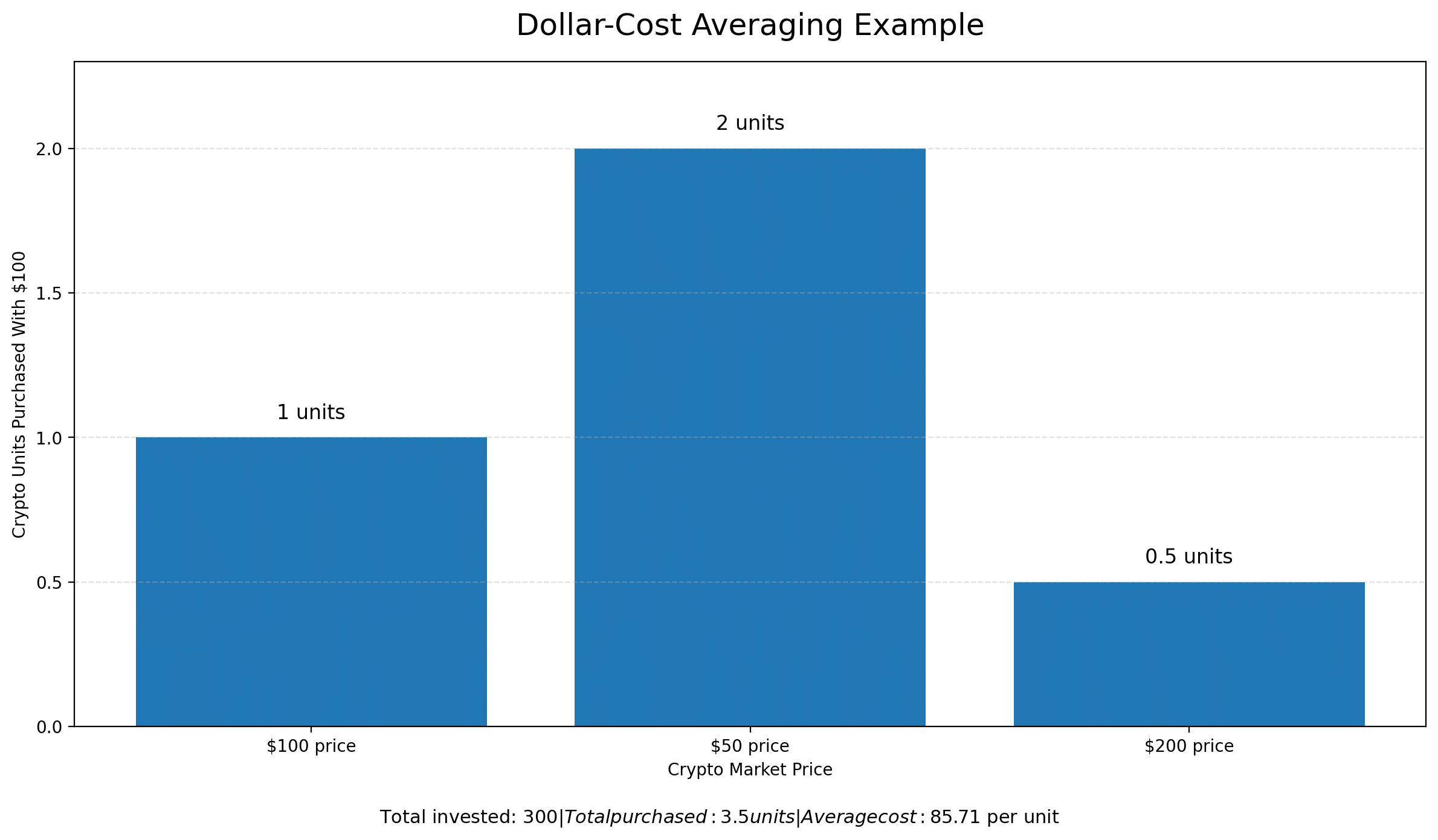
Suppose an investor commits $300 through 3 purchases. At $100 per unit, the first $100 buys 1 unit. At $50, the next purchase buys 2 units. At $200, the final purchase buys 0.5 units. The investor owns 3.5 units for $300, creating an average cost of about $85.71 per unit.
Why the Method Suits a 24/7 Market
Crypto never closes, and that nonstop structure makes timing difficult, even for experienced traders.
Dollar-cost averaging turns uncertainty into routine. It often suits investors using salary income because new cash arrives gradually. It may help someone who understands an asset but knows that one large purchase would create anxiety.
A plan may stop an investor from freezing during a decline or buying too aggressively after a rally. Still, better execution cannot repair a poor asset choice.
DCA Versus a Lump-Sum Purchase
A lump-sum strategy places available capital into the market at once. It gives the full amount immediate exposure and may perform better when prices keep rising.
Dollar-cost averaging spreads entry risk across several dates. It may soften the effect of buying shortly before a decline, although it can lag when a rally begins immediately.
The source of the money matters as an investor using part of each paycheck is not delaying capital that already exists. Someone holding $20,000 in cash faces another choice because spreading it across 12 months leaves part outside the market.
Traditional-market research often favors lump-sum investing over time, yet the stronger mathematical choice can fail if a sudden drawdown triggers panic selling.
Fees, Spreads, and Slippage Matter
The advertised trading fee does not reveal the full cost of a recurring purchase. Investors should also examine spreads, card charges, withdrawal fees, network costs, and slippage.
A spread is the difference between the buying and selling price. Slippage appears when an order executes away from the expected price, often because liquidity is weak.
Dollar-cost averaging can magnify these costs when orders are tiny and frequent. A daily $10 purchase may appear disciplined, but a recurring markup or payment fee can take a meaningful share. Weekly or monthly orders may reduce that drag.
Key Crypto Indicators to Review
Price alone cannot show whether an asset deserves long-term accumulation. Market capitalization measures price multiplied by the circulating supply and gives a broad view of size. It does not guarantee safety.
Trading volume shows how much of an asset changed hands during a period. Rising volume may support a breakout, while a price surge on weak volume can be easier to reverse.
Liquidity measures how easily an asset can be traded without its price moving sharply. Thin liquidity raises spread and slippage risk.
Volatility reflects the size and frequency of price changes. High volatility can make dollar-cost averaging useful because entry prices vary widely, but it also signals greater downside risk.
Circulating supply shows how many tokens are available. Investors should also study future token unlocks because added supply may pressure price.
The Relative Strength Index, or RSI, measures momentum from 0 to 100. Readings above 70 may suggest an overheated market, while levels below 30 can signal heavy selling. RSI should never be treated as a stand-alone buy signal.
Moving averages smooth price data over periods such as 50 or 200 days. They help show whether broader momentum is strengthening or weakening.
Building a Practical Purchase Schedule
A sound dollar-cost averaging plan starts with an amount that will not strain daily finances. Essential expenses and emergency savings should come first.
Frequency should match income and costs. Weekly buying provides more entry points. Monthly buying creates fewer transactions and simpler records. Daily buying may offer little extra benefit once fees and tax tracking are considered.
Asset selection remains central. Established networks generally offer deeper liquidity and longer histories, though they still carry risk. An investor should explain why the asset may remain useful in 3 to 5 years.
Dollar-cost averaging also needs review dates. A quarterly or semiannual check can test whether network activity, token economics, regulation, competition, or leadership has changed. Discipline means following a plan while remaining willing to update it.
Custody, Automation, and Records
Recurring-buy tools make execution easier, but convenience creates responsibility. Holding funds on an exchange brings counterparty risk. Moving assets to a personal wallet reduces platform dependence, although the owner becomes responsible for private keys and recovery phrases.
Third-party bots add risk. API permissions should be limited, withdrawal access disabled where possible, and accounts protected with strong security.
Each purchase may create a separate tax lot. Records should include the date, amount paid, units received, fees, transfers, and sale proceeds. Tax rules differ by country, so investors should follow local requirements.
When the Strategy Should Be Reconsidered
Dollar-cost averaging cannot protect an investor from a failing project. Repeated purchases may deepen losses when users leave, developers disappear, supply expands sharply, or leadership loses credibility.
It may also be unsuitable when fees are excessive, emergency savings are weak, or one asset dominates the portfolio.
An investor should pause when the original thesis fails. A lower price does not automatically create value.
Conclusion
Dollar-cost averaging gives crypto investors a structured way to handle an unpredictable market. It replaces constant guessing with a repeatable process and can reduce the emotional pressure surrounding entry prices.
Its value depends on asset quality, costs, custody, records, and regular review. It supports disciplined execution but never guarantees profit.
Frequently Asked Questions
Is DCA profitable in crypto?
It may be profitable if the selected asset rises over time, but no schedule guarantees returns.
Is weekly or monthly buying better?
The better schedule controls fees, matches income, and remains easy to maintain.
Can DCA prevent losses?
No. It spreads entry timing, but an asset can still decline permanently.
Does DCA work for altcoins?
It can, although smaller tokens often carry higher liquidity, supply, and failure risks.
Glossary of Key Terms
DCA: Investing a fixed amount at regular intervals.
Cost basis: The total purchase cost used to calculate gains or losses.
Liquidity: The ease of trading without causing a large price change.
Slippage: The difference between the expected and executed price.
Spread: The gap between buying and selling prices.
Volatility: The speed and size of price movements.
Market capitalization: Price multiplied by circulating supply.
Tax lot: A record of one purchase and its cost.
Sources
Disclaimer: This article is for educational purposes only and does not provide financial, investment, tax, or legal advice. Crypto assets are volatile and can cause substantial losses. Investors should conduct independent research and consult qualified professionals before making financial decisions.