







This article was first published on The Bit Journal.
As Bitcoin dipped past $90,000 to its lowest in seven months, traders and investors have begun discussing a fresh Bitcoin price outlook involving deep levels of liquidity, institutional flow and macro-headwinds.
Based on recent chart work by experts and analysts, Bitcoin seems to have been walking down the liquidity staircase, with major shelves laying at $85,000 and further down by $73,000.
Market watchers are on the lookout for the factors steering the present perspective, support levels to pay attention to and a view of where Bitcoin could go in the future.
Bitcoin Market and Sentiment Change
Bitcoin just hit its lowest point of the year at $90,000 and was trading around $89,900 just recently, quite far from its October high above $126,000.
This wipe-out of about 30% in a matter of days is suggestive of a change in risk sentiment, driven by higher U.S. interest rates and institutional selling.
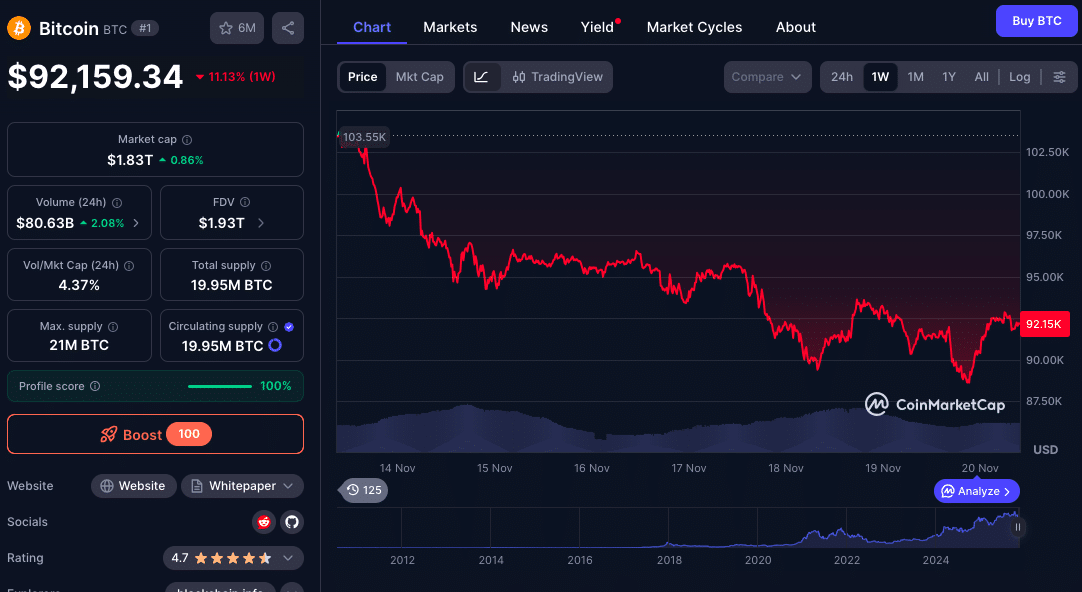
The shift in sentiment has brought a renewed focus on Bitcoin ’s price structure and the “liquidity shelves” that traders look at. According to the analysis, Bitcoin is now trading inside a large bracket, from which earlier supports have been turned into resistances.
The implication is that Bitcoin price outlook and expectations is no longer just up, it has to wrestle with downside structure and market fear.
Major Support Areas
The concept of the liquidity staircase has now become central in the Bitcoin price outlook. This plots ranges of historical order-book depth, levered positions and psychological levels.
Bitcoin is trading within a band whose previous support at around $92,000-$93,000 has turned into resistance. Anything beneath brings around large liquidity pools at around $85,000, below it stands between $77,000 and $74,000.
If the price does break below the $85,000 shelf, then the next important area at around $73,000 may act as an attractor for buyers.
This structure implies that in the event of a breakdown, it could come swiftly, guiding the Bitcoin price outlook to a heightened risk of an extended, complex lower correction.
Institutional Flows and Macro Factors That Provide Perspective
Institutional flows and the macro backdrop are also factors influencing the Bitcoin price outlook. Rising Treasury yields and uncertainty over U.S. interest-rate cuts have tarnished the appeal of risk assets like crypto.
Meanwhile, spot Bitcoin ETFs have experienced significant outflows over the past few weeks, suggesting that institutional capital could be taking a break from accumulating.
On the other hand, historical data indicates November is one of Bitcoin ’s strongest months, with median returns of 11.2%, which has given hope for recovery.
These tensions generate a tug-of-war: macro-risk pulling the outlook lower, while structural factors and institutional architecture continue to be constructive signals.
The resulting Bitcoin price outlook is thus contingent, depending on which factors take dominance.
Bitcoin Price Prediction: A Forward-Looking Path
Given the structure and sentiment at this time, there are two potential pathways to follow according to Bitcoin price analysis.
First, if Bitcoin drops backward below the $85,000 range, it starts to look at a possible drop toward the $73,000 vicinity.
On the other hand, with support and institutional flows returning to the fold, Bitcoin may want to claw its way back toward $95,000-$110,000.
Based on these, the next page of Bitcoin ’s price action is either consolidation at current levels or a quick revisit of $73,000 before any real recovery.
For Investors and Traders
For those observing Bitcoin price action, the uncertainty of this market demands a high level of consciousness toward risk management and liquidity zones.
This will enable traders to form strategies that position them better for directional moves toward the $92,000-$93,000 resistance, the $85K shelf and a potential target at around $73K.
The seasonal trade of November is a bit more optimistic, but macro risks and institutional outflows suggest caution.
For investors looking to get exposure to Bitcoin, they should think about how this fits with their wider portfolio and whether they can tolerate if Bitcoin were to go back down towards significant support levels.
Conclusion
The current trajectory of Bitcoin price outlook makes analysts consider the upside versus downside risk.
With the cryptocurrency recently falling below $90,000 and probing structural bands closer to $85,000 and perhaps even $73,000 in the days ahead, this next phase may be one of rebound if institutional flows pick up again or a deeper correction if the liquidity shelves break.
The next few weeks will be important. For now, traders and investors have to adjust their expectations to the reality that Bitcoin could be going down towards its lower floors of consolidation before it makes the next big move.
Glossary
Liquidity Staircase: lateral flat bars on the price history, where the majority of Order-book depth and leverage are accumulated, serving as a temporary Support or Resistance.
Support Shelf: A common price point for the purchasing trend to appear, serving as a “floor” for the price.
Institutional Flow: The capital moving through funds, ETFs and big investors that may drive price action in an asset.
Seasonality: Past behavior in price action by time of year, like November’s usual bullishness for Bitcoin.
Frequently Asked Questions About Bitcoin Price Outlook
What is Bitcoin’s major support level now?
In liquidity-band analysis as of November 2025, one significant support area exists around $85,000 with the next substantial area being at about $73,000.
Is it possible Bitcoin could bounce, not drop?
Yes, the Bitcoin price outlook is that it can go from defending support to rallying back toward $95,000-$110,000, as long as institutional flows increase and macro fundamentals improve.
Why isn’t Bitcoin’s future as clear now?
That’s because macro pressures (rising interest rates) and institutional outflows are battling seasonal strengths and liquidity profiles in the outlook.
Does this then mean Bitcoin could be in a bear market?
Not necessarily. The possibility of a deeper correction has risen, but the market has not established a bear phase. The details of such analysis depend on whether support must hold or fall.
References