







This article was first published on The Bit Journal.
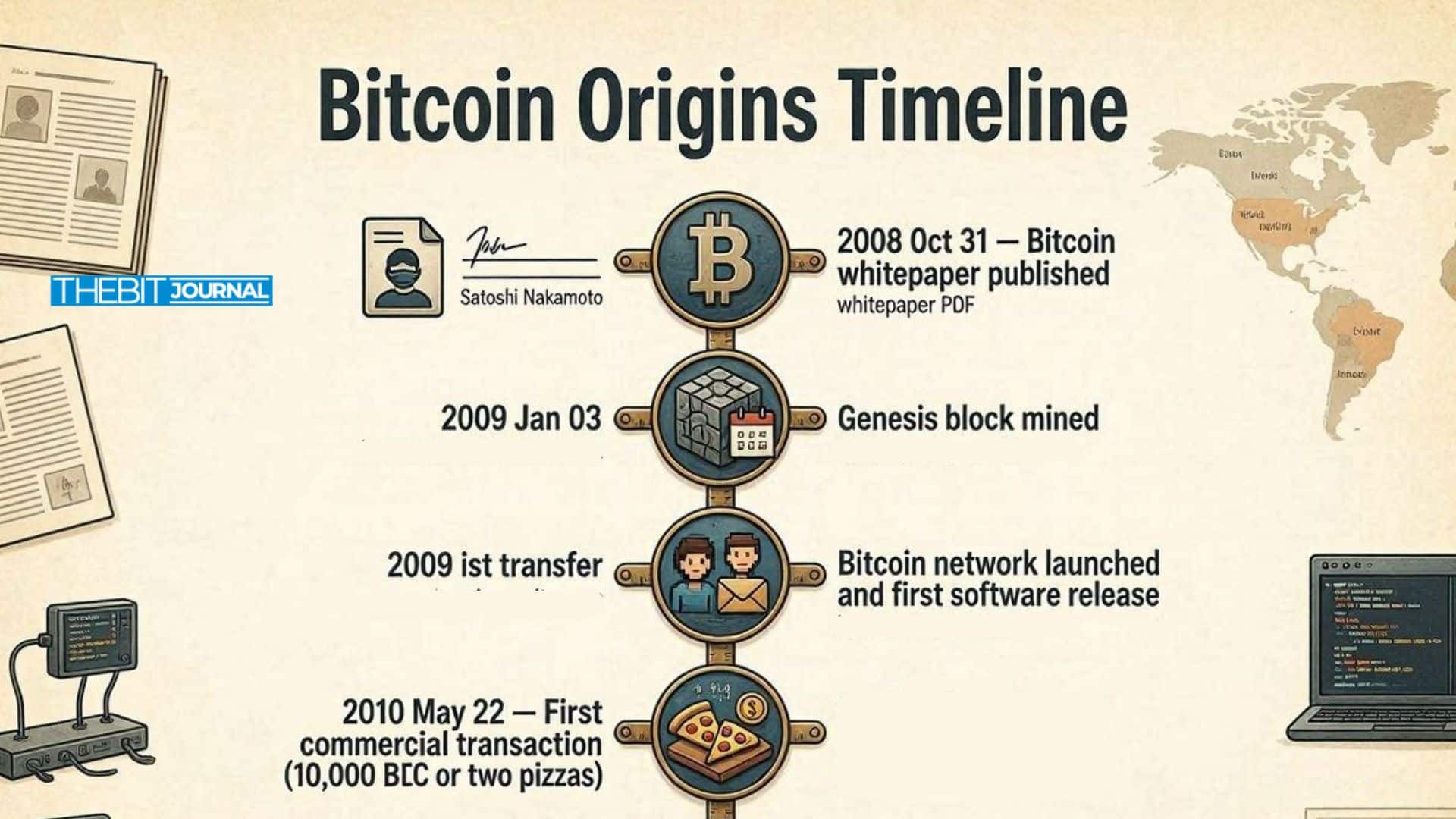
Bitcoin’s invention spans over several notable dates. Its design was first laid out in an October 2008 publication, but the network didn’t go live until the following January. Simply put, Bitcoin was invented in 2008 when a developer with the pseudonym Satoshi Nakamoto, released a whitepaper called “Bitcoin: A Peer-to-Peer Electronic Cash System”. The actual fleshed out Bitcoin blockchain (or the Genesis Block) was mined on 3rd January, 2009.
The answer to the question “when was Bitcoin invented?” can vary depending on which milestone one chooses to focus on. Some say it was invented in 2008 when whitepaper was published, others say 2009 is the birth-year as it was the first network launch or the first transaction. The basics is that Bitcoin’s roots lie back in late 2008.
Currently, Bitcoin has turned into a rather substantial $1+ trillion asset, but it all started with the 1990s crypto-punk ethos and the financial crisis of 2008.
Bitcoin’s Whitepaper (October 2008): The First Milestone
Bitcoin’s invention started with Satoshi Nakamoto’s 2008 whitepaper. On the 31st October, 2008, a link to “Bitcoin: A Peer-to-Peer Electronic Cash System” was posted to an online crypto mailing list. This was a 9-page proposal outlining a digital currency with no banks, no middlemen; that was the whole idea.
Nakamoto had in fact registered the domain bitcoin.org a bit earlier in the year, in August (18th August, 2008). The plan for the Bitcoin network was made public on Halloween 2008.
The whitepaper’s main innovation was merging existing cryptographic ideas (digital signatures, hash-based proof-of-work) to form a complete system that solved the double-spending problem. The idea here was a peer-to-peer network where transactions get added to a public ledger (blockchain) and that ledger is kept safe by people called miners.
In this context, Bitcoin was invented as a concept on 31st Oct 2008. Not a single Bitcoin coin existed at that point and there was no market price. Satoshi just threw the idea out into the world, which is consistent with the statement that the whitepaper was the one that “gave the system its name, goal, and core mechanism”.
This event can be called the earliest potential date for the “invention date”. Put simply, the question of when was Bitcoin invented? really depends on whether you count this publication as the birth or a later launch (see below). But for many purposes, 2008 is the year of creation.

Genesis Block and Launch (January 2009)
Once the whitepaper was published, the next thing to happen in Bitcoin’s history was to start turning the theory into a real working network. On 3rd January, 2009, Satoshi Nakamoto mined the actual Genesis Block (Block 0) of Bitcoin. That was the moment the Bitcoin blockchain was finally up and running.
This event also famously contained the text “The Times 03/Jan/2009 Chancellor on brink of second bailout for banks,” which goes to show how much of an impact the financial crisis of the time was still having. The 50 BTC reward from this block remains unspendable, effectively marking the start of a fully decentralized currency.
Mostly, the Genesis Block’s mining date is often cited as Bitcoin’s launch. According to leading analyses, this was “two months later” than the whitepaper release. The Genesis Block made the system live: instead of being just a design on paper, Bitcoin had a running ledger.
The Genesis Block started the chain on January 3, 2009, which is why the invention date and the launch date are related but not the same. In other words, Bitcoin became operational in January 2009.
Shortly after, on January 9, 2009, Satoshi released the first Bitcoin software (v0.1) as open-source on SourceForge. This allowed anyone to run a Bitcoin node and mine new blocks.
By mid-January, a tiny network of early adopters (including Hal Finney, Wei Dai, and Nick Szabo) was mining. The whitepaper, Genesis Block, and public software release each mark different phases of the same invention.
Important Dates to Remember
As a timeline shows below, these are the critical dates that are significant the question “when was Bitcoin invented”.
| Date | Event |
| August 18, 2008 | Bitcoin.org domain registered by Satoshi (approximate). |
| October 31, 2008 | Bitcoin whitepaper released by Satoshi Nakamoto. |
| January 3, 2009 | Genesis Block (first block) mined by Satoshi, launching Bitcoin’s blockchain. |
| January 9, 2009 | Bitcoin v0.1 software released publicly (SourceForge). |
| January 12, 2009 | First bitcoin transaction: Satoshi sent 10 BTC to Hal Finney. |
| May 22, 2010 | Bitcoin Pizza Day: 10,000 BTC spent for two pizzas; first recorded commerce. |
Each row above helps to piece together the various stages of Bitcoin’s creation but to get a true picture of things, one has to consider all of them individually and not point to a single one as the moment of invention.
The whitepaper (2008) was the design publication, and January 2009 is when it actually hit the streets; the first few transactions (Jan 12) show how it was used in real life. Put all these pieces together one gets the full story of just when Bitcoin was invented and deployed.
These key dates give you the answer to the question of “when was Bitcoin invented”. October 31, 2008 was when the idea of Bitcoin came out and January 3, 2009 was when the network went live.
The First Bitcoin Transaction (January 2009) – Hal Finney’s Account
Just a few days after the network went live, the first user transaction went down. On January 12, 2009 Satoshi Nakamoto sent 10 BTC to the cryptographic activist Hal Finney. This transaction (in block 170) showed that Bitcoin could indeed transfer value from one person to another without needing a middleman.
Hal Finney, a cryptographer and one of the handful of people who had the software up and running at the time, later recounted his role in Bitcoin’s creation:
“I think I was the first person besides Satoshi to run Bitcoin… I was the recipient of the first Bitcoin transaction, when Satoshi sent ten coins to me as a test”.
This is a first-hand confirmation of the timeline from someone who was there and saw it all happen. The Washington Post noted that on Jan 3 Satoshi mined the first 50 BTC, and by Jan 12 Finney received the first payment. This lines up with technical records and was later recorded in sources like Guinness World Records.
Finney’s perspective is a really useful insight as to the question “when was Bitcoin invented?’. He was in regular touch with Satoshi and was able to report bugs and also saw the system evolve from a difficulty of 1 to something more serious. He said at the time that those early days were all about testing the code. He was able to confirm that the core protocol was working fine right from the start.
In terms of answering the question of when was Bitcoin invented , Finney’s quote goes to show that by Jan 09, the design was already good enough to allow user-to-user transactions.
Why Bitcoin Was Invented
Satoshi’s whitepaper and the Genesis Block came during the 2008 global financial crash which almost destroyed people’s trust in banks. The crash revealed why Bitcoin was trying to give people financial freedom and freedom from censorship. Satoshi was also deliberate about including a Times headline in the Genesis Block that was talking about bank bailouts. This goes to tell that Bitcoin’s invention was somehow a reaction to centralized failures.
A lot of cryptographers had tried to work out how to create digital cash. Bitcoin’s creation was built on top of all that work. The cypherpunk movement of the 80s-90s promoted the use of cryptography for private protection. For years people like Wei Dai and Nick Szabo were pitching ideas (b-money and bit gold) that really influenced Bitcoin’s development.
Even Hal Finney was working on something called Reusable Proofs of Work (RPOW) back in 2004. All these precursors had some of the ideas, but they did not solve the double-spending or decentralization problems , however, they did lay the groundwork for Satoshi’s invention.
Bitcoin’s inventor (Satoshi) took all those ideas and combined them with a proof-of-work blockchain to finally solve the long-standing problem of creating a money system that actually works.
Bitcoin’s Early Days (2010)
Bitcoin’s first commercial use happened in 2010. On May 22, 2010, programmer Laszlo Hanyecz paid 10,000 BTC for two pizzas, an event which is now celebrated as “Bitcoin Pizza Day”. This was the first time people had seen any real value in Bitcoin.
To put a price on it, at Bitcoin’s all-time high of around $126,000 in 2025, those pizzas would have been worth over $1.26 billion.
Pizza Day is often seen as a milestone that happened after the invention of the coin. It shows how Bitcoin actually moved to actual money and real-world value, albeit slowly. This doesn’t change the day Bitcoins was invented, it just marks the beginning of Bitcoin’s economic life.
Conclusion
The question “when was Bitcoin invented” is answered by looking at multiple milestones.
The Bitcoin whitepaper was published on October 31, 2008, which is the day the idea of Bitcoin was born. The Bitcoin network then launched on January 3, 2009 with the Genesis Block.
So, in a way, Bitcoin’s invention straddles 2008-2009. The invention date is often cited as October 31, 2008 and the launch date is January 3, 2009. This timeline shows both the invention (design) and the operational launch of Bitcoin.
Glossary
Bitcoin: this is a decentralized digital currency that came about in 2009. Bitcoin was created by an enigmatic figure Satoshi Nakamoto. Its purpose is to allow peer-to-peer transactions without any need for banks.
Satoshi Nakamoto: the person (or people) behind the creation of Bitcoin.
Whitepaper: a detailed technical document that Satoshi published on October 31st 2008, explaining Bitcoin as a peer-to-peer electronic cash system.
Genesis Block (Block 0): the very first block of the Bitcoin blockchain.
Hal Finney: a pioneer in the world of cryptography, and one of the first people to help out with the development of Bitcoin.
Blockchain: a public record of all the Bitcoin transactions, dating all the way back to the Genesis Block and continuing to grow with each new block that gets mined (which happens roughly every 10 minutes).
Peer-to-Peer: a system where users communicate directly without any central servers involved. Bitcoin transactions work in this way, so no bank is needed for transfers.
Frequently Asked Questions About “When was Bitcoin Invented?
When was Bitcoin invented, and who created it?
Bitcoin was invented in 2008 by someone (or group) using the pseudonym Satoshi Nakamoto, and they published the Bitcoin whitepaper on October 31, 2008. The network did not go live until January 2009.
What is the Bitcoin Whitepaper and when was it released?
The Bitcoin whitepaper is Satoshi Nakamoto’s document outlining how Bitcoin works. It is considered the “founding document” of Bitcoin and was released on October 31, 2008 under the title “Bitcoin: A Peer-to-Peer Electronic Cash System”.
When did the Bitcoin network launch (Genesis Block)?
The Bitcoin network kicked off on January 3, 2009, when Satoshi Nakamoto mined the first ever block – the Genesis Block (Block 0). This pioneering block got the whole thing started, and included a newspaper headline from that day in the block itself. We often look back to the Genesis Block as the official start date of the Bitcoin network.
When did the very first Bitcoin transaction happen, and who was involved?
The first Bitcoin was transferred on January 12, 2009. Satoshi Nakamoto sent 10 BTC to developer Hal Finney. Finney was one of the first people to run the Bitcoin software. This transaction marked the first time Bitcoin changed hands between users in a real peer-to-peer deal, without any middlemen getting involved.
What’s the story behind Bitcoin Pizza Day, and when did it happen?
Bitcoin Pizza Day refers to May 22, 2010, when programmer Laszlo Hanyecz decided to spend 10,000 BTC on two pizzas. It is celebrated as the first known purchase of a real-world item with Bitcoin and an interesting early milestone in the history of the network. It happened well after the network was up and running (about 1.5 years after the official launch)
References
Disclaimer: This article is for information purposes only and is not meant to be taken as financial advice.