













Solana is back under pressure, after a strong run earlier in the year, the token has given back a big chunk of its gains, wiping billions from market value. Recent data shows that firms holding large SOL positions on their balance sheets have seen aggregate net asset value drop from roughly 3.5 billion dollars to about 2.1 billion dollars in a matter of weeks, a slide of close to 40 percent.
For companies that built a Solana treasury during the explosive rally earlier in the year, the latest sell off feels brutal. In many cases, share prices moved almost tick for tick with SOL, which turned what was billed as a diversification play into a high beta bet on a single network. The drawdown has also triggered questions from traditional investors who are still learning how on chain assets behave on a corporate balance sheet.
Public companies show two faces of Solana exposure
The listed company universe that leans on Solana is small but growing. One consumer-focused group that repositioned itself as a Solana treasury vehicle reported that its holdings climbed by about 4.4 percent to more than 2.1 million SOL between early September and the end of October, even as the token itself turned volatile.
At the same time, a different firm that marketed a two billion dollar Solana treasury plan saw its stock price fall more than 80 percent in a single week after announcing a major fundraising deal. Equity investors clearly worried that the structure and timing of the offer put too much pressure on shareholders just as SOL was losing altitude.
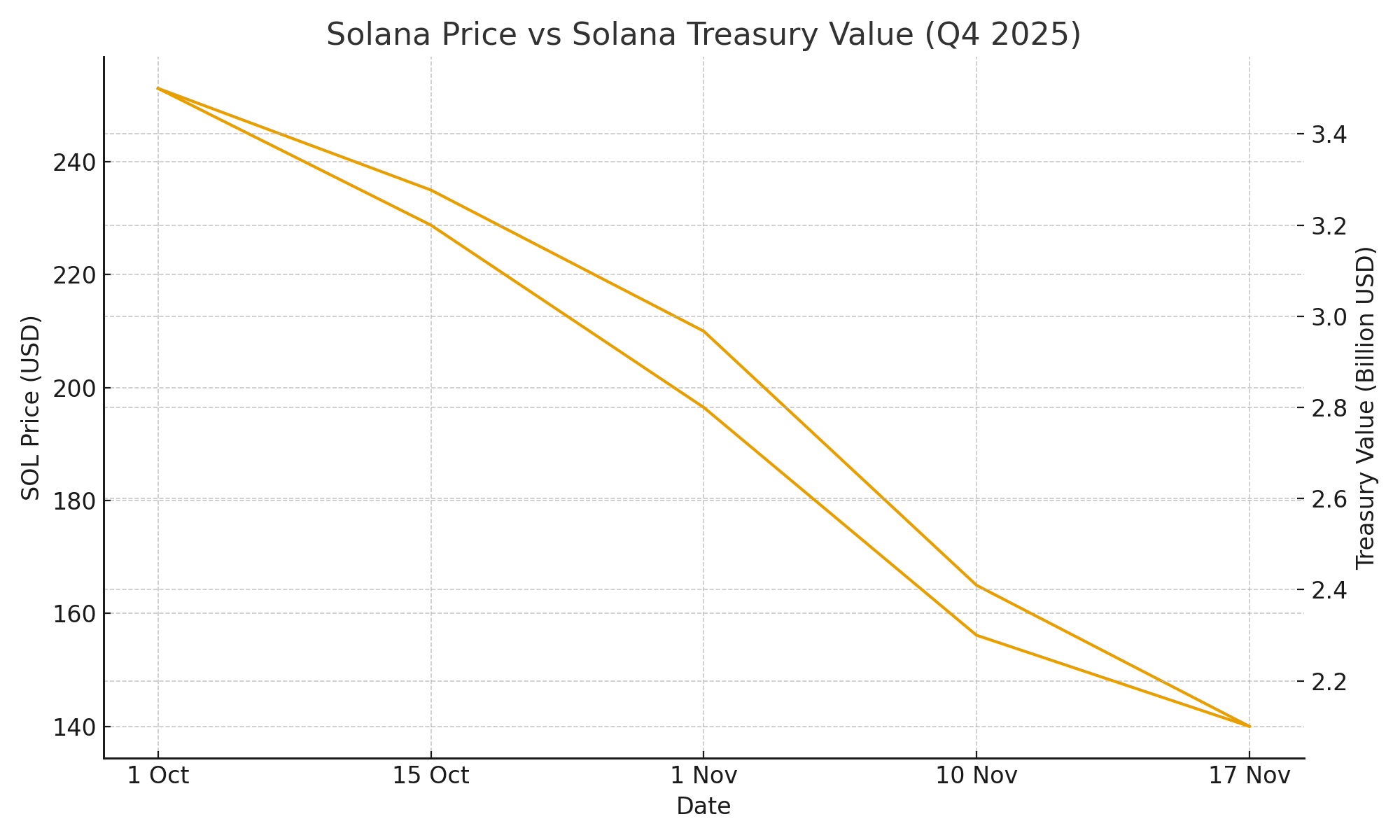
These extremes show how sensitive any Solana treasury strategy is to both token moves and market trust. A company can accumulate millions of SOL and still struggle if investors feel that governance, disclosure, or capital allocation are not clear enough.
Staking yield, ETFs and the bigger treasury picture
The drawdown in Solana focused firms is happening while corporate crypto treasuries as a whole are expanding. Recent research suggests that more than 140 companies now hold over 130 billion dollars in digital assets across Bitcoin, Ethereum, Solana and other networks.
Within that landscape, several managers are doubling down on the Solana treasury model. One recent update described billions of dollars of SOL allocated into staking programs with yields near 7.7 percent, even as market sentiment stayed cautious. For treasurers, that income stream is attractive because it turns a volatile asset into something closer to a productive position that can help fund operations.
On top of that, the first spot Solana exchange traded product in a major market has already attracted hundreds of millions of dollars in assets and sits inside a broader forecast that altcoin themed funds could see tens of billions in inflows over the coming months. Those flows matter, because they give future Solana treasury buyers a more liquid, regulated reference for valuing their holdings.
Why some CIOs still talk about a 10,000 dollar decade setup
Given the scale of the recent losses, a call for Solana at 10,000 dollars in the next decade sounds bold. One chief investment officer who oversees a dedicated Solana treasury argues that the current devaluation is exactly what long term accumulation looks like. The thesis is simple. As more economic activity moves to high speed blockchains, networks that combine low fees, deep liquidity and strong developer communities should command a premium.
From that point of view, a sharply lower mark-to-market on a Solana treasury today may represent the entry price for a much larger footprint in the next cycle. The CIO view is that markets are paying investors to be patient, as long as risk limits are clear and leverage is controlled. That framing will not convince everyone, but it explains why some listed firms continue to add SOL even after a 40 percent drawdown.
Solana price today and the key crypto indicators
Spot data shows Solana trading close to 141 dollars, after dropping from levels above 165 dollars earlier in November. Over the past week, the token has printed several days with intraday swings of more than five percent, a reminder that volatility is still part of the package.
The main indicators that traders and analysts watch right now are daily trading volume, funding rates in derivatives markets, net exchange flows, and staking participation. Technical screens from several research desks point to a short term environment that is cautious but not fully broken, with roughly half of recent sessions closing in the green and volatility around ten percent over thirty days. In simple terms, the health of the Solana treasury ecosystem now ties directly to whether SOL can defend support in the 130 to 140 dollar zone through November.

Solana price prediction for November 2025
Short term price forecasting is never exact, and this period is especially tricky because macro signals are mixed. The wider crypto market has been under pressure as investors reassess interest rate expectations and rotate some capital back into equities. Over the last month, Bitcoin has dropped more than twenty percent from its peak and Solana has seen single day losses near six percent on several occasions.
Quant models from several analytics platforms currently project a modest upside bias for Solana into the end of November, with point estimates in the low to mid 140 dollar range over the next few sessions and into the 30 day window ahead. A reasonable base case for the rest of the month is a trading band between 130 and 160 dollars, with sharp spikes possible around macro data releases or fresh ETF headlines.
If that range holds, the Solana treasury theme gains credibility because corporate buyers will appear disciplined for adding on weakness instead of chasing rallies. A clean break below 130 dollars would tell a different story and might force some treasuries to rethink position size or hedging. Any projection should be treated as a scenario, not a promise, and professional investors typically pair such views with strict risk controls. This article is for information only and is not financial advice.
What this means for the future of corporate crypto holdings
The current stress test will shape how boards, regulators and investors judge the next wave of digital asset adoption. For long term investors, the Solana treasury story is no longer a side note. It has become a live experiment in whether a high throughput blockchain can sit at the center of real corporate balance sheets, support staking income, and still survive heavy drawdowns without breaking trust. The outcome will influence how other networks are treated when the next cycle of treasuries and ETFs arrives.
Frequently Asked Questions
Why did Solana linked treasuries lose about 40 percent in value?
They lost value mainly because the market price of SOL fell sharply after a strong rally. Firms that hold large amounts of SOL mark their positions to market, so a drop in price translates directly into lower net asset value, even if the number of tokens has not changed.
How do corporate SOL holdings earn yield for companies?
Many treasuries stake their SOL with validators or run validator infrastructure themselves. In return, they receive staking rewards that can reach high single digit annual yields. Those rewards can be used to fund operations, buy more SOL, or diversify into other assets, depending on internal policy.
Are spot Solana exchange traded products important for price stability?
Spot products make it easier for institutional capital to gain exposure within existing brokerage accounts. Early flows into these vehicles have already reached hundreds of millions of dollars. Over time, steady inflows from that channel can support liquidity and may reduce the impact of isolated selling events, although they cannot remove volatility altogether.
Is Solana at 10,000 dollars in ten years realistic?
That figure reflects one aggressive long term thesis rather than a consensus forecast. For such a price level to become realistic, Solana would likely need to capture a very large share of real world transaction volume, stay technically reliable, and maintain strong developer and user growth for many years. There is no guarantee that this path will play out.
Glossary of key terms
Treasury
The pool of assets that a company or protocol controls for strategic, operational or investment purposes, often held on the balance sheet.
Staking
The process of locking tokens in a proof of stake network to help secure the chain. In return, the participant receives rewards, usually paid in the same token.
Exchange traded product (ETP)
A security that trades on an exchange and tracks the value of an underlying asset such as a cryptocurrency, an index, or a basket of assets.
Net asset value (NAV)
The total value of assets minus liabilities for a fund or company, often used to benchmark whether a traded vehicle looks cheap or expensive relative to what it owns.
Volatility
A measure of how much an asset price moves over a given time period. High volatility means large and frequent price swings, while low volatility means more stable pricing.
References