

Updated on, 6th January, 2026
Bitcoin mining has spent years stuck in the same shouting match: critics call it wasteful, supporters call it misunderstood, and most readers are left with more heat than light. The conversation is starting to mature, largely because governments, grid operators, and researchers are now tracking the load more closely and asking narrower, more practical questions. How much electricity is being used in specific regions, when it is used, what power plants are on the margin at that hour, and who pays if the grid has to expand.
Those questions matter because electricity is not a moral category. It is a system with constraints, price signals, and local politics. A megawatt that shows up at 2 a.m. in a windy region looks very different from a megawatt that hits during a summer peak in a fossil-heavy area. The climate impact also changes if the load displaces flaring, absorbs curtailed renewables, or forces new generation onto the system. In 2026, the debate is less about slogans and more about accounting.
Bitcoin mining and the environment: what changed and what regulators watch
The first shift is that the issue is no longer abstract. In the United States, the Energy Information Administration has published preliminary estimates suggesting electricity use from crypto mining likely represents about 0.6% to 2.3% of total U.S. electricity consumption, explicitly noting that the added demand has drawn attention from policymakers and grid planners worried about costs, reliability, and emissions.
That range is wide, but the point is clear: the load is large enough to be felt in planning conversations, especially where multiple facilities cluster near the same transmission corridors.
The second shift is methodological. Bitcoin mining is global, mobile, and privately operated, so no single organization can simply read every meter. That is why leading estimates lean on models that use network data, mining economics, and hardware efficiency assumptions to produce ranges rather than a single “true” number.
The Cambridge methodology, for example, publishes lower-bound and upper-bound estimates based on different assumptions about what hardware is operating and how quickly miners upgrade to more efficient machines. The uncertainty is not a weakness; it is the honest part of the math.
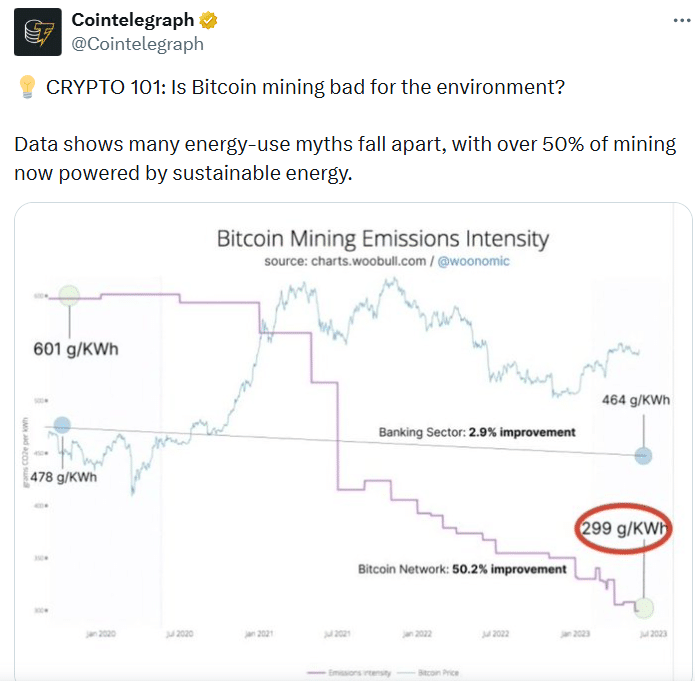
The third shift is that the power mix itself is changing, and the details now matter more than the headline. A major industry survey-based study from Cambridge reported that surveyed miners drew 52.4% of electricity from “sustainable” sources, split between renewables and nuclear, while natural gas became the single largest source, and coal’s share fell sharply compared with earlier estimates.
Even readers who disagree with the framing can see the direction: coal is less central, and the argument has moved toward marginal emissions, gas, and grid integration.
The indicators that determine whether the footprint grows or shrinks
Most environmental takes miss the simple mechanics of why miners turn on and off. Bitcoin mining sits at the intersection of energy markets and crypto markets, so the environmental footprint responds to both.
Hash rate is the first indicator. It reflects how much computing power is competing to secure the network. When hash rate rises, it often signals that more machines are running, which tends to push electricity demand higher unless efficiency improvements offset it. Difficulty is the second indicator. It adjusts to keep block production steady, and it usually increases when more miners compete, tightening margins and pushing weaker machines out.
Hardware efficiency, often discussed as joules per terahash, is the third indicator and the quiet driver of long-term change. More efficient fleets can reduce electricity per unit of work, but total electricity still depends on how many machines are deployed and whether revenue supports their operation.
The revenue side completes the picture. The block subsidy and transaction fees, combined with the market price of the asset, set the ceiling on what miners can afford to spend on power. When revenue rises, older and less efficient machines can become profitable again and return to service. When revenue falls, inefficient machines shut down and the network’s demand can drop. This is why responsible estimates stay dynamic and why confident single-number claims often age poorly.
The flare-gas storyline is real, and it is also easy to overpromise
One argument that keeps resurfacing is that miners can monetize wasted energy, especially flared gas at oil fields. There is a legitimate climate backdrop here. The World Bank’s 2025 gas flaring tracker reported that global flare volumes rose to 151 bcm in 2024 and that flares were associated with 389 million tonnes of CO2e emissions, including a portion attributed to unburnt methane. Methane is a high-impact gas over shorter time horizons, and reducing venting and inefficient flaring can deliver meaningful benefits.
Still, the details decide whether the practice is climate-positive. If a mining setup measurably reduces methane slip and replaces uncontrolled waste with monitored combustion, it can be an improvement. If it becomes a justification to keep marginal production operating longer, it can backfire. In climate reporting, intent is less important than verification, and verification requires transparent measurement, third-party checks, and clear boundaries.
Grids are starting to treat mining like an industrial load, not a culture war
The newest policy discussions focus on planning and cost allocation. Texas, for example, passed legislation in 2025 aimed at large-load planning in the ERCOT region, creating new structures around how very large electricity users interconnect and how reliability concerns are managed. The policy point is straightforward: when a single customer can add a small city’s worth of demand, regulators want guardrails so the grid does not get surprised.
This is also where the “flexible load” argument becomes relevant. Some operations can curtail quickly during scarcity pricing, acting more like controllable demand than a fixed factory. That can help reliability during stress events, but it only works if incentives align and curtailment is dependable. The environmental upside is indirect: smoother grids can integrate more intermittent renewables over time, but only if the load is actually managed as flexible rather than simply marketed that way.

A new international signal: governments are now openly courting the industry
Not all news is coming from North America. In 2025, Pakistan’s Finance Division said the country would allocate 2,000 MW in a first phase aimed at powering Bitcoin mining and AI data centers, framing it as a way to monetize surplus electricity, attract investment, and create high-tech jobs. That sort of state-level endorsement changes the global map, because it suggests some governments see mining as a buyer of last resort for excess generation.
The environmental impact of such moves will depend on what “surplus” means in practice. If the power is genuinely stranded or curtailed, the incremental emissions may be limited. If the power is available only because the grid is overbuilt or poorly optimized, the impact may still be manageable. If the policy simply redirects scarce electricity away from households or industry, the politics and the climate math will turn ugly fast.
Conclusion
Bitcoin mining is not becoming “green” by slogan, and it is not doomed to remain a climate villain by default. The truth is more conditional: the footprint depends on hardware efficiency, power sourcing, grid timing, and whether growth forces new generation. The latest public data points show why policymakers are paying closer attention, and why serious coverage needs to move beyond viral comparisons and into verifiable, local reality. The industry’s next chapter will be written in disclosure standards, grid rules, and measurable emissions outcomes, not in opinion pieces that ignore the math.
FAQs
Is Bitcoin mining a meaningful part of U.S. electricity use?
The U.S. Energy Information Administration has published preliminary estimates suggesting crypto mining likely represents about 0.6% to 2.3% of total U.S. electricity consumption, while noting that policymakers and grid planners are watching potential impacts on cost, reliability, and emissions.
Does Bitcoin mining really run on mostly clean energy?
A major survey-based study from Cambridge reported that surveyed miners drew 52.4% of electricity from “sustainable” sources, including renewables and nuclear, while natural gas was the single largest source and coal’s share was much smaller than earlier estimates.
Why do electricity estimates for Bitcoin mining come as ranges, not a single number?
Because there is no global meter-reading system for miners, leading methodologies model electricity use using network data, profitability, and hardware assumptions, then publish lower-bound and upper-bound estimates to reflect uncertainty.
Can using flared gas make mining cleaner?
It can reduce waste in certain settings, but claims need verification. The World Bank reported global flaring of 151 bcm in 2024 and associated emissions of 389 million tonnes CO2e, which is why reducing waste has real climate relevance, but project-level measurement still matters.
Glossary of key terms
Bitcoin mining: The process of securing the network through proof-of-work, where specialized computers compete to add blocks and earn rewards.
Hash rate: A measure of total computing power devoted to the network, often used as a proxy for competitive intensity and potential energy demand.
Difficulty: A network adjustment that keeps block timing steady by making the puzzle harder or easier as total competition changes.
Joules per terahash (J/TH): A common efficiency metric describing how much energy a machine uses to perform a fixed amount of mining work.
Marginal generation: The power plant or resource that ramps up to meet an extra unit of demand at a specific moment, often the key driver of incremental emissions.
Curtailment: Renewable electricity that could have been produced but is reduced because the grid cannot absorb it at that time, sometimes cited as an opportunity for flexible loads.
Sources
Cambridge Judge Business School
U.S. Energy Information Administration