













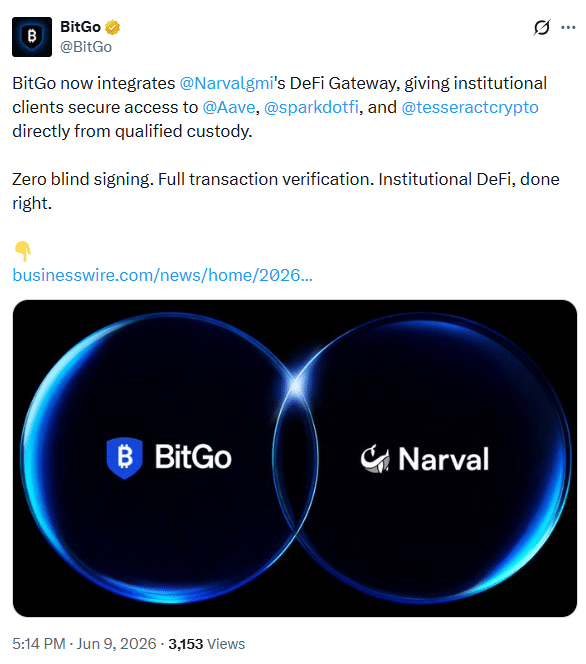
BitGo DeFi custody has expanded through a Narval integration that gives eligible institutional clients access to Aave, Spark and Tesseract. The service links approved DeFi protocols with wallets held inside BitGo Bank & Trust’s qualified custody environment.
The setup lets clients use on-chain markets without moving assets to external wallets. BitGo said more protocols will be added after launch.
Narval Adds Policy Checks to BitGo DeFi Custody
Narval’s gateway connects DeFi applications to BitGo’s custody and wallet systems. It uses delegated wallet connections and an embedded software kit to route approved transactions through signing steps.
Before BitGo receives a signing request, Narval converts the transaction into readable details. Its verification engine checks the protocol, contract address and planned action against client policies.
BitGo DeFi custody gives institutions a custody-first path into approved on-chain markets. It keeps assets inside BitGo’s custody framework while allowing interaction with selected DeFi applications.
The model focuses on transaction review, wallet governance and policy controls. It does not remove protocol, market or smart-contract risk.
Aave Adds Lending Access
Aave gives eligible clients access to lending markets. Institutions can supply assets or borrow against collateral while keeping their wallet structure inside BitGo’s approval system.
This setup helps clients use Aave without shifting control outside the custody framework.
Spark Supports Credit Markets
Spark adds access to stablecoin and Ether-based savings and credit markets. The protocol uses coordinated liquidity management and layered risk controls.
Through BitGo DeFi custody, eligible institutions can reach Spark while keeping internal transaction policies in place.
Tesseract Offers Managed Earnings
Tesseract provides managed onchain earnings through segregated client vaults built on Fusion by IPOR. Tesseract Investment Oy manages each mandate under its MiCA authorization, according to the announcement.
The protocol adds another earnings route for institutional clients.
Narval Reduces Blind Signing Risk
Narval checks transactions before they reach BitGo’s custody approval process. The system displays transaction details in readable form and compares them with approved apps and smart-contract addresses.
This step aims to reduce blind signing. Blind signing occurs when a user approves a transaction without clearly seeing its terms.
Policy Controls Guide Usage
BitGo DeFi custody also supports policy-based execution. Institutions can set rules for which protocols, wallets and actions employees may use.
Those controls help firms manage access before a transaction reaches a signer. They create a review layer between institutional wallets and supported DeFi applications.
Executives Point to Institutional Demand
BitGo chief executive Mike Belshe said institutions want access to DeFi. He said the integration combines transaction checks and whitelisting controls with BitGo’s OCC-regulated custody infrastructure.

Narval chief executive Greg Jessner said the company aims to make on-chain participation secure and seamless for institutions. His comments positioned the gateway as a tool for controlled DeFi activity.
Institutional DeFi Access Expands
The launch follows broader efforts to connect custody systems with on-chain markets. In May, MoonPay Trade introduced institutional access to Aave, Morpho and Maple across more than 200 networks.
Earlier reporting also covered OKX’s integration with BitGo’s off-exchange settlement service. That arrangement lets U.S. institutional clients trade on OKX while assets remain in cold custody.
Conclusion
BitGo DeFi custody brings Aave, Spark and Tesseract into a controlled access model for eligible institutions. The Narval integration adds transaction checks, policy rules and whitelisting before signing.
The service gives clients a way to use approved DeFi protocols while retaining custody controls. It also reinforces the custody-first model in institutional DeFi.
Appendix: Glossary of Key Terms
Qualified custody: A regulated custody setup used to hold institutional client assets under defined security and compliance standards.
Narval: A transaction gateway that connects DeFi applications with BitGo’s custody and wallet approval systems.
Aave: A DeFi lending protocol where users can supply assets or borrow against collateral.
Spark: A DeFi protocol focused on stablecoin and Ether-based savings and credit markets.
Tesseract: A platform that offers managed onchain earnings through segregated client vaults.
Blind signing: A risky approval process where users sign transactions without seeing clear transaction details.
Policy-based execution: A control system that lets institutions set rules for approved wallets, protocols and actions.
Frequently Asked Questions About BitGo DeFi custody
1- What is BitGo DeFi custody?
BitGo DeFi custody lets eligible institutions access approved DeFi protocols while assets remain in BitGo’s custody environment.
2- Which protocols are available at launch?
Aave, Spark and Tesseract are available at launch.
3- What does Narval do?
Narval reviews transaction details before requests reach BitGo’s signing process.
4- Does this remove DeFi risk?
No. It adds controls but does not remove protocol, market or smart-contract risk.
References