





Activity surrounding a recent Chainlink breakout spiked when a freshly minted wallet opened up about 252,000 LINK tokens 10× leveraged long position, worth approximately $2.27 million in trade.
This type of aggressive positioning is often a proof of conviction that a market move might already be in progress. This Chainlink breakout comes after many months of selling pressure and consolidation for the oracle network’s native token.
A $2.27M Leveraged Position Signals Strong Trader Conviction
A newly created wallet just opened a massive derivatives position, pushing focus towards the Chainlink breakout. The wallet opened a long, 10× leveraged position on 251,798 LINK worth about $2.27 million.
The liquidation level for the position is just under $6.55, meaning that this trader appears to be confident that the market will hold well above that price point. Positions of this scale don’t usually happen randomly in derivatives markets, and they’re frequently a result of calculated wagers on directional momentum instead of impulsive speculation.
Heavily leveraged trades often steal the show because they reveal how sophisticated agents are set before potential price moves. In this case, the trade reinforced growing market interest in the ongoing Chainlink breakout, especially as traders examined whether institutional-style positioning may be returning to the asset.
Derivatives data increasingly shows that experienced market participants are leaning toward bullish exposure, which has helped amplify discussion around LINK’s short-term structure.
Chainlink Breakout Emerges After Months of Downward Pressure
The Chainlink breakout technically holds weight, as LINK had traded within a descending channel for months before gaining any momentum upwards. The recent exit from that channel is an important change, with buyers regaining control of price direction.
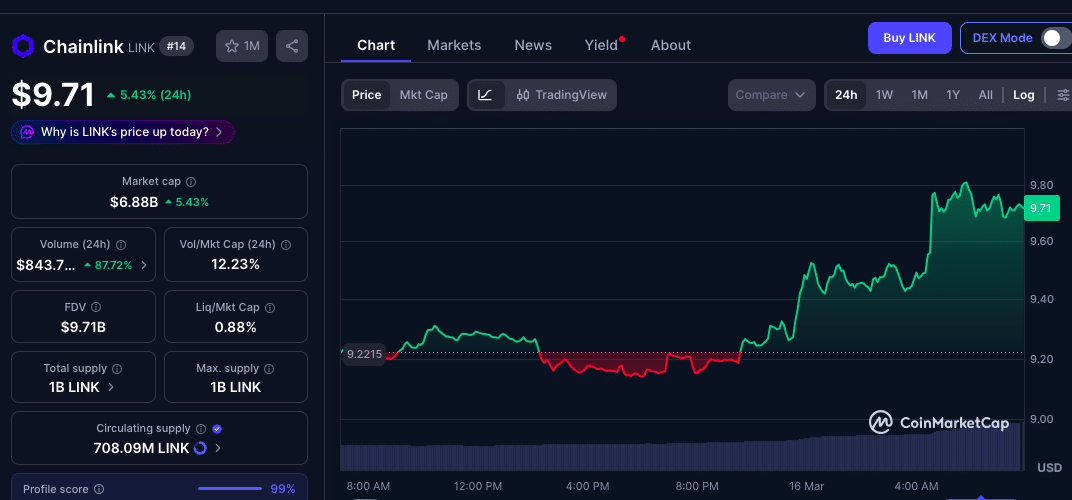
$LINK began to break the pattern, finding price stability around $9 with a few signs that the market might be trying to form a new recovery base.
The next level of interest sits near $9.60-$9.70 which currently serves as the first big resistance hurdle. Analysts say, if buyers continue to exert pressure above the breakout zone, higher resistance zones could come into play.
Recent market analysis also suggests there are signs of a technical upturn. The Directional Movement Index shows the positive directional indicator overtaking its negative counterpart, a sign that buyers are starting to dominate market direction.
At the same time, the Parabolic SAR indicator has flipped underneath price, a signal that often occurs when markets are leaving their downward trends behind them and transitioning into possible phases of recovery.
These signals are combining to strengthen the Chainlink breakout; although markets ultimately need buying pressure in order for this to be sustainable.
Binance Traders Tilt Strongly Toward Long Positions
Just recently, 71.2% of Binance top trader accounts were long in LINK, while 28.8 percent were short exposed according to derivatives data from CoinGlass. This long-to-short ratio of nearly 2.47 indicates that many experienced traders are betting that the price will stabilize around its current levels, or perhaps continue to recover.
When the pros are heavily biased toward long exposure, it is typically a sign of confidence in the market structure. Yet concentration of positioning can also lead to more volatility, especially if crowded trades start to unwind.
Still, the strong long bias among Binance traders shows how many look at the current breakout for Chainlink as a change after months of downward pressure.
Accumulation of Short Liquidations Power the Chainlink Breakout
Link also saw a number of short liquidations in the recent price action, strengthening the stance for Chainlink breakout.
Liquidation data reveals that shorts have endured roughly three times the number of forced exits than their long counterparts in recent sessions. Short liquidations totalled approximately $30,390 as opposed to just $9,480 worth of long liquidations.
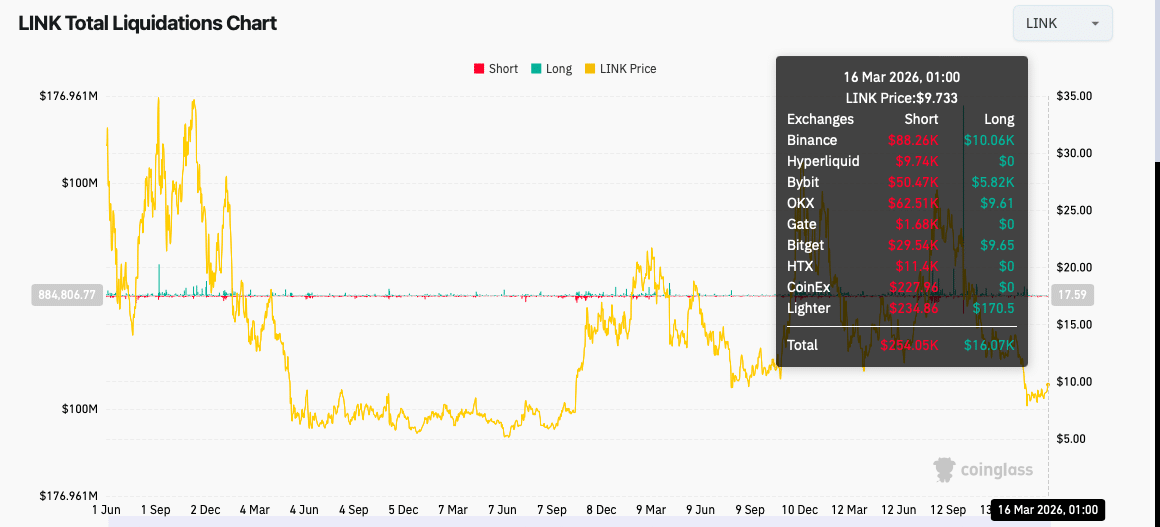
Short liquidations happen when traders who bet against the market are forced to close out their positions as prices climb. Since closing a short position is done through purchasing the asset, these liquidations often add extra demand to the market.
That orientation can spiral prices upwards in rapid succession, particularly when the sentiment is accompanied by growing longs and constructive technical formations.
Institutional Adoption Adds Context to LINK’s Market Recovery
In early March 2026, several infrastructure integrations highlighted the growing institutional use of Chainlink’s technology. One notable development involved the integration of Chainlink’s Cross-Chain Interoperability Protocol (CCIP) with the Layer-1 blockchain Monad, enabling secure transfers of Bitcoin-backed assets between networks.
In another initiative, Chainlink data standards were deployed across the Canton Network for regulated real-world asset infrastructure. This includes services such as Data Streams and Proof of Reserve feeds for institutional-grade financial applications.
Meanwhile, a cross-border settlement initiative featuring Visa, ANZ, ChinaAMC and Fidelity International utilized Chainlink infrastructure and later integrated it to facilitate financial transactions across blockchain networks.
These advancements help Chainlink’s growing position. The current Chainlink breakout is still very much a market matter, but growing institutional adoption of the ecosystem gives more push to LINK’s rising interest.
Conclusion
The recent has easily become one of the hottest topics surrounding Link market over March. A recent $2.27 million leveraged long position, rising long exposure of experienced market participants and incoming increasing also drawn attention to the evolving market structure of the asset.
The Chainlink breakout has quickly become one of the most discussed developments surrounding the LINK market in March. A recent $2.27 million leveraged long position, rising long exposure among experienced traders, and increasing short liquidations have raised investors’s hopes about Chainlink breakout in the evolving market structure.
But at the same time, this breakout comes after months of downward pressure that had LINK trading in a descending channel. With the recent break above that pattern; the dialogue has changed to whether or not buyers can maintain control and move to progressively test the higher resistance zones.
The market activity surrounding LINK is also informed by developments within the Chainlink ecosystem, including new integrations and partnerships with institutions.
For the time being, traders are closely monitoring whether the recovery structure holding on top of its new support levels can hold; moving forward.
Glossary
Chainlink: A decentralized oracle network that provides external data to blockchain smart contracts.
LINK: the native cryptocurrency used within the Chainlink network to pay for oracle services, .
Leverage: A means of trading where investors can control larger positions through borrowed funds.
Short Liquidation: An event where the market moves against traders betting that price will go down, forcing his or her short position to close.
Descending Channel: Chart pattern with lower highs and lower lows, usually a sign of a downward trend.
Frequently Asked Questions About Chainlink Breakout
What sparked the newest Chainlink surge?
A sizable leveraged trade of about $2.27 million, along with increasing long positions across traders, have drawn focus to LINK’s market structure once again.
Why watch $9.60-$9.70 for LINK?
The $9.60-$9.70 region serves as a notable resistance zone after the breakout from the descending channel.
What does the Long-to-short ratio tell about market sentiment?
According to data from Binance, more than 70 percent of leading investors have long positions at present suggesting optimism towards future bullish movements.
How do short liquidations affect the market?
When short traders are forced to close positions; they need to buy the asset back, which can create buying pressure and make prices rise more quickly.
References