





Chainlink DeFi dominance is becoming a clear and measurable trend in institutional positioning, as capital flows, on-chain security indicators, and ecosystem integration continue to highlight the difference between infrastructure-focused networks and narrative-driven assets. These factors show how investors are increasingly evaluating utility and reliability rather than short-term market themes.
Recent data points to a visible gap between where decentralized finance activity is rebuilding and where institutional capital is being allocated. This divergence places Chainlink at the center of a broader shift in how large investors are approaching the DeFi market.
What is driving the renewed focus on Chainlink’s role in DeFi?
The current market cycle has questioned the assumption that strong fundamentals alone are enough to attract institutional capital. Ethereum highlights this disconnect. Even after declining 11% in 2025, the network continued to show solid activity. The Fuska and Pecta upgrades lowered fees, reduced congestion, and pushed daily transactions to a record 2.3 million, indicating that these technical changes have carried their impact into the 2026 cycle.

However, institutional participation has not increased at the same pace. This difference between on-chain strength and capital allocation has created room for Chainlink DeFi dominance to develop, shaped more by infrastructure importance than by short-term price narratives.
Why do ETF flows highlight a structural divergence?
Institutional flows provide one of the clearest signals in the current market. Ethereum-linked ETFs recorded nearly $664 million in outflows within a single week. During the same period, Chainlink’s Grayscale ETF (GLNK) drew $4.05 million in inflows, while Ethereum’s Grayscale Spot ETF (ETHE) alone saw $52 million leave the product. $LINK is currently trading at $11.61, down 6.37% over the past week.
This sharp contrast among high-cap digital assets points to more than a short-term shift. The consistency of these flows supports the view that Chainlink DeFi dominance is being driven by longer-term allocation decisions rather than speculative positioning.
How does Chainlink compare with other major assets?
Further contrast becomes clear when comparing Chainlink with Dogecoin. Despite Dogecoin’s market capitalization being nearly three times larger, its ETF inflows continue to lag behind those linked to LINK. This imbalance suggests that capital is not simply following size or retail-driven popularity.
Instead, ETF inflows into Chainlink indicate growing confidence in its functional role within the ecosystem. In this context, Chainlink DeFi dominance reflects an institutional preference for assets connected directly to protocol-level demand and security.
What does DeFi’s broader recovery reveal?
Decentralized finance is gradually regaining scale. Data from DeFiLlama shows that total value locked across all Layer-1 networks has risen to $170 billion, returning to levels last seen before the 2022 bear market. Liquidity is reappearing across major areas such as stablecoins, real-world assets, and AI-related applications.
As on-chain activity grows, the need for reliable data infrastructure becomes more critical. This setting has strengthened Chainlink DeFi dominance, as a rising number of protocols rely on secure oracle services to operate smoothly.
Why is stablecoin integration strategically important?
Chainlink’s involvement in the Global Alliance for KRW Stablecoins places the network within the core infrastructure supporting South Korea’s expanding stablecoin framework. Stablecoins serve as the settlement layer of DeFi, making their underlying infrastructure critical to ecosystem growth.
Integration at this level strengthens Chainlink’s position in compliance, privacy, and interoperability. Rather than competing at the application layer, the network is embedding itself into the rails that support DeFi growth, reinforcing Chainlink DeFi dominance through long-term structural relevance.
What does the $70 billion TVS milestone indicate?
Chainlink’s total value secured reached a record $70 billion in the fourth quarter of 2025. TVS reflects the total assets protected and supported by Chainlink’s oracle network, providing a clearer view of real-world usage rather than market sentiment.
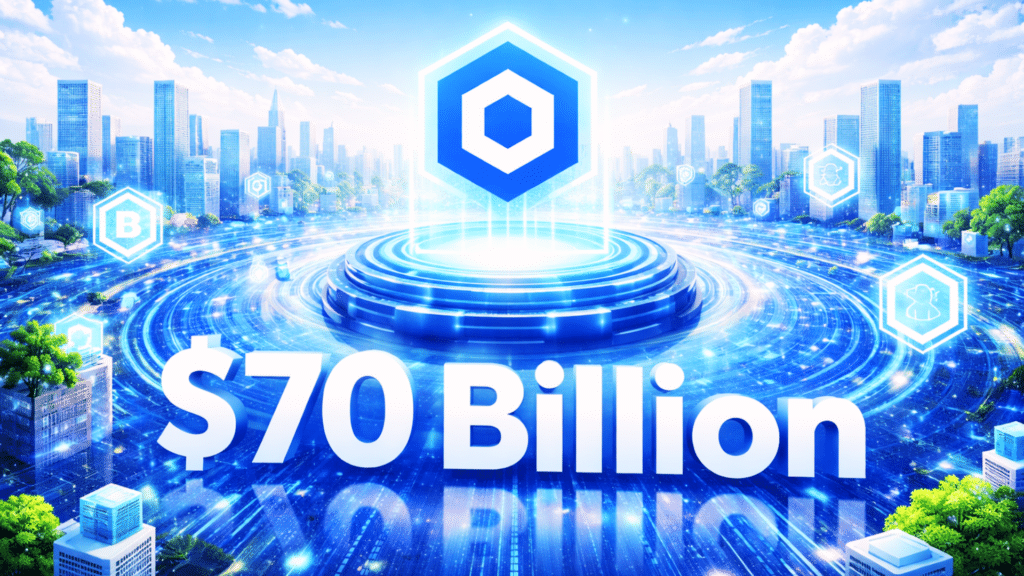
This milestone points to growing adoption and trust across decentralized finance. As more value depends on Chainlink’s infrastructure, Chainlink DeFi dominance shifts from visibility to necessity within decentralized markets.
Conclusion
Chainlink DeFi dominance continues to stand out even as major assets such as Ethereum and Dogecoin face sustained ETF outflows. The network has reached $70 billion in total value secured, highlighting its growing adoption and trust.
Expanding stablecoin integration and a recovering DeFi environment further reinforce its importance. Overall, Chainlink DeFi dominance reflects a broader shift toward infrastructure-first models, where utility and security are defining leadership in decentralized finance.
Glossary
TVS: Value of assets protected by Chainlink.
Oracle Network: Securely sends real-world data to blockchain apps.
Fuska & Pecta Upgrades: Ethereum updates that lower fees and boost speed.
DeFi: Financial services on blockchain without banks.
ETF Inflows: Funds coming into a crypto ETF, showing demand.
Frequently Asked Questions About Chainlink DeFi Dominance
Why is Chainlink gaining momentum in DeFi?
Chainlink is gaining momentum because its network is secure, integrated with major stablecoins, and has strong institutional support.
What does $70 billion TVS mean for Chainlink?
$70 billion TVS means Chainlink powers $70 billion worth of assets through its oracle services, showing strong adoption and trust.
How do ETF inflows affect Chainlink?
ETF inflows show that institutions are investing in Chainlink, which supports its long-term growth and DeFi dominance.
How does Chainlink compare to Ethereum and Dogecoin?
Chainlink is attracting more institutional capital than Ethereum and Dogecoin, even if they have higher market caps, because of its infrastructure focus.
How does DeFi’s recovery impact Chainlink?
As DeFi grows and total value locked increases, Chainlink becomes more important because protocols rely on its secure oracle services.
Sources