





ISIS-K-linked USDT balances were frozen on 131 TRON addresses after an OFAC sanctions update. The move turned stablecoin sanctions into a live enforcement test.
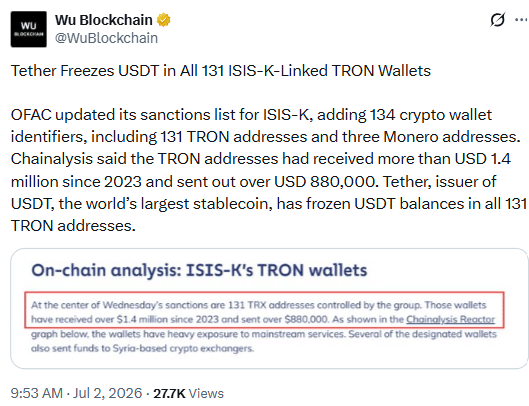
The July 1 update added digital currency identifiers to the ISIL Khorasan designation. Chainalysis said OFAC listed 134 crypto addresses, including 131 TRON addresses and three Monero addresses.
Tether then froze balances on all 131 TRON addresses. The action showed how public-chain intelligence, sanctions lists, and issuer controls can work together.
ISIS-K Wallet Flows Put Stablecoin Sanctions in Focus
Chainalysis said the 131 TRON wallets tied to ISIS-K received more than $1.4 million since 2023. The wallets also sent more than $880,000.
The stablecoin sanctions action also showed that wallets on a public chain can become part of a broader compliance map. Governments can name targets. Analytics firms can map exposure. Issuers can stop balances when the token system allows it.
The case highlights a major shift in crypto enforcement. Sanctions do not stop at exchanges or custodians when the asset is a freezeable stablecoin.
For exchanges, payment firms, and compliance vendors, the listed addresses must be screened. For stablecoin issuers, the action can go further. They can freeze token balances at the issuer-control layer.
Tether had already moved toward this model. In December 2023, it said it had introduced a voluntary wallet-freezing policy for activity tied to persons on OFAC’s SDN List.
Stablecoin Sanctions Add Issuer Control
OFAC has used digital currency addresses in sanctions designations for years. Stablecoins add a different control point.
OFAC guidance says blocked digital currency should be blocked and reported when identified. That applies to covered parties that handle or detect sanctioned assets.
For stablecoin sanctions, the issuer can sit closer to the asset itself. If a listed wallet holds a freezable token, the issuer may interrupt the balance without waiting for an exchange deposit or withdrawal.
TRON-Based USDT Sits at the Center
The TRON address count gives the case its shape. Chainalysis said the OFAC update included 131 TRON addresses and three Monero addresses.
Tether’s freeze applied to the TRON-based USDT balances. That is because those tokens sit inside a system the issuer can control.
The detail matters for exchanges and payment firms. TRON-based USDT is widely used for fast and low-cost dollar transfers. When sanctioned TRON addresses are listed, firms must review direct and indirect exposure.
Compliance Burden Moves Beyond Listed Wallets
The listed wallet is only the starting point. The larger task is tracing the route around it.
Chainalysis said several designated wallets sent funds to Syria-based crypto exchangers. It also said they had heavy exposure to mainstream services.
That is where stablecoin sanctions become infrastructure, not just paperwork. Firms must identify counterparties, service exposure, linked wallets, and customer risk.
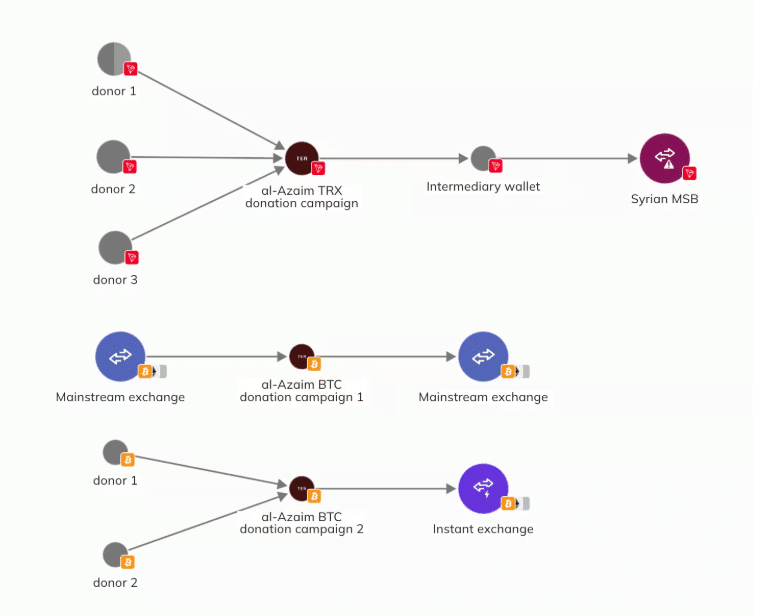
This turns sanctions screening into a real-time routing problem. The goal is not only to block one address. It is also to understand how funds moved before and after designation.
Monero Shows the Limit
The same OFAC update also included three Monero addresses. That contrast shows the limit of issuer-driven enforcement.
Monero is controlled through private keys. It does not have a centralized issuer that can disable token balances. OFAC can still list Monero addresses. Exchanges and covered firms can screen for exposure where they have visibility.
Investigators can also pursue devices, service providers, counterparties, and user mistakes. But there is no issuer switch like the one used for USDT.
Tether Actions Show a Repeat Pattern
Tether’s recent enforcement history shows a wider trend. In April, the company said it supported freezing more than $344 million in USDT with OFAC and U.S. law enforcement.
In May, it said the T3 Financial Crime Unit had frozen more than $450 million tied to illicit crypto flows. That unit involves Tether, TRON, and TRM Labs.
These actions are separate from the ISIS-K update. Still, they show a repeatable model. Analytics identify risk. Enforcement channels flag wallets. The issuer freeze becomes part of the response.
Route Becomes the Next Fight
The ISIS-K case points to the next phase of crypto enforcement. The focus is shifting from one wallet to the full route around it.
A listed address can be frozen if it holds issuer-controlled stablecoins. It can also be screened by exchanges and custodians. They can use new addresses, unlisted intermediaries, offshore exchangers, privacy tools, or assets without issuer controls.
That means stablecoin sanctions are powerful but not complete. They work best when illicit finance uses tokenized dollars on transparent chains.
Conclusion
The ISIS-K update shows how stablecoin sanctions can move from a public designation to an active freeze. It also shows why issuers are becoming part of the enforcement stack.
The stack now includes sanctions lists, blockchain intelligence, issuer controls, exchange compliance, and vendor tools. Each part covers a different point in the flow of funds.
Appendix Glossary of Key Terms
USDT Freeze: A restriction placed by Tether that stops selected token balances from moving within its system.
OFAC Crypto Addresses: Digital wallet identifiers added to a sanctions list for compliance screening and enforcement.
TRON-Based USDT: USDT issued on the TRON network, often used for fast and low-cost dollar transfers.
Issuer Controls: Tools that allow a stablecoin issuer to block, freeze, or reject certain token activity.
On-Chain Intelligence: Blockchain analysis used to trace wallet activity, fund flows, and related addresses.
Sanctioned Wallet: A crypto address linked to a listed person, group, or entity under sanctions rules.
Frequently Asked Questions About Stablecoin Sanctions
1. What happened in the ISIS-K USDT case?
OFAC updated the ISIL Khorasan designation with crypto addresses. Tether froze balances on 131 TRON addresses tied to ISIS-K.
2. What do stablecoin sanctions mean?
Stablecoin sanctions refer to enforcement actions where sanctioned wallet exposure can be screened, blocked, or frozen when the token system allows issuer control.
3. How much did the ISIS-K wallets receive?
Chainalysis said the 131 TRON wallets received more than $1.4 million since 2023 and sent more than $880,000.
4. Why were Monero addresses different?
Monero does not have a centralized issuer that can freeze balances. Enforcement depends on screening, investigation, and visibility at service points.
References