







This article was first published on The Bit Journal.
The CLARITY Act delay in the U.S. is changing the conversation around federal crypto regulations and reaction from industry leaders, lawmakers and banks has been vocal.
The Stalled Digital Asset Market Clarity Act, which intended to redefine current authority and set rules for stablecoin guidance, asset classification, as well as decentralized finance (DeFi) standards, was met with heavy resistance and industry pushback, notably from industry titan Coinbase, which pulled its support this month.
The CLARITY Act delay reveals deep divisions over how to strike that balance, especially when it comes to yield-bearing stablecoins, tokenized equities and regulation of the decentralized finance platforms.
It has led some analysts to argue that the pause may ultimately benefit crypto by leaving negotiation open and not allowing overly restrictive rules to be put into place.
Coinbase Rejection Triggers Legislative Slowdown
The most tangible recent change happened when Coinbase CEO Brian Armstrong made a public statement that the exchange couldn’t continue to support the CLARITY Act as it was.
Armstrong described several provisions in the bill that he and others in the crypto industry take issue with, including restrictions on stablecoin yield or interest, a possible ban on tokenized securities and broad rules affecting decentralized finance platforms.
In an X post announcing the decision, Armstrong wrote that certain provisions “would leave the industry worse off than the current regulatory environment,” a point many analysts shared.
Within hours of the Coinbase withdrawal, the Senate Banking Committee postponed its planned markup session where lawmakers discuss, amend and vote on legislation.
The postponement was portrayed by Senate Chairman Tim Scott as a “brief pause” to facilitate additional lawmaking talks involving congressional, industry, community bank and regulatory advisers.

Yield-Bearing Stablecoins at the Center of the Battle
At the heart of the dispute that delayed the CLARITY Act is how regulators should treat stablecoins, particularly when platforms provide rewards or yield for holding funds.
The Senate’s draft bans the payment of interest “solely for holding” stablecoins, a provision that would touch popular programs in which users earn passive interest income on assets such as USDC.
Banking industry lobbyists say these yield offerings resemble unregulated deposit products that could pull money out of traditional banks, which would reduce lending capacity and community deposits.
Estimates from financial industry sources claim that use of stablecoins could drain $6.6 trillion from traditional banking systems over the next few years, if those incentives are not constrained.
Crypto proponents argue the rewards are a bona fide innovation that spurs liquidity and participation in digital markets. They argue that stablecoin incentives tend to be for activity-based participation, not just simple “interest,” and say sweeping bans would snuff out competition instead of safeguarding consumers.
DeFi and Tokenized Assets Spark Industry Concern
Outside of stablecoins, some also criticized the language in the CLARITY Act for the potential impact on decentralized finance (DeFi) and tokenized securities markets.
Industry lawyers and DeFi advocates cautioned that the framework could impose overly broad obligations for builders and infrastructure providers that were ill-fitting for permissionless protocols.
Some elements in the draft legislation also seemed to restrict issuance and trading of tokenized equities and other real-world assets; which worried market participants that blockchain innovation in the asset markets could be slowed or even thwarted altogether.
This aspect of the discussion begs a deeper question: do the regulators want to pursue a regulated environment that maximizes clarity and compliance, or one that allows for more experimentation and decentralized innovation?
The ongoing CLARITY Act delay provides an opportunity for lawmakers to reconcile these conflicting priorities.
White House in Talks With Industry
Amid sensational headlines depicting a clash between Coinbase and the White House, the exchange’s CEO took to public channels to push back on the notion that there was any real discord in discussions, stating that their conversations had been “super constructive,” and ongoing.
Armstrong emphasized that the point is to ensure a draft of the bill emerges that works for both the crypto community and traditional stakeholders, such as local banks.
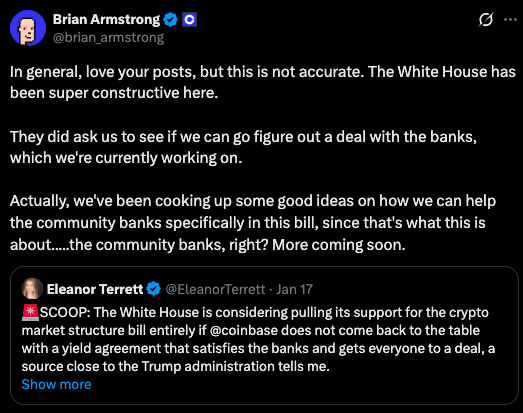
The White House has said it is still working with the lawmakers on the law. Some critiqued the delay in enacting the CLARITY Act as a political loss but senior advisors claim that a constant dialogue is necessary to create framework that protects innovators while preventing systemic risks.
The responses from industry stakeholders have been mixed: while Coinbase has already publicly voiced its opposition to the bill, other interests including Ripple and some venture capital firms are in favor of industry-wide regulation, saying that a balanced bill could help assure U.S. leadership in crypto markets.
Analyst View: Delay May Be a Net Positive
Market analysts have responded on what the CLARITY Act delay could mean for the crypto industry. One commonly cited perspective comes from market analyst Michaël van de Poppe, who said that the stagnation may in fact do markets some good by preventing an overly stringent set of regulations from being “locked in” pre-emptively.
Van de Poppe said; “I think if the bill were approved in its current form, it would have had a very bad impact on the markets in general. So, now, all the parties are aligned to continue the discussion. It reminds me a lot of the Markets in Crypto Assets (MiCA) regulations in Europe.”
He drew a comparison to the European Union’s Markets in Crypto-Assets (MiCA) regulation which took several rounds of negotiation before being passed to desultory effect but with more balance and inclusiveness.
Supporters of the delay say that additional time to negotiate would provide industry leaders, regulators, and lawmakers an opportunity to further define terms, harmonize oversight between the CFTC and the SEC, and ensure certain rules support, not hinder, on-chain innovation.
Conclusion
What started as a bipartisan effort to clarify and bring structure on digital asset regulation has become a complex negotiation between regulators, lawmakers, industry titans and the traditional financial sector.
Core sticking points, including restrictions on stablecoin yield, DeFi oversight, and tokenized assets, have resulted in disagreements about how to balance innovation with consumer protection and financial stability.
That pause in the legislative process, triggered largely by Coinbase’s withdrawal of support over what it described as overly aggressive provisions, has led the discussion away from vote-ahead to more of a negotiation.
Some analysts argue that this CLARITY Act delay could aid in eventually crafting a more refined and thoughtful regulatory regime that allows room for innovation but also oversight.
Glossary
CLARITY ACT: U.S. federal bill to create a comprehensive crypto market structure and regulatory framework.
Stablecoins: digital coins that are tied to a stable reference, such as the U.S. dollar.
Yield-bearing stablecoins: Stablecoins that generate returns for holders of idle balances, using rewards or similar structures.
DeFi (Decentralized Finance): Blockchain financial services that work without a centralized bank intermediary.
Tokenized equities: digital representations of traditional securities issued on a blockchain.
FAQs About CLARITY Act Delay
What is the CLARITY Act delay?
It is a postponement of Senate markup of the Digital Asset Market Clarity Act, which faced industry opposition, including from exchange Coinbase, calling out its key provisions.
Why did Coinbase withdraw support?
Coinbase CEO Brian Armstrong said the current form of the bill might put stablecoin yields, decentralized-finance access and tokenized equities at risk and make things worse than they are now.
How do stablecoin rewards factor into the debate?
The bill includes provisions limiting the return on interest that platforms like Coinbase can get from stablecoin holdings, a sizable source of revenue for these entities, and banking lobbyists maintain they compete with old-fashioned deposits.
Is the CLARITY Act dead?
No. The postponement halts progress but lawmakers and industry leaders are still in talks to refine the bill.
Could the delay prove to be an opportunity for the crypto industry?
Market analysts say the pause could avert overzealous rule-making and foster more balanced regulation similar to the extended negotiations faced by Europe’s MiCA.
References
Cointelegraph
Reuters
CryptoSlate