







This article was first published on The Bit Journal.
Decisions over how stablecoins shall be regulated have intensified even further this month as the U.S. Senate prepares to vote on crypto market structure legislation.
This controversy centers on whether stablecoin issuers and third-party platforms should be legally permitted to share yield with users.
A prominent academic voice has entered the discussion to challenge the objections of the banking sector. Omid Malekan, an adjunct professor at Columbia Business School and author on crypto topics, says that many of the banking industry’s fears about stablecoin yields are in fact unnecessary and building on “unsubstantiated myths.”
Banking Sector Claims about Stablecoin Yields
Stablecoin yield has been of great concern to the traditional banks, portraying it as a competitive threat to the traditional banking deposit model.
Banks are worried that if stablecoin owners can get risk-free returns, especially from Treasury-backed mechanisms, it could drain funds out of low-interest bank accounts, thus eroding deposit bases that play important roles for lending and community banking.
Banking lobbyists, along with groups like the American Bankers Association, have also warned publicly that widespread stablecoin yields could disrupt existing financial structures.
The groups are pushing for regulations hat would prohibit passive stablecoin yields under the proposed CLARITY Act or some other digital asset legislation.
Critics of such claims, including tech commentators and academics, argue that the banking industry’s professed worries are more about defending profit centers than squaring formidable new risks.
The already weakened business model for banks is further threatened by the fact that unlike low or zero-yield deposit accounts which is a main source of the banking sector’s revenue, stablecoins backed by high-quality assets such as U.S. Treasuries can produce yields between around 3% and 5%.
Professor Malekan’s Rebuttal of Stablecoin Yield Fears
Omid Malekan has come out to debunk what he calls “unsubstantiated myths” floating around the U.S. capital on stablecoin returns. In a post he made on X, Malekan took aim at how banking worries have framed discussions around stablecoin yield provisions in market structure bills, saying they are not grounded in empirical fact.
He made a point of saying,
“I am disappointed that market structure legislation seems to be held up by the stablecoin yield issue. Most of the concerns bouncing around Washington are based on unsubstantiated myths.”
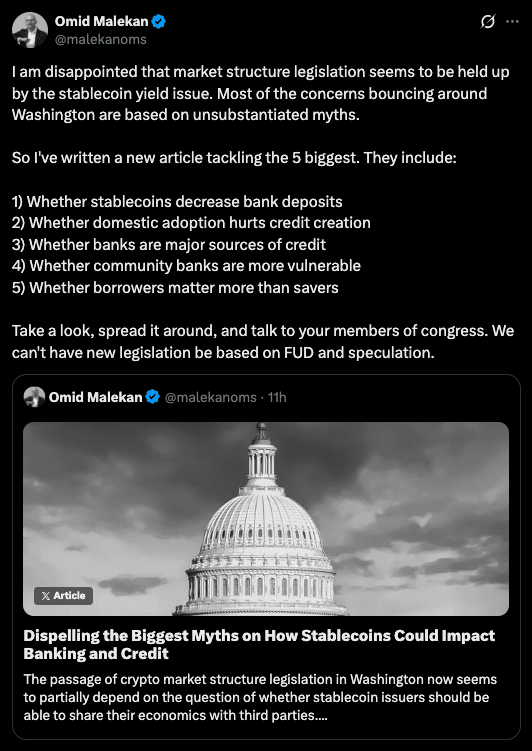
Malekan’s critique lies partly in the assumption that stablecoin growth necessarily drains bank deposits or harms lending. He said that a lot of demand for stablecoins comes from global customers who don’t live in the U.S. and that issuers have to back them with reserves in bank deposits and Treasury bills, which can serve to increase not reduce bank activity.
In his view, the stablecoin ecosystem complements rather than destroys existing financial structures, as overall banking and reserve demand grows.
Debunking the Banking Arguments
Prof. Malekan presented opposing arguments to some of the most frequently heard bank defenses:
For one, he said that the adoption of stablecoins does not necessarily decrease bank deposits. Instead, he noted, the reserves backing stablecoins tend to be bank-based assets like Treasuries and deposits that loop back into the banking system.
In other words, stablecoin-issuers add to overall financial activity by expanding money supplies rather than contracting them.
Second, Malekan added that fears about stablecoin competition hurting lending are unfounded. Banks account for only about 20% of U.S. credit, and the majority is coming from non-bank sources like money market funds and private credit, he said.
For this reason, stablecoin competition would have relatively little direct effect on credit markets but could influence bank profitability.
Malekan pushed back at the assertion that community and regional banks are particularly at risk from adoption of stablecoin. He argued that “It’s the large ‘money center’ banks that are more vulnerable,” and that most of the banking chatter on this point is a confusion of banks’ interest in making profits.
By putting the debate in this light, he was prodding policymakers to realize that depositors deserve consideration and a chance for some yield along with borrowers.
Industry Reaction
Entities like Coinbase have resisted proposals that would ban or severely curb stablecoin rewards, threatening to withdraw support for the CLARITY Act if it curbs stablecoin yield. Coinbase’s Chief Policy Officer has publicly characterized stablecoin yield restrictions as stifling consumer choice and innovation.
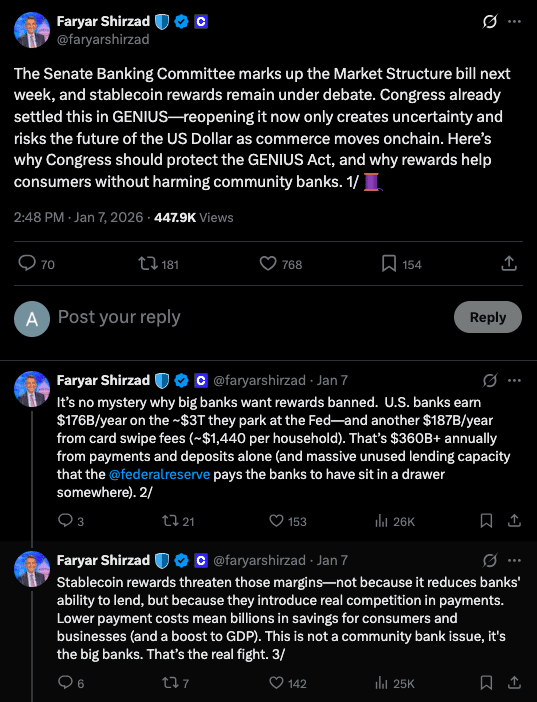
Platforms contend that limiting yield could erode U.S. competitiveness in global digital finance, as other jurisdictions increasingly adopt yield-friendly stablecoin models.
Lawyer and Senate candidate John Deaton also added that senators are being pressured by the banking lobby to not allow third-party platforms like Coinbase to pay yield on stablecoins.
This intersection of banking influence, regulatory design, and crypto innovation has made stablecoin yield a focal point of legislative contention. Observers note that reaching consensus on yield provisions will determine how the US stablecoin market develops, and its level of integration with traditional financial systems.
Conclusion
The discussion around stablecoin yield myths has exposed extreme differences between traditional banking interests and pro-crypto innovators.
Columbia Business School lecturer Omid Malekan has already pushed back against bank warnings on stablecoin yields, claiming that many concerns are not backed by empirical evidence and instead come from a place of defensiveness rather than systemic risk.
His rebuttals, supported by on-chain demand and banking reserve supply dynamics, argue that stablecoin adoption will not destroy bank deposits or impede lending as the argument goes.
Now, lawmakers have to navigate those rival narratives as they craft legislation that could determine how the digital currency operates in the American financial system.
Glossary
Stablecoin yield myths: Arguments made by some banking groups that stablecoin holders earning yield threatens traditional bank deposits.
Stablecoin: A cryptocurrency that is intended to maintain a steady price, often tied to a fiat currency such as the U.S. dollar.
CLARITY Act: Proposed U.S. legislation regarding the U.S. crypto market structure; its objective is to clarify regulatory oversight as it relates to digital assets, including stablecoins.
Yield-bearing stablecoins: Stablecoins or structures that distribute returns (directly or indirectly) to holders, generating financial yield compared to traditional zero-interest deposits.
FAQs About Stablecoin Yield Myths
What’s the big debate over stablecoin yields?
The question is whether stablecoin holders should earn a yield on their stablecoin balances and whether it would draw deposits away from traditional banks, which critics dismiss as “unsubstantiated myths.”
Who objects to the position being taken by the banking industry?
Omid Malekan, a part-time lecturer at Columbia Business School, has gone to great lengths to fight banks, suggesting their worries are based on myths and that consumers’ needs come first.
Does the rise of stablecoins lead to less bank deposits?
Demand for stablecoins may fuel banking activity because issuers keep their reserves in bank deposits and Treasuries, Malekan said.
What is at stake with regulation and innovation in stablecoins?
Limits on yield features could limit competing products and even push innovation to less restrictive jurisdictions, industry advocates said.
References