






Crypto investing can reward patience, research, and timing, but it punishes loose habits faster than most markets. Prices move around the clock, social media can turn fear into panic within minutes, and a single leveraged trade can wipe out months of gains. That is why crypto risk management is not a side topic. It is the foundation of survival. For investors building a portfolio, the goal is not to win every trade. The real goal is to stay in the market long enough for good decisions to matter.
Crypto Risk Management Starts With Survival, Not Prediction
Many traders enter crypto believing the hardest part is finding the next coin before it runs. In reality, the harder part is staying calm when the chart moves against them. Crypto risk management begins with one simple truth: no investor can control price, but every investor can control exposure.
A portfolio should be built around risk first and profit second. That sounds boring, yet it is how serious traders avoid blowing up. They decide how much can be lost before entering a position. They know where the trade is invalid. They avoid betting the whole account on one headline, one influencer, or one candle. In crypto, the market does not need to be fair. It only needs one mistake.
Why Most Crypto Traders Lose Money and How to Be in the Smaller Group
The common claim that 90% of traders lose money is not a fixed scientific number, but the pattern behind it is real. Most losing traders chase green candles, buy after a sharp rally, sell after a scary drop, and treat volatility as a shortcut instead of a warning sign. They confuse activity with skill.
The better group does the opposite. It waits for clear setups, uses crypto risk management before placing orders, and avoids emotional revenge trades after a loss. There is no magic there. It is discipline dressed in plain clothes. Traders who last tend to think in probabilities, not certainties. A good setup can still fail. A bad setup can still win. The difference is whether the risk was planned.
Position Sizing: The 1–2% Rule for Crypto
Position sizing decides how much capital is placed at risk on a trade. The 1–2% rule means a trader risks only 1% to 2% of the total portfolio on a single idea. This does not mean buying only 1% or 2% worth of crypto. It means the possible loss, from entry to stop-loss, should equal 1% to 2% of the account.
For example, if an account is worth $10,000 and the trader risks 1%, the maximum planned loss is $100. If the stop-loss is 10% below entry, the position size should be around $1,000 because a 10% loss on $1,000 equals $100. This is where crypto risk management becomes practical, not theoretical.
This rule protects investors from the trade that looks perfect but fails anyway. In fast markets, survival often comes from smaller position sizes, not better predictions.
Stop-Loss Orders: When to Set Them and Where to Place Them
A stop-loss is an exit order designed to limit damage when a trade moves against the plan. It should be set before the trade is opened, not after the market starts falling. Once fear takes over, logic becomes negotiable, and that is where losses grow.
A stop-loss should not be placed randomly. Traders often place it below a support level, below a recent swing low, or at the point where the original trade idea no longer makes sense. Placing stops too tight can lead to repeated exits during normal volatility. Placing them too wide can make the loss too large. The balance depends on the asset, timeframe, liquidity, and position size.
A coin that moves 8% in an ordinary afternoon needs more room than a large-cap asset moving inside a calmer range. Still, room is not the same as recklessness. A stop-loss should serve the plan, not protect pride.
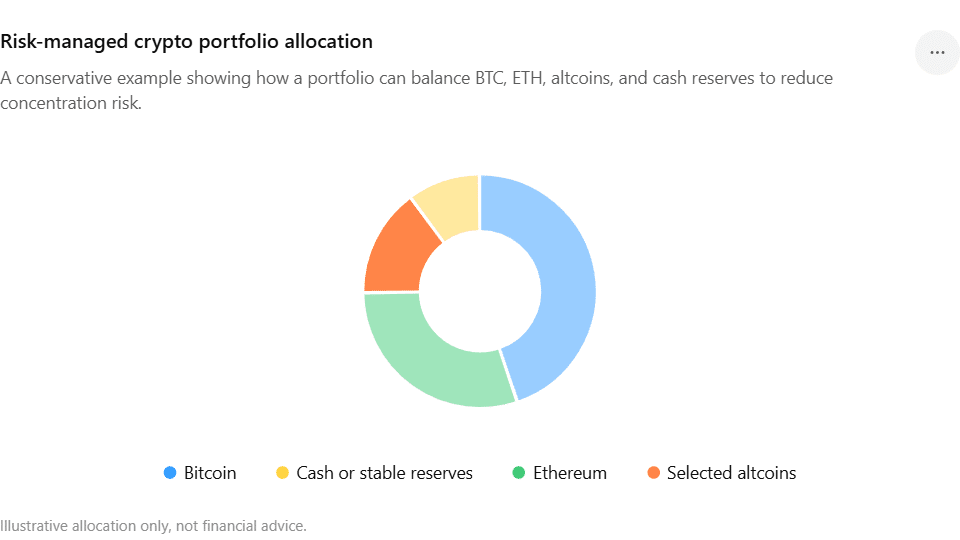
Portfolio Diversification in Crypto: How Much BTC, ETH, and Alts?
Diversification means spreading exposure so one failed asset does not sink the whole account. In crypto, this often starts with Bitcoin and Ethereum because they tend to have deeper liquidity, stronger market recognition, and longer track records than smaller tokens. That does not make them safe in the traditional sense, but they are usually less fragile than thinly traded altcoins.
A cautious portfolio may hold a larger share in BTC and ETH, with a smaller allocation to altcoins. A more aggressive portfolio may increase altcoin exposure, but that also raises drawdown risk. For many investors, a balanced starting point could be 40% to 50% BTC, 25% to 35% ETH, and the rest divided among carefully researched altcoins, stable assets, or cash reserves.

Good crypto risk management does not mean avoiding altcoins completely. It means knowing that smaller tokens can rise quickly and fall even faster. Narratives fade. Liquidity disappears. Token unlocks can pressure price. A diversified portfolio should include assets with different use cases, not 10 tokens that all move the same way when Bitcoin dips.
Understanding Leverage: Why 10x Kills Most Traders
Leverage allows traders to control a larger position with less capital. At 10x leverage, a 10% move against the position can erase the margin before fees, funding, or slippage are considered. That is the trap. Leverage makes normal volatility feel like a cliff edge.
A trader using 10x does not need to be completely wrong to lose everything in that trade. The market only needs a routine shakeout. Crypto often moves 5% to 15% in short windows, especially around economic data, exchange news, liquidation cascades, or sudden Bitcoin moves. With leverage, those swings become account-level events.
Crypto risk management treats leverage as a tool for experts, not a shortcut for small accounts. Lower leverage, smaller positions, and strict stop-losses are not cowardly. They are the cost of staying alive in a market that never closes.
Risk/Reward Ratio: Only Enter Trades With 1:2 or Better
Risk/reward compares the amount a trader is willing to lose with the amount they expect to gain. A 1:2 ratio means risking $100 to target $200. This matters because no trader wins every time.
If a strategy wins only 50% of the time but keeps losses smaller than gains, it can still be profitable. If it wins often but takes one huge loss, it can still fail. That is why trades with poor upside and large downside are rarely worth taking, no matter how tempting the chart looks.
Before entering a trade, the investor should know the entry, stop-loss, target, and reason for the trade. If the target is too close or the stop needs to be too wide, the trade may not deserve capital. Sometimes the smartest trade is the one left alone.
Exchange Risk: What Happens When a Platform Collapses
Exchange risk is the danger that a trading platform fails, freezes withdrawals, mismanages assets, suffers a hack, or becomes insolvent. The collapse of a major exchange in 2022 proved that even widely known platforms can fail when custody, leverage, internal controls, and customer asset protection break down.
The lesson is direct: coins left on an exchange carry platform risk. Investors may use exchanges for trading, but long-term holdings are often better kept in self-custody, provided the investor understands wallet security. Hardware wallets, strong passwords, two-factor authentication, withdrawal allowlists, and separate trading and storage accounts all reduce risk.
Crypto risk management also means not keeping all assets on one platform. A trader can be right about the market and still lose money if the venue fails.
Building a Risk-Managed Crypto Portfolio from Scratch
A new investor should begin with capital that is not needed for rent, bills, debt, or emergency savings. Crypto should never be treated as a rescue plan for weak personal finances. After that, the investor can set clear allocation limits.
A starter portfolio may include a core allocation to BTC and ETH, a smaller section for selected altcoins, and a cash or stable-value reserve for opportunities and protection. Each asset should have a reason for being included. “It might pump” is not a reason. A better reason includes liquidity, use case, network activity, token supply, developer strength, regulatory risk, and market structure.
Crypto risk management should also include a written plan. The plan should define maximum portfolio drawdown, maximum risk per trade, rebalancing rules, profit-taking zones, and rules for moving assets off exchanges. Written rules reduce the chance of panic decisions. Markets are loud. A plan keeps the volume down.
Key Crypto Indicators Investors Should Understand
Market capitalization shows the total value of a crypto asset and helps compare size. Trading volume shows how much is being bought and sold, which can confirm or weaken a price move. Liquidity shows how easily an asset can be entered or exited without heavy slippage. Open interest tracks the value of active derivatives contracts and can signal crowded leveraged positions.
Funding rates show whether long or short traders are paying to keep positions open in perpetual futures. High positive funding may suggest overconfidence on the long side. High negative funding may show heavy bearish positioning. Relative Strength Index, often called RSI, helps identify momentum, but it should not be used alone. Support and resistance show price zones where buyers or sellers have reacted before.
These indicators are not crystal balls. They are dashboard lights. They help investors see conditions more clearly, but they do not remove risk.
Conclusion
Crypto rewards conviction, but it respects risk control more. The investors who last are not always the loudest, fastest, or most aggressive. They are usually the ones who protect capital when the market becomes irrational. They size positions carefully, use stop-losses, avoid reckless leverage, diversify with purpose, and treat exchanges as tools rather than banks.
The main lesson is simple enough to remember: never risk so much that one mistake can end the game. Crypto risk management is not about fear. It is about staying ready for the next real opportunity.
Frequently Asked Questions
What is the safest way to manage crypto risk?
The safest approach is to limit position size, avoid high leverage, diversify holdings, use secure storage, and keep cash reserves. No method removes all risk.
How much should an investor risk per crypto trade?
Many disciplined traders risk 1% to 2% of total portfolio value per trade. Smaller accounts or highly volatile assets may require even lower risk.
Is Bitcoin safer than altcoins?
Bitcoin usually has deeper liquidity and a longer market record than most altcoins, but it is still volatile and can suffer large drawdowns.
Should every crypto trade use a stop-loss?
For active trading, a stop-loss is often essential. Long-term investors may use different exit rules, but they still need a defined risk plan.
Can crypto risk management prevent all losses?
No. It cannot prevent losses, but it can stop one bad decision from destroying an entire portfolio.
Glossary of Key Terms
Position Size: The amount of capital allocated to a trade based on planned risk.
Stop-Loss: An order or exit level used to limit losses when price moves against a position.
Leverage: Borrowed exposure that increases both potential gains and potential losses.
Risk/Reward Ratio: A comparison between possible loss and expected gain on a trade.
Liquidity: The ease of buying or selling an asset without causing a large price move.
Open Interest: The total value of active derivatives contracts in the market.
Funding Rate: A periodic payment between long and short traders in perpetual futures.
Self-Custody: Holding crypto in a private wallet where the user controls the private keys.
Drawdown: The decline from a portfolio’s high point to a lower value.
Sources
Disclaimer
This article is for educational and informational purposes only. It is not financial, investment, legal, or tax advice. Crypto assets are highly volatile and may result in partial or total loss of capital. Investors should conduct independent research and consult a qualified professional before making financial decisions.