

This article was first published on The Bit Journal.
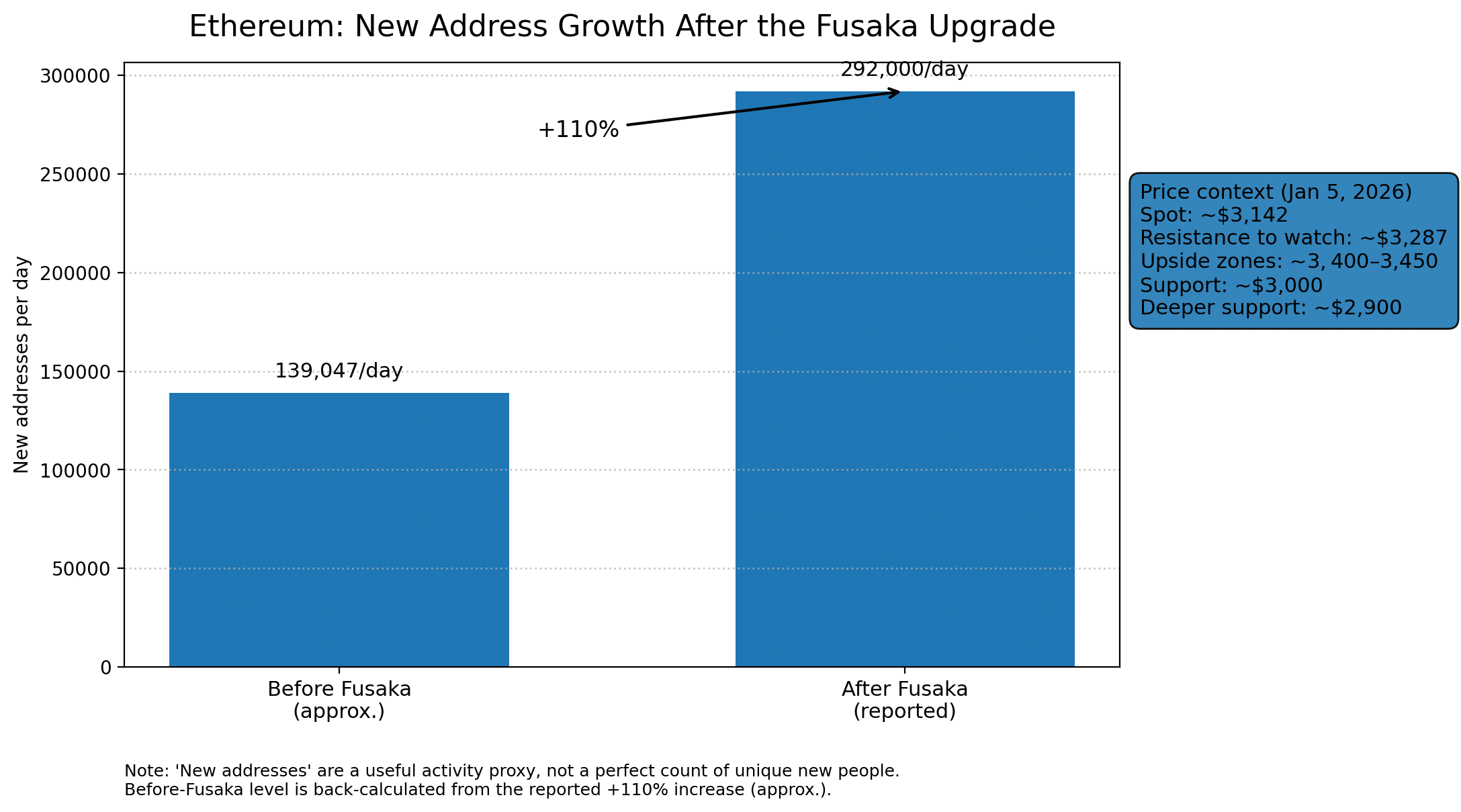
Ethereum is logging a jump in first-time wallet activity after the Fusaka upgrade activated on December 3, 2025. On-chain tracking of new addresses interacting with ETH shows an average increase near 110% in recent weeks, with roughly 292,000 new addresses appearing per day. The figure is not a perfect headcount of new people, yet it often reflects a real shift in participation when it holds for weeks, not hours.
What Fusaka Changed and Why It Can Show Up in Activity
Fusaka focuses on scaling work that most users never see, but many eventually feel. A headline component is PeerDAS, which upgrades how the network verifies blob data that rollups publish. The design aims to spread the data burden so nodes do not need to download every blob in full, while still keeping strong security guarantees. The practical takeaway is a stronger runway for Layer 2 growth and, over time, a better chance of smoother costs when usage rises.
New Addresses Are Not a Census, but They Still Matter
Wallet creation can spike for reasons like exchange wallet rotation or automated bots. Still, sustained growth tends to travel with real usage, more transfers, and deeper liquidity, which can make price swings less violent in stressed markets.
Price Action: Falling Wedge Near $3,142
On January 5, 2026, ETH is trading near $3,142. The structure resembles a falling wedge, where lower highs and lower lows compress toward a point, a pattern many technicians treat as potentially bullish if price breaks upward with follow-through.
The near-term levels are straightforward. A break above about $3,287 would suggest buyers have absorbed nearby supply and could open a path toward $3,400 to $3,450. A rejection can keep ETH stuck in the squeeze, and a drop below $3,000 would put $2,900 in focus as the next support area that could turn the market choppier.
Holder Behavior Adds a Twist
Recent cohort data suggests mid-term holders, often defined as wallets holding for roughly 3 to 6 months, have been more inclined to sit tight rather than rush for exits. That can reduce near-term selling pressure, but it also creates a potential supply pocket if price returns to common break-even zones for those buyers. In practice, a breakout needs fresh demand, not only patient holders.
Indicators That Help Without the Noise
Moving averages help frame trend strength by showing whether pullbacks reclaim key lines quickly. RSI and MACD can add context on momentum as price tightens, but volume is the real tell. A breakout backed by stronger participation is more likely to hold, while a thin move often snaps back into the range.
Conclusion
Fusaka has added a fundamental tailwind in the form of stronger post-upgrade activity, and the new-address surge is a tangible datapoint with clear caveats. Price still has to choose a direction. With ETH coiling near $3,142, the next move likely comes from a clean push through $3,287 or a breakdown under $3,000.
Frequently Asked Questions
What does the 110% “new holder” surge measure?
It tracks new addresses interacting with ETH, which can signal rising activity but does not equal a verified count of unique new investors.
Is Fusaka built to reduce fees?
It improves how rollups post and verify data, which supports cheaper Layer 2 usage over time, although fees still respond to congestion.
What levels matter most now? $3,287 is nearby resistance, while $3,000 is the first major support.
Glossary of key terms
Fusaka: Ethereum upgrade activated on December 3, 2025.
PeerDAS: Data availability sampling for blobs used by rollups.
Blob: Temporary data used to publish rollup batches.
Falling wedge: Converging downtrend lines that can resolve upward on a breakout.
Support and resistance: Price zones where buying or selling pressure often clusters.
References