






This article was first published on The Bit Journal.
The Ethereum 2026 roadmap offers a two-pronged scaling proposal designed to meet the throughput requirement, increase data capacity and propel the decentralized application ecosystem to a larger size.
After the Fusaka upgrade shipped on December 3, 2025, the protocol now prepares for more upgrades in 2026 that are heavily vested on validator uptake of zero-knowledge (ZK) proof verification as well as other architectural changes.
These advances are expected to increase capacity, but bring technical dependencies that might influence the network capabilities in the next year.
Fusaka Delivered, Shifts to a Data-First Scaling Strategy
The Ethereum 2026 roadmap is expected to pick up where the Fusaka upgrade leaves off. Fusaka added Peer Data Availability Sampling (PeerDAS) as a way for peers to validate rollup data without downloading the full blob, notably reducing the bandwidth necessary for validators.
This mechanism locks in the first major trajectory for higher data capacity, allowing the blob space, temporary storage used by rollups to scale in measured steps via “blob parameter only” (BPO) increases after deployment.
According to Token Terminal and other Ethereum developers, these BPO steps provide a gradual increase of blob targets which enables more rollup data availability without overwhelming node resources.
PeerDAS and its soft blob escalation train the network for more heavy Layer-2 use that may support thousands of transactions per second on secondary layers.
Fusaka coincided with an increase in the block gas limit, which had increased from 45 million to 60 million, the highest since four years on Ethereum. The upgrade had strong validator support with over 516,000 validators voting in favor of the increase, which automatically expands availability for transactions and smart contract executions on Layer-1.
Validator ZK Proof Adoption
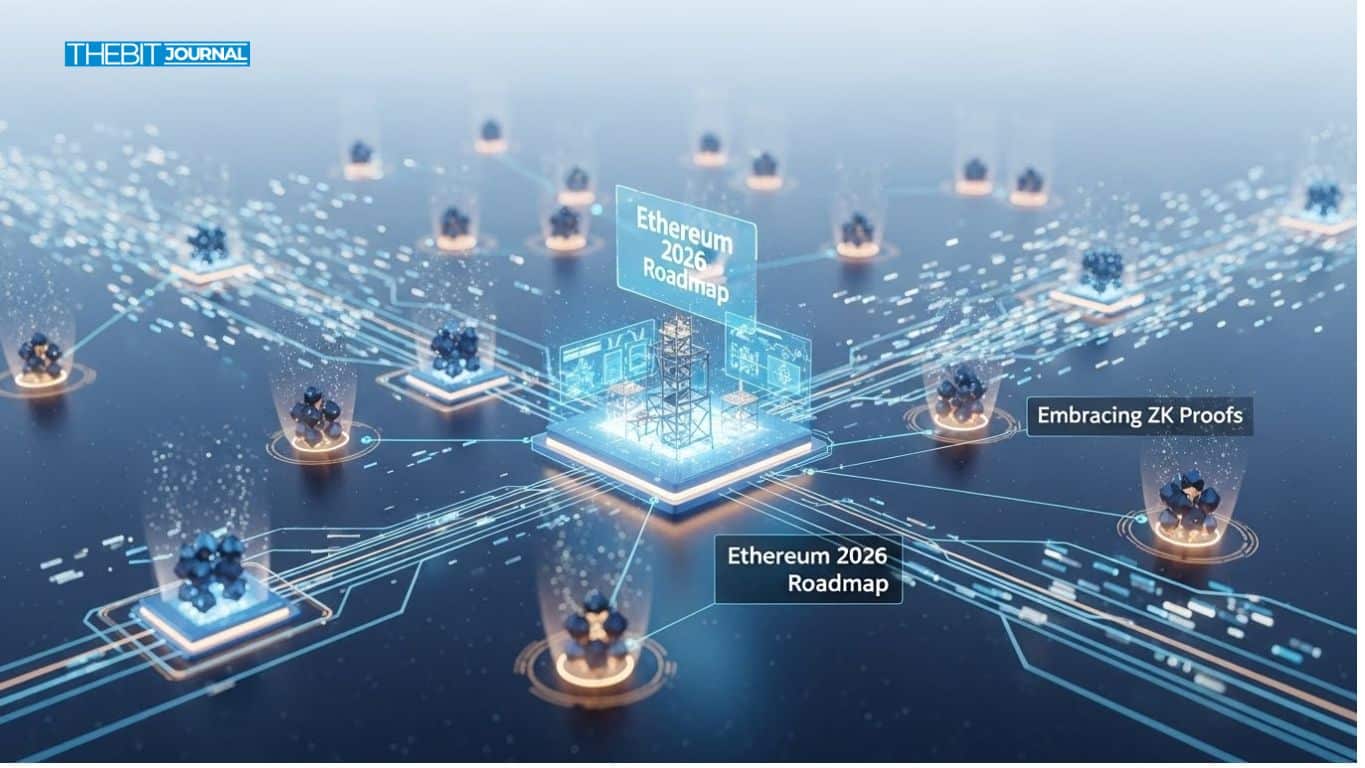
The second track on the Ethereum 2026 roadmap focuses on execution throughput, from validators re-executing blocks to verifying zero-knowledge (ZK) execution proofs.
This change is a prerequisite for achieving higher gas limits and throughput.
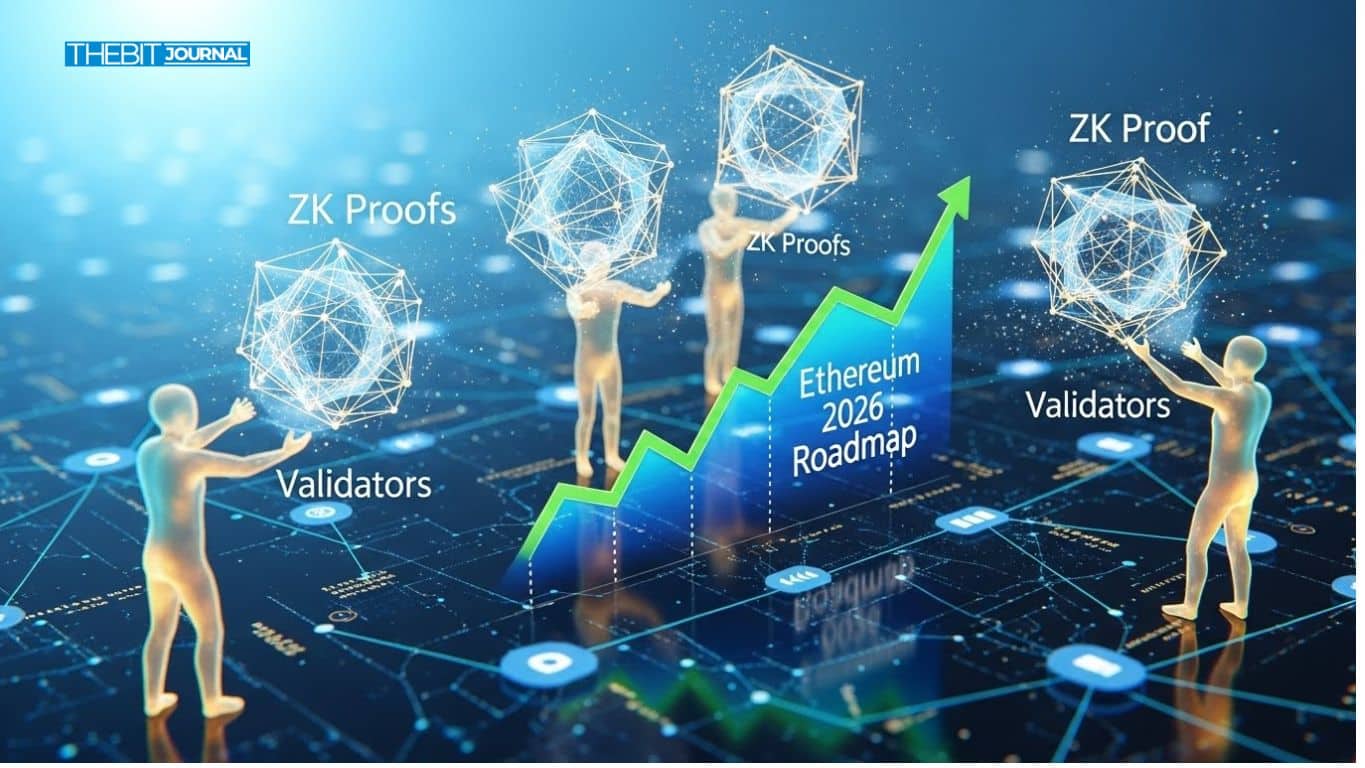
ZK Execution proofs would, in fact, allow validators to verify block correctness through compressed proofs rather than by re-execution, and that would offload the current burden from the validator’s hardware in order to explore higher block capacities.
The ZK shift is intended to happen in a phased manner, with a small set of validators spooling up ZK clients in production.
Only after a super majority of stakeholders have voted in favor of these changes, can Ethereum safely raise gas limits above threshold levels where the standard ZK-proof validation would be deployed.
These are some of the constraints stipulated in The Ethereum Foundation’s Realtime Proving roadmap that need to be satisfied before widespread adoption.
Industry reporting states that phase 1 of the ZK deployment would expect approximately 10% of validators to engage in ZK proof verification by 2026.
This recognizes the ongoing fact that validators are operating at block gas limits and spending more money replaying transactions as they increase in their allowed gas amounts. Changing to ZK proofs is less load, but requires client coordination, decentralized testing ,and good bandwidth usage funneling.
Glamsterdam and Execution Pathway Changes
Following Fusaka, the next stop in the Ethereum 2026 roadmap is that of Glamsterdam, which should be rolling out at some point early in the new year.
Glamsterdam combines a few execution-focused upgrades, including Enshrined-Proposer-Builders Separations (ePBS), Block-Access Lists (BALs), and general gas repricings.
ePBS implements a new way to propose and build transaction blocks. By incorporating proposer and builder separation directly into the protocol, it should work to lessen the power of dominant third-party block builders while also facilitating a more open and decentralized proposal process.
BALs complement this by also defining what state elements a transaction touches before execution starts, ensuring that parallel tasks may be scheduled more efficiently.
Together, these changes should improve throughput and efficiency, but they rely on widespread client support as well as careful balancing to execution and consensus mechanism.
None of these are ready for a general testing or use yet; all must be polished and revised through community interaction, as well as developer testing.
Validator Risks and Network Constraints
However, whilst possessing greater data throughput and transaction precedence to deliver more ambitious visions of Ethereum 2026, the current Ethereum 2026 roadmap has its limitations.
According to the core roadmap focus, the dependency on validators to embrace ZK proof verification introduces a fragile point in the upgrade path. Validators have to balance concerns of bandwidth, block propagation, and decentralization as they migrate to novel validation models.
The operations of the validator under ZK proof also add further failure modes. For instance, validators do not re-execute transactions, so errors or bottlenecks at the proving market can cause a temporary freeze in throughput.
Furthermore, draft academic research on ePBS warns of potential liveness risks; scenarios where proposed optimizations, such as automatic construction, could be abused or exercised in a way that degrades network performance, particularly subject to market volatility.
These technical risks do not point to immediate failure; they are a reminder that Ethereum’s route to greater scalability depends as much on protocol design as it does on wide and careful validator uptake.
Testing, Gas Limit Progression, and Next Steps
Practical network testing is indeed already happening, over and above the broad plans. Fusaka was successfully deployed on Ethereum testnets, including Holesky, Sepolia, and Hoodi, paving the way for mainnet activation.
Subsequent updates to the protocol will continue to tune parameters and increase gas limits as client teams iterate with performance improvements.
Developers are already talking about raising the gas limit even above 60m, with proposals to raise it to 75-80m after early 2026 BPO forks, etc. These incremental tweaks show iterative tuning rather than fixed hard forks, and they rely on validator client support.
Conclusion
The Ethereum 2026 will be one of the most aggressive scaling paths ever envisioned for the protocol. It builds on the Fusaka upgrade that substantially increased data availability with the PeerDAS, as well as increasing gas limits.
In the future, Ethereum plans to increase block FN capacity by unlocking ZK proof verification through validators and will work to rework execution-layer PMSPs with the Glamsterdam upgrade.
Validator adoption of ZK validation serves as the central point in this roadmap, where protocol aspirations and operational realities intersect.
If the validators, client teams, and the rest of the ecosystem can all work together, 2026 level throughput and scale could soar.
Glossary
Fusaka Upgrade: A critical upgrade to the Ethereum network released in Dec. 2025, which increased data capacity and introduced PeerDAS for rollup scaling.
PeerDAS: Peer Data Availability Sampling, a mechanism that enables validators to validate blob data without having to perform full downloads, thus saving bandwidth.
Blobs: Temporary data packets on Ethereum that are used for rollup data availability.
ZK Proofs: Zero-knowledge proofs by which validators can validate whether transactions are true without the need to fully re-run all transactions.
Glamsterdam: A planned 2026 Ethereum upgrade featuring ePBS and BALs, among other execution improvements.
Frequently Asked Questions About Ethereum 2026 Roadmap
Ethereum 2026 road map? What would it look like and emphasize?
Targets of the roadmap include improved data availability via blobs and enhanced execution throughput through gas limit growth and validator adoption of ZK proof verification.
What was the Fusaka upgrade?
Fusaka was an Ethereum upgrade that brought in PeerDAS and established the groundwork for rollups to scale capacity by blob.
Why do validators matter for 2026 upgrades?
Validators help determine gas limits and must adopt ZK proof verification for Ethereum to fully realize high throughput.
What is ePBS?
Enshrined Proposer-Builder Separation is a potential execution-layer change to further decentralize block production.
Could gas limits go up in 2026?
Developers have argued for gas limits of 75-80 million or more in an upcoming parameter update.
References
CryptoSlate
TradingView
CoinGecko
ethereum
Ethereum Foundation Blog
incrypted
CryptoNew