




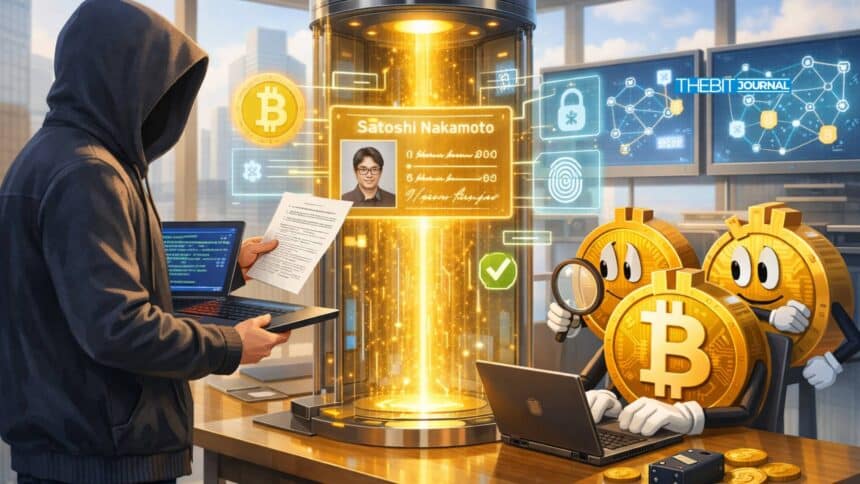

Every cycle has its familiar sparks: a viral clip, a new claimant, a fresh “leak,” and a quick burst of market chatter that treats the mystery like a season finale. Bitcoin, however, was never designed to resolve identity by persuasion.
It was designed to resolve disputes by verification, which is why the question of Satoshi Nakamoto keeps returning again and why it keeps ending the same way, with the network insisting on proof that anyone can check. In practice, the debate is not about charisma or credentials; if a person truly is Satoshi Nakamoto, there is a public test that does not require trust, and it hinges on control of the right private key.
Why Bitcoin Turns Identity Into a Cryptographic Check
Bitcoin ties control to private keys as private keys can prove ownership without being revealed, which means verification can be public and independent, and the system never has to ask the world to believe a founder.
Because that verification is binary, most traditional “evidence” stays squishy. Documents can be forged, memories can be wrong, and closed-door demos cannot be reproduced at scale, while cryptographic checks either pass or fail.
Satoshi Nakamoto and the Only Proof That Ends the Argument
The strongest proof is a public message signed with a private key tied to one of the earliest Bitcoin addresses associated with the creator’s 2009-era activity. Anyone can verify the signature with standard tools, and it cannot be forged without the real key, which is why it ends arguments instead of extending them.
This is where public claims usually collapse. A claimant might know early history, mimic writing habits, or present screenshots, but none of that demonstrates early key control, and in Bitcoin’s logic keys define identity.
How Message Signing Works, Without the Mythology
Message signing is like proving someone has the key to a lock without handing over the key. The signature is created with the private key and checked against the public address, so anyone can reproduce the verification step and reach the same result.
That reproducibility is why “private proof” does not land. When the claim involves Satoshi Nakamoto, the bar is a public signature tied to early addresses, not a story told in a back room.
The Stronger Signal That Almost Nobody Wants to Trigger
A louder proof would be moving coins from a long-dormant early wallet linked to the creator’s era. One onchain transfer would be visible globally and would likely erase most doubt, but it could also invite intense scrutiny, personal danger, and market turmoil driven by fears of future selling.
That trade-off explains why inaction remains plausible. Even if Satoshi Nakamoto still has access, proving it could come with a lifetime of risk that few people would choose.
Courts, Claims, and Why the Market Still Demands Keys
A UK High Court ruling rejected Craig Wright’s claim and criticized the credibility of the supporting evidence, showing how legal systems can dismantle weak documentation. Yet the broader lesson for Satoshi Nakamoto claims is simpler: courts can weigh testimony, but they cannot supply the early keys that Bitcoin treats as final.
Why Partial Proof Keeps Failing in Public
Many claimants try to split the difference with fragments of proof: a signature from a newer address, a private demo to a small circle, or circumstantial material that seems persuasive at first glance. The problem is reproducibility. Bitcoin can only validate what strangers can verify themselves, without trust. When the name Satoshi Nakamoto is on the line, anything that cannot be checked publicly will never settle the argument. That is why Satoshi Nakamoto claims tend to fade once the signature question.
Indicators Traders Watch When the Satoshi Story Returns
Speculation around Satoshi Nakamoto often hits the same pressure points. Social chatter rises, short-term volatility can flare, and positioning can stack up as traders chase momentum.
Onchain, the indicator that matters is plain: any verifiable signature tied to early addresses, or any movement from long-dormant early era coins. Most of the time, nothing happens, and the narrative fades. When something does happen, it forces repricing because it is evidence the market cannot hand-wave away.
Conclusion
The mystery survives because it is emotionally satisfying, but Bitcoin is not an emotional system. For Satoshi Nakamoto, the bar is public, reproducible, and rooted in early private keys. Message signing meets that standard with minimal disruption, while moving early coins would be even stronger but far more dangerous. Until one of those events occurs, claims will keep cycling, and the network will keep answering in the same blunt language: prove key control, or accept uncertainty.
Frequently Asked Questions
What would convince most of the market quickly?
A publicly verifiable message signed with an early private key associated with the creator’s era.
Can documents or writing style prove the claim?
They can support theories, but they are not definitive because they can be forged or imitated.
Do court rulings settle the issue?
Courts can reject claims, but they do not replace cryptographic proof of early key control.
Glossary of Key Terms
Satoshi Nakamoto: The pseudonymous creator associated with Bitcoin’s early design and launch.
Private key: The secret value that authorizes spending or signing from a Bitcoin address.
Message signing: A method of proving control of a private key without revealing it, producing a signature others can verify.
Disclaimer: This article is for informational purposes only and does not constitute investment, legal, or tax advice. Readers should conduct independent research before making decisions.
Sources