





A price on a screen can look firm, but that does not mean every trader can buy or sell at that level. The real test is whether the market can absorb an order without shifting sharply. That is why liquidity in crypto matters so much. It connects quoted prices with actual execution and often decides whether a trade feels smooth or turns costly within seconds.
Liquidity in Crypto: The Market Strength Behind Every Price
Liquidity describes how easily an asset can be bought, sold, or swapped without causing a large price change. A liquid market has enough buyers, sellers, market makers, and available capital near the current price. A thin market has fewer orders, wider gaps, and less capacity to handle size.
The difference becomes clear when order value increases. A $100 purchase may clear near the displayed price, while a $100,000 order in the same token may push through several price levels. The chart may show one price, yet the final average execution can be much worse.
This is why liquidity in crypto should be judged against the planned trade size.
How Order Books Turn Interest Into Execution
When many orders sit close to the current price, traders can enter or exit with limited disruption. When those orders are sparse, a market order moves through several levels, a process often called walking the book.
Market makers help keep the book active by posting bids and asks. They earn from the spread and adjust quotes as volatility changes. During calm periods, they may offer tighter prices and larger size. During stress, they often widen spreads or reduce exposure, weakening liquidity in crypto exactly when traders need it most.
The Main Indicators Every Trader Should Read
The bid-ask spread is the gap between the best buying and selling prices. A tight spread usually signals stronger competition and easier execution. A wide spread raises the cost of entering and leaving before fees are counted.
Order-book depth measures how much value is available near the market price. Top-of-book depth covers the best bid and ask, while 1% or 2% depth reveals how much capital sits within that distance of the quote. Deeper books can absorb larger trades with less damage.
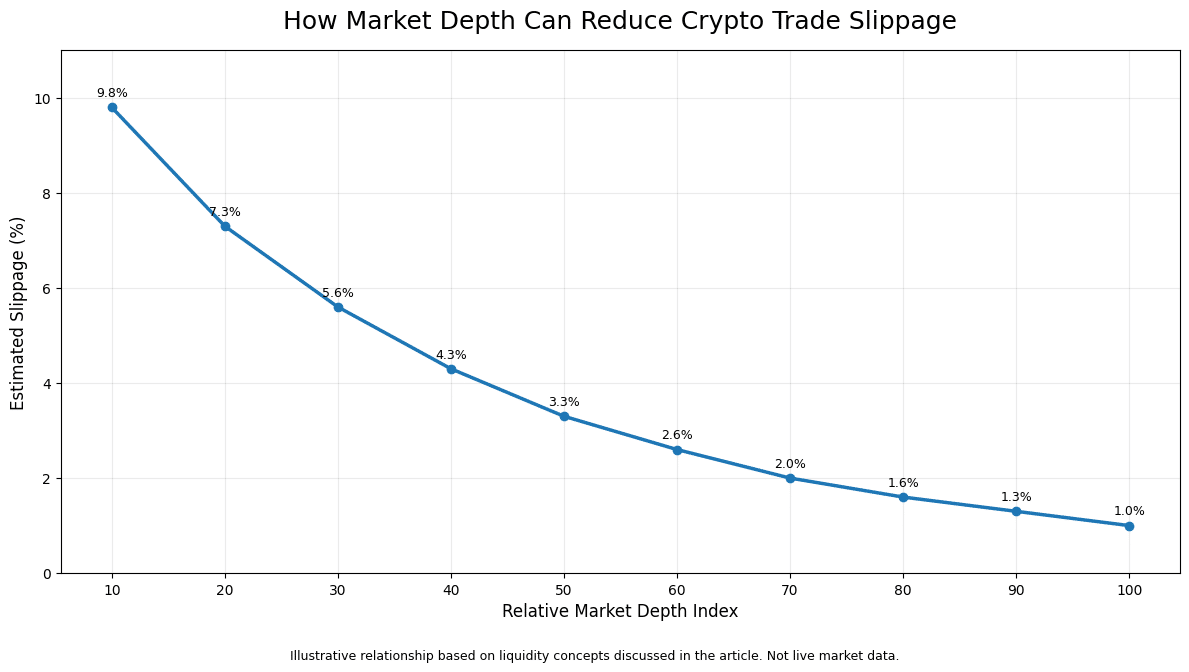
Slippage is the difference between the expected price and the final execution price. It rises when an order is large relative to available depth, markets move quickly, or a trade route passes through weak pools.
Trading volume measures activity over a period, but it does not prove that usable liquidity in crypto is available at the moment of execution. High volume can come from rapid turnover, incentives, or activity far from the current price.
Why Volume and Market Capitalization Can Mislead
Volume, market capitalization, and liquidity measure different things. Market capitalization multiplies price by circulating supply, but it does not show how much can be sold at that price. A token may carry a high valuation even when only a small part of its supply trades actively.
Liquidity in crypto is more practical because it asks what can trade now, at what cost, and with how much price movement.
A token valued at $1 billion does not necessarily have $1 billion of willing buyers. Its valuation may be based on the latest transaction involving a relatively small number of tokens. If a major holder attempts to sell, the available bids could disappear long before the full position is cleared.
This distinction matters because market capitalization often attracts attention, while execution quality receives less scrutiny. Traders may assume that a highly valued token offers a safe exit, only to discover that most of its demand exists far below the current price.
How Liquidity Pools Work in Decentralized Finance
Decentralized exchanges often use liquidity pools instead of traditional order books. Users deposit pairs of assets into smart contracts, and an automated market maker calculates swap prices from the balance of those reserves.
When a trader removes one asset and adds another, the reserve ratio changes. The larger the trade compared with the pool, the greater the price impact. Deep, balanced pools usually deliver better execution, while shallow pools can produce sharp slippage on modest orders.

Liquidity providers earn a share of fees and may receive token incentives. Their return is not guaranteed. They face smart-contract risk, token risk, and impermanent loss, which occurs when relative prices change and leave the provider with a less favorable asset mix than simple holding would have produced.
Strong liquidity in crypto must be paired with sound infrastructure and secure code. A large pool does not automatically make a token reliable. Malicious contract permissions may prevent selling, while vulnerable code can expose deposited assets to theft or permanent loss.
Why Liquidity Can Vanish During Market Stress
Markets often appear deepest when trading is calm. During sharp moves, that depth can disappear quickly. Market makers may cut order size, leveraged positions may be liquidated, and traders may rush toward the same exit.
Stablecoin stress adds another layer because many markets use dollar-linked tokens as quote assets. When confidence or redemption access weakens, liquidity in crypto can fragment across pairs and exchanges even when the underlying token has not changed.
Leverage can make the situation worse. When prices fall below certain levels, exchanges automatically close leveraged positions. Those forced sales can consume nearby buy orders and push the market into thinner sections of the order book.
The result resembles a crowded doorway during an emergency. The exit may appear wide enough under normal conditions, but it becomes difficult to use when everyone tries to leave at once.
How to Check a Market Before Placing a Trade
The spread should be checked alongside depth, recent volume, slippage estimates, and withdrawal access. On a decentralized exchange, pool size, reserve balance, route, contract permissions, and expected price impact deserve equal attention.
Liquidity in crypto also changes with timing and conditions. Weekends, sudden announcements, network outages, and heavy liquidations can all reduce execution quality. A market that handled size yesterday may not handle it today.
A trader should also preview the final amount before confirming a swap. Many decentralized platforms display estimated price impact and minimum received amounts. These figures can reveal whether an order is too large for the available pool.
Limit orders may provide greater price control on order-book exchanges because they define the worst acceptable execution level. However, a limit order may remain unfilled if the market moves away. Dividing a large position into smaller orders can reduce immediate impact, though it may expose the trader to changing prices over time.
For very large transactions, an over-the-counter desk may provide a private quote without displaying the full order publicly. This approach can reduce market disruption, but counterparty, settlement, and custody risks still require careful review.
High Liquidity Does Not Mean Low Risk
A liquid asset can still fall sharply as liquidity only describes the ease and cost of trading, not the future direction of price. Investors must also consider volatility, token design, custody, regulation, smart-contract security, leverage, and issuer risk.
For that reason, liquidity in crypto should be viewed as a market condition, not a permanent label.
Bitcoin and Ether usually trade across more venues and pairs than smaller tokens, which often provides stronger depth. Even so, major assets can experience wider spreads and higher slippage during extreme volatility. Exchange outages, transfer delays, or regional demand differences may also produce temporary pricing gaps.
Liquidity helps a market function, but it cannot protect an investor from a poor asset, weak security, or an unfavorable price trend.
Conclusion
Liquidity is the bridge between a quoted price and a usable price as it shapes spreads, slippage, market depth, execution speed, and the ability to leave a position during stress. Investors who study these signals can avoid hidden costs that do not appear on a chart.
The sensible approach is to judge the pair, venue, route, and order size together. Liquidity in crypto is not only a technical metric for professional desks. It is a basic risk check for anyone who plans to trade, invest, provide capital, or move between digital assets.
Frequently Asked Questions
What does crypto liquidity mean?
It means an asset can be traded quickly without causing a large price movement.
Is high trading volume the same as high liquidity?
No. Volume shows past activity, while liquidity shows current execution capacity near the market price.
Why does low liquidity cause slippage?
A thin market has fewer orders or reserves, so a trade accepts progressively worse prices.
Are decentralized exchanges always transparent?
Reserves are often visible on-chain, but contract, token, bridge, and routing risks remain.
Can Bitcoin face liquidity problems?
Yes. Bitcoin is generally deeper than smaller assets, but stress or fragmented venues can still weaken execution.
Glossary of Key Terms
Bid-ask spread: The difference between the highest buyer price and lowest seller price.
Market depth: The amount of buy and sell interest available near the current price.
Slippage: The gap between the expected trade price and final execution price.
Price impact: The price change caused by a specific order.
Market maker: A participant that posts buy and sell quotes.
Liquidity pool: A smart contract holding token reserves for swaps.
Automated market maker: A protocol that prices trades through a formula.
Impermanent loss: The opportunity cost a provider may face when pooled asset prices change.
Sources
Disclaimer: This article is for educational purposes only and does not provide financial, investment, legal, or tax advice. Crypto assets are volatile, and readers should conduct independent research before making financial decisions.