




The headline Bitcoin price often feels like a wall as a newcomer sees BTC trading near the cost of a midsize car, then quietly assumes the market is only for whales and early insiders. Many beginners ask whether they can buy less than a Bitcoin, or if they must save for a full coin before they are taken seriously.
That assumption is simply wrong. Modern crypto markets are built around fractions. Exchanges and wallets are designed so that even a small monthly budget can gain exposure to Bitcoin without chasing a full unit.
This article breaks down how fractional Bitcoin works, why investor psychology often lags behind the technology, and which indicators matter most when someone decides to buy less than a Bitcoin as part of a broader crypto strategy.
How Bitcoin Divisibility Makes Small Tickets Possible
Bitcoin was designed from day one to be divisible. Each BTC can be split into 100,000,000 units called satoshis, or sats for short. In other words, 1 satoshi equals 0.00000001 BTC.
Practically, this means:
A person can hold 0.01 BTC, 0.001 BTC, or even 0.0001 BTC.
The underlying asset is the same, only the position size changes.
Any wallet or exchange that supports Bitcoin supports fractions as well.
Educative resources across the industry stress that it is a common misconception that only whole coins are available. They highlight that investors can start with modest sums, sometimes from around $10 to $30, depending on the platform minimums.
In practice, every major venue that offers spot Bitcoin allows an investor to buy less than a Bitcoin using fiat deposits or stablecoins. The infrastructure does not care whether the order size is 0.8 BTC or 0.0008 BTC, as long as the trade meets the minimum order requirement.
Unit Bias: The Hidden Psychological Barrier
If the technology is so flexible, why do so many people still believe a small fraction is “not worth it”?
Behavioral finance researchers point to unit bias. This is the tendency to prefer whole units over fractions, even when the fraction has real and meaningful value. In crypto, unit bias shows up when a person ignores Bitcoin and chases a token priced at $0.01, simply because they can own thousands of units.
Educational articles and opinion pieces show how this bias keeps newcomers out of BTC. They note that buying 0.00034500 BTC feels trivial, while describing the same amount as 34,500 sats suddenly feels substantial. The numbers did not change, only the frame.
The Bitcoin/com guide on this topic makes a similar point. It explains that many people abandon BTC after seeing the headline price and migrate to lower unit cost coins that frequently carry higher risk. Instead of accepting that it is perfectly valid to buy less than a Bitcoin, they let unit bias push them toward speculative assets.
In reality, a fractional holding still participates in every percentage move of the market.
How Returns Work When Someone Owns Only A Fraction
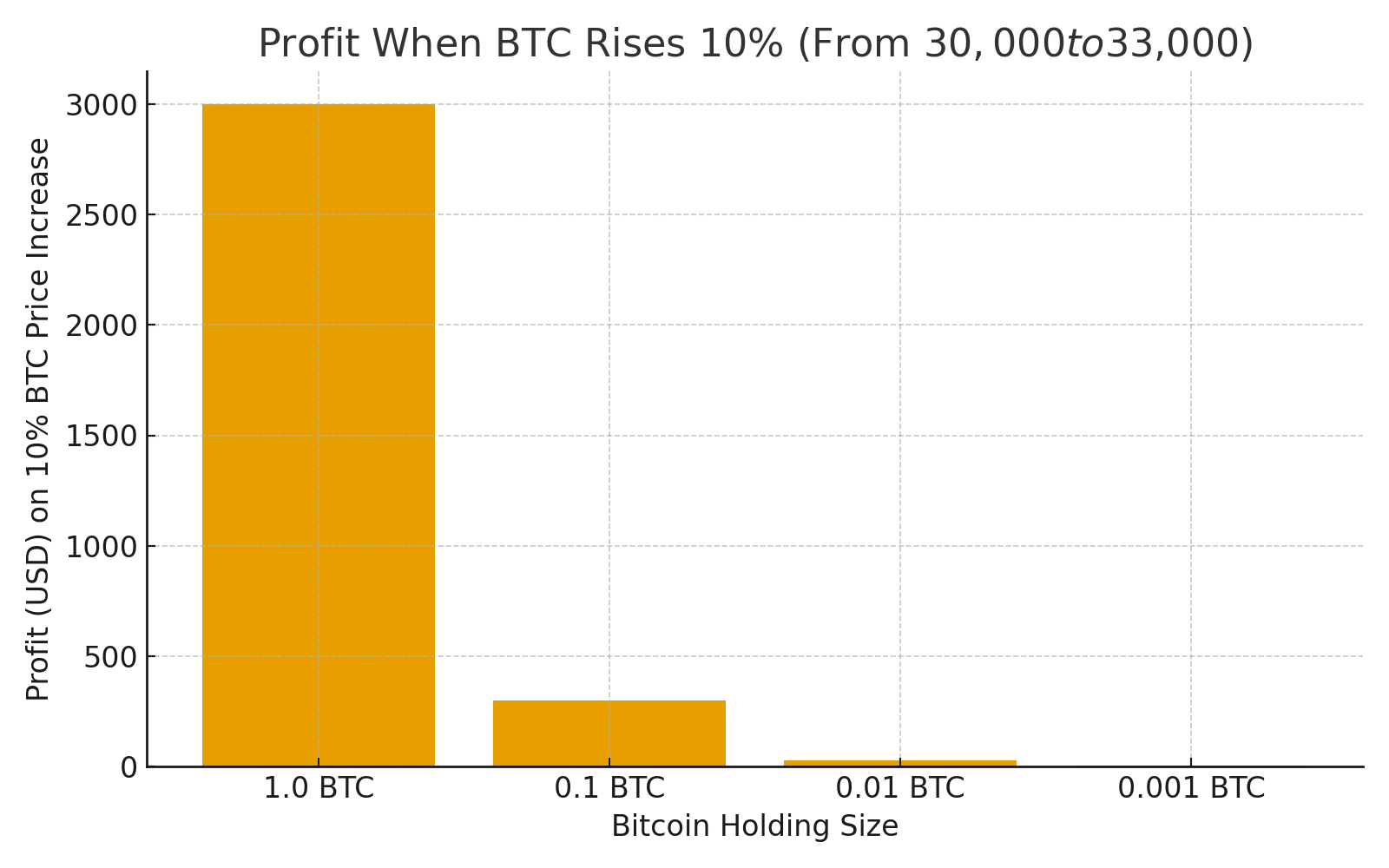
The mathematics of returns does not care whether a holder owns a full or partial coin. If BTC trades at $90,000 and later rises to $99,000, that is a gain of 10 percent.
In that simple example:
1 BTC becomes $99,000.
0.1 BTC becomes $9,900.
0.01 BTC becomes $990.
Educational platforms routinely present similar calculations to show that the key variable is percentage return, not whether an investor started with a full coin.
From a practical perspective, this means an individual can buy less than a Bitcoin, hold 0.02 BTC, and still see meaningful upside when the asset appreciates over time, provided that risk is managed properly and the investment horizon is long enough.
Key Indicators To Watch Before Buying Any Amount Of BTC
Since Bitcoin sits inside the broader crypto asset class, it helps to look at some core indicators that professionals track before they buy less than a Bitcoin or allocate a larger ticket.
Market capitalization and dominance
Market cap shows the total value of all coins in circulation. Bitcoin maintains the largest market cap and a significant share of total crypto value, which many analysts treat as a sign of relative stability within a volatile sector.
Liquidity and trading volume
High daily volume across major exchanges means orders are easier to fill near the current market price. Deep liquidity reduces slippage, which is especially useful for investors who regularly buy less than a Bitcoin through recurring purchases.
Volatility profile
Bitcoin remains volatile compared with traditional assets, yet it is often less extreme than many altcoins. Historical price charts reveal repeated cycles of sharp drawdowns followed by strong recoveries. A long term approach is crucial.
On-chain security and network health
Hash rate, number of active addresses, and transaction settlement data all provide context about the security and usage of the network. A strong hash rate signals robust miner participation and resilience against attacks.
Regulatory landscape and access channels
Guidance from regulators, approval of spot ETFs, and broader institutional participation influence perceived risk. Educational pieces on unit bias note that exchange-traded products make it easier for traditional investors to gain exposure without managing wallets directly, although they still own a claim on underlying BTC rather than coins in self-custody.
Together, these indicators help investors judge whether their plan to buy less than a Bitcoin aligns with their risk tolerance and time horizon.
Practical Paths To Build A Position Over Time
For many households, saving enough to purchase 1 full BTC in a single transaction is unrealistic. A more accessible approach is gradual accumulation.
One strategy is to set a fixed budget, for example $50 or $100 per month, and automatically buy a small fraction of BTC at regular intervals. Educational guides show that this kind of repeated fractional purchase smooths the impact of short term volatility and removes some emotional pressure from timing decisions.
For someone with a limited monthly budget, the most realistic path is to buy less than a Bitcoin at steady intervals rather than chase a lump sum purchase at a specific price.
Minimum order sizes vary by platform, but the broad trend is clear. Many services allow beginners to start with relatively small amounts, hold those coins in a wallet, and later transfer them to more secure storage such as hardware devices once balances grow.
Many long term holders who began with salaries in emerging markets could only buy less than a Bitcoin at first, yet gradually built sizable stacks over several market cycles.
Risk Management And Security Still Matter For Small Amounts
The ability to buy less than a Bitcoin can create a false sense that the stakes are low. In reality, security and risk management apply to every aspect.
Anyone who decides to buy less than a Bitcoin should still consider platform reputation, fee structure, regulatory status in their region, and personal security habits. Two-factor authentication, unique passwords, secure backups of recovery phrases, and a clear migration plan to self-custody are all important, even when balances begin small.
Just as important, investors should avoid overextending their finances. Bitcoin fits best as part of a diversified portfolio, with clear rules about allocation size and a well defined time horizon.
Conclusion: Fractional BTC Removes The “Too Late” Excuse
The ability to buy less than a Bitcoin changes the narrative around accessibility. Bitcoin is not reserved for early adopters or high net worth traders. It is divisible into tiny digital units that fit comfortably into modest monthly budgets.
The psychological hurdle is often larger than the technical one. Once investors understand unit bias, focus on percentage returns, and pay attention to core indicators such as market cap, liquidity, and network health, fractional ownership begins to look entirely rational.
In the end, the question is not whether someone can buy less than a Bitcoin. The real question is whether that person has a clear plan, realistic expectations, and the discipline to treat Bitcoin as a long term, researched allocation rather than a lottery ticket.
Frequently Asked Questions
Q1. Is a small fraction of BTC “real” Bitcoin?
Yes. Any amount recorded on the blockchain, even 0.0001 BTC, is genuine BTC and moves one for one with the overall Bitcoin price in percentage terms.
Q2. How little BTC can an investor purchase?
Most platforms support purchases down to very small fractions, limited mainly by platform minimums such as $10, $20, or $30 and the fee structure.
Q3. Can fractional BTC still lead to meaningful gains?
Yes. Returns are based on percentage change. If BTC doubles, a $100 position doubles in value in the same way a $10,000 position does.
Q4. Are fractional BTC holdings safer than full coins?
The security model is the same. A small holding still requires strong passwords, two factor authentication, careful storage, and awareness of phishing risks.
Q5. How often should someone accumulate BTC?
Many investors prefer regular schedules such as weekly or monthly purchases. The ideal frequency depends on income, volatility tolerance, and fees.
Glossary Of Key Terms
Satoshi (sat)
The smallest unit of Bitcoin. One satoshi equals 0.00000001 BTC, which allows highly granular transactions and investments.
Unit bias
A behavioral tendency to prefer whole units over fractions, even when the fractional amount has meaningful value.
Market capitalization
The total value of a cryptocurrency, calculated by multiplying the current price by the circulating supply.
Liquidity
A measure of how easily an asset can be bought or sold without significantly impacting its price, often linked to trading volume.
Fractional ownership
Holding less than one full unit of an asset. In Bitcoin, this refers to owning any amount below 1 BTC, expressed in decimal form or in satoshis.
Self custody
The practice of holding one’s own private keys, usually through hardware or software wallets, rather than leaving funds on an exchange.
References/Sources