

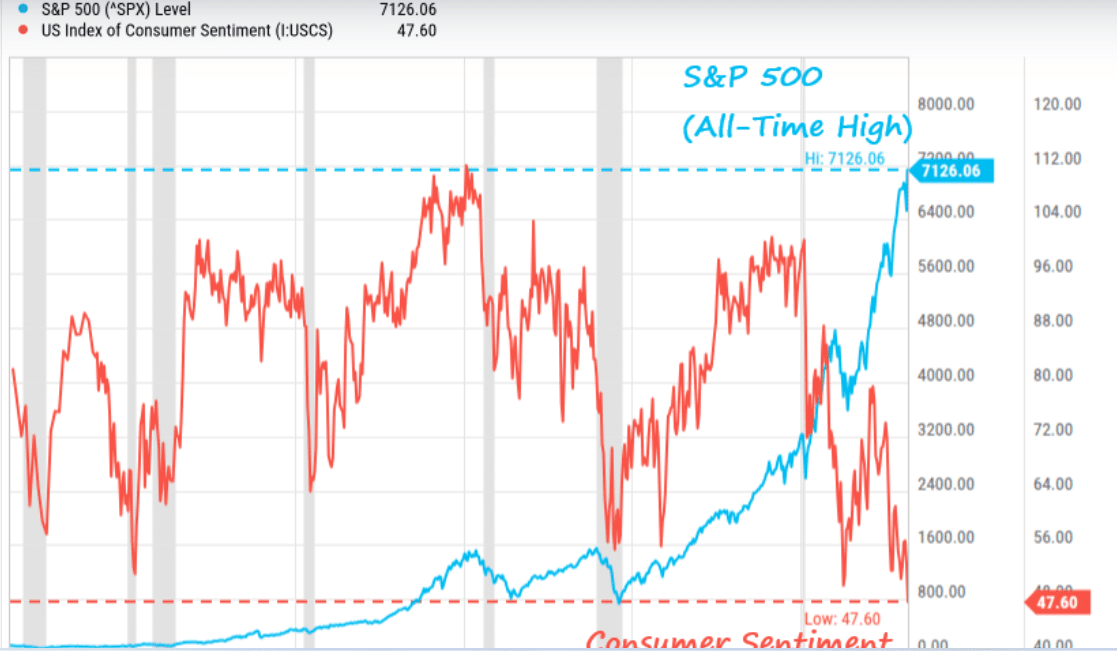
The market has reached one of those uneasy moments when numbers on the screen and life on the ground no longer seem to belong to the same economy. U.S. stocks pushed to fresh highs on April 17, with the S&P 500 closing at 7,126, yet the University of Michigan’s preliminary consumer sentiment reading for April fell to 47.6, the weakest level in the survey’s history.
That split matters because Bitcoin now sits between two competing forces. It still carries the image of a hard asset built for distrust in the old system, but recent trading shows it moving more like a high-beta risk asset tied to Wall Street mood, ETF demand, and macro positioning.
Bitcoin walks a narrow line between risk and refuge
The current setup leaves little room for lazy assumptions. The Bitcoin price has stabilized near $75,500 after recovering in recent weeks, but that recovery comes with a catch. It remains closely linked to broader equity behavior at a time when stock market leadership looks increasingly concentrated and fragile. Bitcoin’s 30-day correlation with the S&P 500 rose to 0.74 in March, which tells the market something simple and uncomfortable. For now, Bitcoin is still trading with risk.
That does not mean the bullish case has disappeared. It means the asset is being tested in public. If Wall Street keeps climbing, the Bitcoin price can continue to benefit from improving sentiment and institutional demand. If that rally cracks, crypto may discover very quickly whether this cycle is really about digital scarcity or just liquidity with a new label.
Bitcoin price and the warning signs beneath the rally
The strongest warning sign is not the headline high in equities. It is the narrowness behind that move. A recent look at earnings revisions showed that one company alone accounted for 51% of positive revisions since the Iran war began, while the top 10 holdings represented 35.5% of SPY and the Magnificent Seven made up 30.4%. That kind of concentration can keep an index rising for a while, but it also makes the structure easier to shake. A market can look healthy right until a few pillars start to wobble.
At the same time, households are sending a very different message. Survey respondents pointed to high prices, weaker asset values, and worsening buying conditions, especially for vehicles and durable goods. One-year inflation expectations also jumped from 3.8% to 4.8%, while crude climbed to $87, Brent reached $95, and national average gasoline prices hovered around $4.05 a gallon. That is the sort of pressure consumers feel before economists finish arguing about it.
ETF flows are supporting the Bitcoin price, but they add risk too
Spot ETFs have changed the texture of the market. They have brought in deeper pools of capital, but they have also tied Bitcoin more tightly to traditional portfolio behavior. On April 17, spot Bitcoin ETFs pulled in $664 million in net inflows, a sign that institutional appetite has returned after earlier weakness. That support can cushion pullbacks and improve momentum, yet it can also work in reverse if risk sentiment turns.

This is why the Bitcoin price now deserves close attention as a macro indicator, not just a crypto headline. When ETF money is strong, the Bitcoin price can rise with equities. When the broader market starts de-risking, the Bitcoin price may absorb that pressure before it gets the chance to behave like digital gold. In plain terms, sponsorship helps, but it comes with strings attached.
Key indicators shaping the next move
Several signals now matter more than social media noise. The Bitcoin price remains the headline metric, but traders are also watching ETF inflows, equity correlation, inflation expectations, oil prices, and consumer sentiment. If ETF demand stays firm and equity markets hold together, the Bitcoin price has room to extend its rebound. If consumer weakness deepens and stock concentration finally cracks, the Bitcoin price could face another sharp test.
Volume and momentum also matter here because they show whether buyers are stepping in with conviction or simply chasing relief. Correlation matters because it reveals whether Bitcoin is acting independently or just following the same macro tape. Sentiment data matters because it often exposes stress long before it fully shows up in earnings or recession forecasts. Right now, all of those pieces point to a market that still has upside, but looks thinner than the headlines suggest.
Conclusion
Bitcoin has not reached its defining moment yet, but it is getting close. The asset is trading in a market where Wall Street still looks confident and households do not as that gap cannot widen forever.
For now, the Bitcoin price is being supported by ETF demand and improved short-term momentum, yet it remains exposed to the same macro fault lines running beneath traditional markets. If the rally holds, the Bitcoin price can keep grinding higher. If the dam breaks, this market will learn whether Bitcoin is truly a hedge against financial stress or simply another asset floating on the same tide.
FAQs
Why is Bitcoin being compared with Wall Street right now?
Because recent trading shows Bitcoin moving more closely with stocks, especially as ETF flows and institutional positioning have become more important.
What is the most important signal for Bitcoin in this setup?
The Bitcoin price is the headline signal, but ETF inflows, correlation with equities, and consumer sentiment are also critical.
Can Bitcoin still act as a safe-haven asset?
It can, but current market behavior suggests investors are still treating it more like a risk asset in the short term.
Glossary of Key Terms
Consumer sentiment: A survey-based measure of how households feel about current and future economic conditions.
Spot Bitcoin ETF: A fund that holds Bitcoin directly and lets traditional investors gain exposure through stock market products.
Correlation: A measure of how closely two assets move together over time.
Inflation expectations: What consumers believe inflation will look like in the months ahead.
Market concentration: A condition where a small number of stocks drive most of an index’s gains.
Source