





RWA tokenization has been sold as a bridge between Wall Street and blockchain, a way to move treasuries, stocks, credit, and other “real” assets onto rails that never sleep. Lately, though, the hype has met a more blunt question: does the bridge actually save anyone time and money, or does it just add another toll booth?
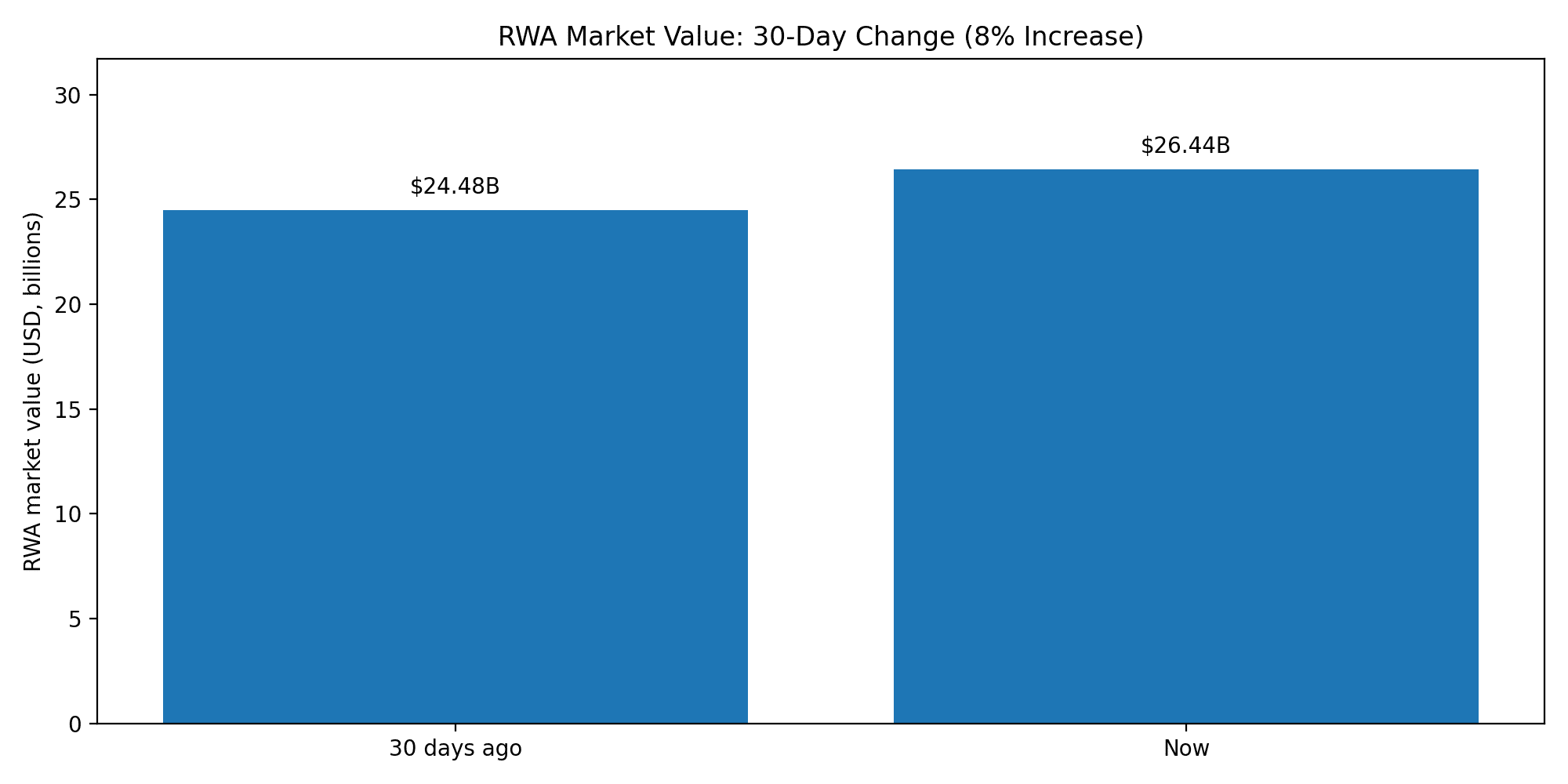
That tension sharpened this week after a market commentator argued that tokenized real-world assets often drift away from core crypto ideals, because they still rely on legal wrappers, custodians, compliance checks, and off-chain enforcement. In that view, the promise of lean, automated finance starts to look like a traditional system wearing a blockchain badge. At the same time, the data tells a different story: on-chain real-world asset activity has continued to grow, with dashboards tracking roughly $26.44B in distributed value and about 657,502 holders, up over the last 30 days.
RWA tokenization and the “more friction, more cost” critique
The criticism is not really about whether tokenizing an asset is technically possible. That part is straightforward. The issue is the real-world plumbing around it. A token that represents a treasury bill still needs a legal structure that defines ownership rights, rules for redemptions, a custody setup, and a compliance layer that can be audited. When something breaks, there also needs to be a dispute process that courts can recognize.
In plain terms, the skeptic’s argument is that RWA tokenization adds more moving parts, not fewer. A tokenized product can end up with a longer chain of service providers than the conventional version, because it must satisfy both traditional finance requirements and on-chain operational needs. That can raise costs, slow down launches, and introduce new points of failure.
The critique also calls out a philosophical mismatch. Permissionless systems are built to reduce trusted intermediaries. Tokenized assets, in many common structures, require trust in issuers, administrators, and legal agreements. That does not make them useless, but it does mean they are not the same thing as a native crypto asset.
Why the biggest institutions still keep building
If the overhead is real, why do the largest players keep leaning in? The simplest answer is that they are not chasing ideology. They are chasing distribution, settlement efficiency, and product design that traditional rails struggle to offer.
Tokenization can make certain assets easier to access, easier to transfer, and easier to integrate into digital workflows. Supporters argue that it can open participation to more users, improve the speed of moving value, and lower operational friction in areas like collateral management. Those gains matter most to institutions that move large volumes and care about settlement windows, cut-off times, and cross-border complexity.
This is where RWA tokenization shifts from a crypto narrative to a market structure narrative. If a tokenized instrument can be held, transferred, and potentially used as collateral with less delay, there is a practical advantage, even if the product still depends on legal and compliance layers.
BlackRock’s tokenized money market fund, launched in March 2024 through a digital securities platform, became a high-profile example of that institutional direction.
The demand signal that critics cannot ignore
The most persuasive argument for tokenized real-world assets is not a slogan. It is usage.
Tracking platforms that monitor on-chain real-world assets show distributed value around $26.44B and total asset holders at about 657,502, with month-over-month growth in both figures. These numbers do not prove that every product is well-designed, but they do show something important: market participants are showing up.
This is where the debate gets interesting. Skeptics look at structure and see added overhead. Supporters look at activity and see product-market fit emerging in real time. Both can be true at once. Early internet commerce was clunky too, with slow pages and awkward payment flows, yet demand still grew until the plumbing improved.
In that analogy, RWA tokenization today may be in its “dial-up era.” Not pretty, not frictionless, but moving in the direction of utility.
Tokenized stocks, and the part of the thesis that feels immediate
Even some critics concede that tokenized equities can make sense, especially for access and extended trading windows. There is also a very practical reason this segment stands out: investors already understand stocks, and the value proposition can be explained without a long lecture.
A major retail platform announced in mid-2025 that it launched stock and ETF tokens for European Union customers, providing access to more than 200 U.S. names and paying dividends in the app’s native format for those tokens. That kind of product puts tokenization into a familiar wrapper: people know what they are buying exposure to, even if the structure behind it is new.
This is also where RWA tokenization starts to compete with crypto-native instruments. Perpetual futures can provide exposure, but they come with funding rates, leverage risks, and liquidation mechanics that many everyday investors do not want. A tokenized stock product, if structured responsibly, can feel closer to the cash market experience.
The 24/7 market argument got louder over the weekend
There is another “tell” in this story, and it showed up during a weekend of heightened geopolitical tension. Traditional markets close. News does not.
A recent report described how traders turned to a crypto derivatives venue for weekend price discovery on instruments tied to oil and metals, with an OTC trader describing it as a key place for weekend pricing. The point is not that these markets are perfect, because they can be thin and volatile. The point is that 24/7 access becomes very attractive when risk events happen outside regular trading hours.
RWA tokenization benefits from that same behavioral shift. When investors get used to always-on markets, they start asking why so many legacy assets still live inside narrow time windows. That question alone creates pressure for experimentation.

Key indicators investors should watch as this sector matures
RWA tokenization is not a single market as it is a stack: legal structure, asset custody, issuance, on-chain settlement, and secondary liquidity. When one layer is weak, the product can still “exist,” but it may not be investable in a meaningful way.
The first indicator is transparency of backing and redemption. Investors should look for clear terms on what the token represents, who holds the underlying asset, how redemptions work, and what happens in edge cases.
The second indicator is liquidity quality. A token that trades rarely can have misleading prices and wider spreads. Investors should watch whether a product has multiple venues, consistent volume, and reliable market making.
The third indicator is compliance clarity. The more regulated the asset, the more important the issuer’s licensing, disclosures, and investor eligibility checks become. In practical terms, compliance is not optional here, it is the product’s foundation.
The fourth indicator is operational resilience. The sector must prove it can handle corporate actions, dividends, interest payments, and reporting without breaking. That is where real adoption either sticks or slips.
This is also where the critique about overhead becomes constructive. If RWA tokenization is going to scale, it has to standardize processes so that every new product does not require reinventing the same legal and technical wheel.
Conclusion: friction is real, but so is momentum
RWA tokenization sits in an awkward middle ground as it is not pure DeFi, and it is not classic finance either. It is a hybrid, and hybrids are often messy at first.
The skeptic’s warning about added intermediaries should not be brushed off. Legal wrappers, custody, compliance oracles, and dispute handling all cost money and introduce complexity. Yet the growth in tracked value and holder counts suggests the market is voting with its feet, even as the broader crypto cycle stays uneven.
The likely outcome is not a clean win for one side of the argument. The more realistic outcome is that RWA tokenization continues to expand in areas where it clearly improves access or settlement, while the industry gradually streamlines the layers that feel redundant. Over time, the question shifts from “Is it worth it?” to “Which structures are worth trusting?”
Frequently Asked Questions (FAQs)
What is RWA tokenization in simple terms?
RWA tokenization is the process of creating a blockchain token that represents rights to a real-world asset, such as a treasury bill, a stock, or a fund share. The token can be transferred on-chain, but ownership and redemption still depend on legal agreements and the issuer’s operational setup.
Why do critics say RWA tokenization adds friction?
Critics argue that tokenized real-world assets often require extra layers, including legal entities, custodians, compliance tooling, and off-chain dispute processes. Those layers can increase costs and reduce the “trust-minimized” feel that many people associate with crypto.
Why are institutions interested anyway?
Institutions are drawn to efficiencies in settlement, the possibility of improved collateral workflows, and the ability to design digital products that move more easily across systems. High-profile launches in tokenized fund structures have reinforced that interest.
Does tokenization make markets truly 24/7?
It can, depending on the venue and product design. Crypto rails can trade continuously, and recent weekend market behavior has highlighted why some traders value always-on pricing during risk events.
What should investors check before buying a tokenized asset?
Investors should review the issuer’s disclosures, backing and redemption terms, custody arrangements, liquidity conditions, and the legal rights attached to the token. If those basics are unclear, the product may carry more risk than it appears.
Glossary of Key Terms
Asset backing
The underlying real-world asset that a token claims to represent, such as cash, treasuries, or equity shares.
Custody
The safekeeping of the underlying asset by a qualified institution or service provider, separate from the on-chain token.
Legal wrapper
A legal entity or structure that holds the underlying asset and defines token holders’ rights, obligations, and redemption rules.
On-chain settlement
The transfer and recording of ownership of tokens on a blockchain, often faster than traditional settlement processes.
Price discovery
The process by which markets determine a tradable price through bids, offers, and executed trades, often highlighted during volatile news cycles.
Tokenized stock
A blockchain token designed to track or represent exposure to a publicly traded equity, usually with specific rules for eligibility, dividends, and redemptions.
Sources
Disclaimer
This article is for informational and educational purposes only and does not constitute investment, legal, or tax advice.