





MicroStrategy vs BlackRock is increasingly shaping up as a defining comparison in institutional Bitcoin exposure. The contest is being closely watched as Strategy expands its Bitcoin treasury through structured financing instruments.
Market attention has intensified around whether its accumulation pace can realistically challenge the position held by the world’s largest asset manager. The latest signals from Michael Saylor have added further speculation around the timing and scale of the next move.
MicroStrategy vs BlackRock: What is driving market speculation right now?
The focus on MicroStrategy vs BlackRock is being driven by a narrowing gap in Bitcoin holdings between the two institutions. Strategy holds 780,897 BTC, while BlackRock’s iShares Bitcoin Trust (IBIT) holds 798,026 BTC. The difference has become small enough that a single large purchase could alter rankings.
Traders are now watching whether Strategy’s next move could shift it ahead of IBIT in total Bitcoin exposure. The situation has become more than a balance sheet comparison. It is now a test of capital market execution versus ETF inflows.
What does Saylor’s ‘Think Even ₿igger’ post indicate about timing?”
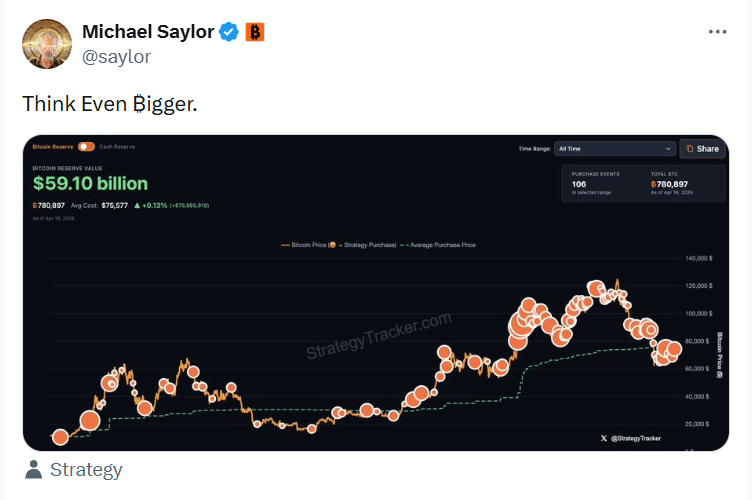
The MicroStrategy vs BlackRock discussion gains added context from Michael Saylor’s “Think Even ₿igger” post on X, where he shared a screenshot of Strategy’s Bitcoin portfolio. Traders associate such cryptic posts from Saylor with signals that have historically appeared shortly before SEC filings disclosing new Bitcoin purchases.
Historically, similar posts have appeared shortly before Strategy discloses new Bitcoin purchases in SEC filings. Market participants now treat the message as an informal indicator that another acquisition may be approaching. However, confirmation is still tied to regulatory disclosure, and expectations remain centered on the upcoming SEC filing window around April 20.
How did STRC become central to Bitcoin funding?
Strategy’s latest Bitcoin purchase was fully funded through its preferred stock instrument, STRC. The company acquired 13,927 Bitcoin for approximately $1 billion at an average price of $71,902 per coin. This brought total holdings to 780,897 BTC, valued at more than $59 billion. The entire purchase was funded by selling 10,028,363 STRC shares.
STRC is structured as a variable-rate cumulative preferred stock with an 11.5% annualized dividend. It is designed to trade close to $100 par value, with monthly dividend adjustments intended to stabilize pricing and liquidity. Strategy still retains $21.6 billion in STRC issuance capacity, alongside additional ATM flexibility in other programs.
Is STRC activity pointing to a larger Bitcoin buy?
The MicroStrategy vs BlackRock gap has sparked speculation that STRC activity may be funding a significantly larger Bitcoin purchase cycle. Reports indicated STRC recorded back-to-back trading days exceeding $1 billion in volume. Recent trading activity has led some market participants to estimate that the structure could support nearly 30,000 BTC in additional purchases.
If realized, such a move would represent one of Strategy’s largest weekly accumulation events since its Bitcoin strategy began scaling. At the same time, analysts note that this remains an estimate tied to capital flow assumptions rather than confirmed execution.
What risks are being highlighted in STRC-based funding?
While STRC has strengthened Strategy’s ability to accumulate Bitcoin, it has also raised questions about funding structure risk. The model relies heavily on continuous capital inflows to support both dividend obligations and Bitcoin purchases. Some analysts describe this as a circular funding loop, where new issuance supports existing commitments.
Concerns focus on what happens if Bitcoin price weakens or investor demand slows. In such a scenario, dividend pressure and liquidity constraints could become more visible. This introduces a counterbalance to the otherwise expansion-driven narrative surrounding Strategy’s accumulation model.
Could Strategy actually overtake IBIT?
The MicroStrategy vs BlackRock comparison is now centered on a narrow numerical gap. BlackRock’s IBIT holds 798,026 BTC, while Strategy holds 780,897 BTC. A purchase exceeding roughly 20,000 BTC could shift the ranking in Strategy’s favor.

However, the outcome depends entirely on the next SEC filing, expected around April 20. Until then, the market scenario remains based on projections rather than confirmation.
Conclusion
MicroStrategy vs BlackRock has reached a stage where small capital movements could reshape institutional Bitcoin rankings. Strategy’s aggressive accumulation model, supported by STRC financing, continues to close the gap with BlackRock’s ETF holdings.
MicroStrategy vs BlackRock is now being defined not just by holdings but by timing signals, funding velocity, and market interpretation of Saylor’s pre-filing behavior. While speculation around a larger purchase is rising, final confirmation still rests on the upcoming SEC disclosure cycle.
Glossary
Bitcoin Treasury: Company holding Bitcoin as a reserve asset.
STRC: Stock used by Strategy to fund Bitcoin purchases.
IBIT: BlackRock’s Bitcoin ETF holding Bitcoin for investors.
Bitcoin Accumulation: Continuous increase in Bitcoin holdings.
SEC Filing: Official disclosure of company financial activity.
Saylor Signal: Michael Saylor’s post hinting at possible Bitcoin buys.
Frequently Asked Questions About MicroStrategy vs BlackRock
What is MicroStrategy vs BlackRock?
It is a comparison between Strategy’s Bitcoin holdings (780,897 BTC) and BlackRock’s IBIT holdings (798,026 BTC).
What is the “Saylor Signal”?
It is Michael Saylor’s “Think Even ₿igger” post. Which has previously appeared before new Bitcoin purchase filings.
How much Bitcoin does Strategy and BlackRock hold?
Strategy holds 780,897 BTC and BlackRock’s IBIT holds 798,026 BTC.
How large was STRC trading volume recently?
STRC recorded more than $1 billion in trading volume on back-to-back days.
How much Bitcoin could STRC funding potentially buy?
Estimates suggest STRC activity could support up to around 30,000 BTC.
Sources –