














This article was first published on The Bit Journal.
For years now, locked up liquidity has been one of the most trusted signals in the world of decentralized finance. Investors have always checked if liquidity is locked before buying a token, figuring that it would give them some form of protection from rug pulls and developer stunts.
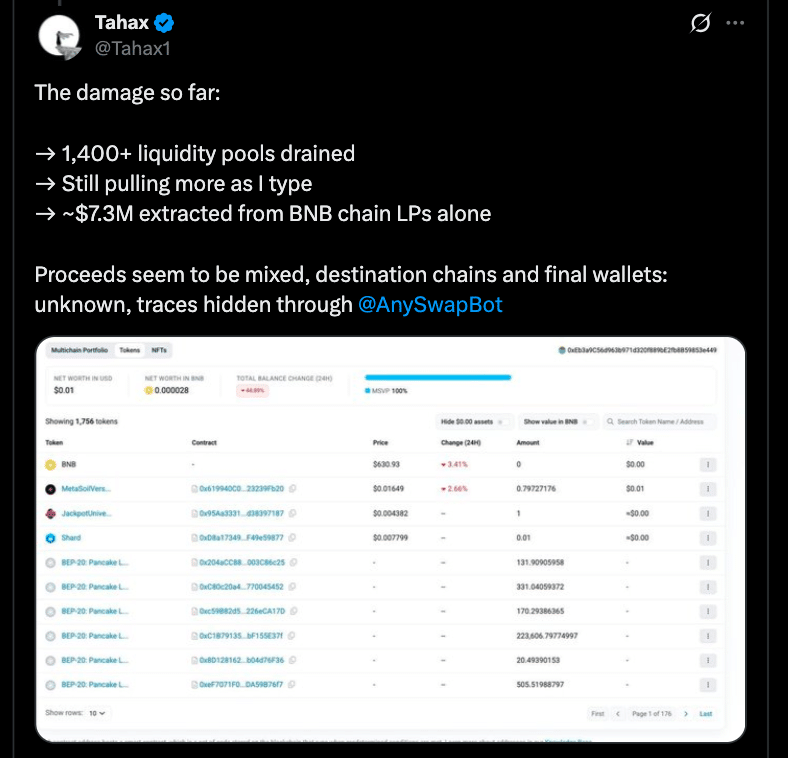
However, the recent DxSale exploit is challenging that assumption. The BNB Chain-based launchpad and liquidity-locking platform reportedly got ripped off of approximately $7.3 million, which affected almost 1,400 liquidity provider positions.
What makes the incident stand out is that the stolen funds came from a system that was specifically designed to keep liquidity locked and safe. Instead of a regular rug pull, investigators believe the attackers found a weakness in the platform’s infrastructure and administrative controls.
This incident is bringing up all sorts of discussions around DeFi security and stressing the reality that many investors tend to overlook which is that locked liquidity can reduce some risks, but it can’t eliminate smart contract vulnerabilities.
What Happened During the DxSale Exploit?
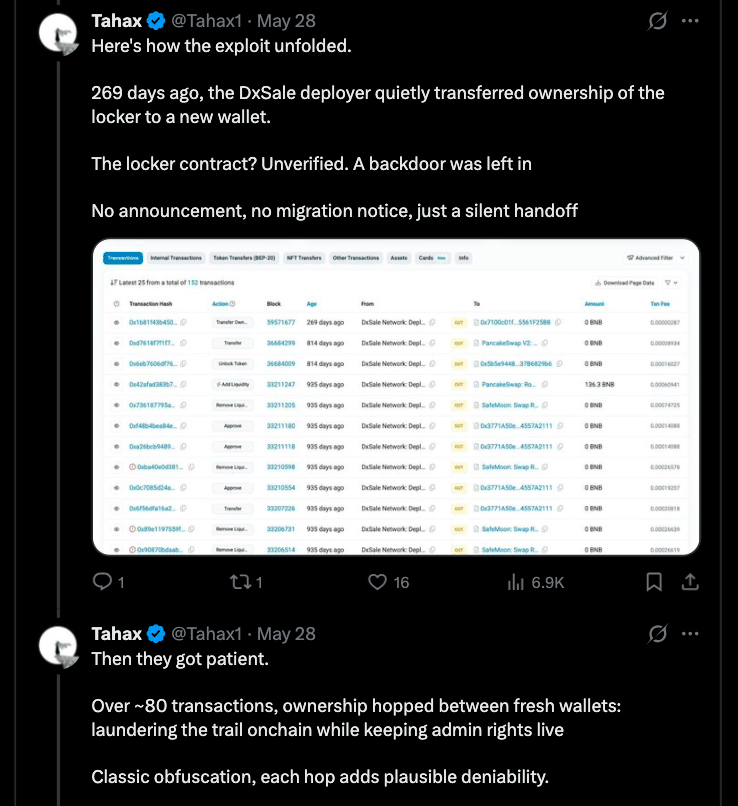
According to the security analyses, the attack targeted the liquidity-locking contracts on BNB Chain.
Evidence suggests the attacker managed to get hold of some privileged admin functions that allowed manipulation of contract settings and withdrawal mechanisms that should have remained inaccessible.
Over 1,400 liquidity pools got hit. Blockchain security researchers pointed to administrative permissions and ownership controls as being the likely weak points. Based on analysis, these privileged functions combined with altered lock parameters effectively turned supposedly locked deposits into withdrawable balances.
For affected users, funds that were supposed to be safe got drained anyway.
Why Locked Liquidity Became a Standard in DeFi
Liquidity locking came about as a way to deal with one of DeFi’s earliest problems: rug pulls.
Back in the day, project teams could just remove liquidity from decentralized exchanges and make off with investor cash. Liquidity locks came in to stop this from happening by throwing liquidity provider tokens into smart contracts that wouldn’t let withdrawals happen for a set period.
Over time, locked liquidity became one of those trust signals in crypto.
The idea is quite simple; if the developers can’t get their hands on the LP tokens, they can’t just remove the liquidity out of the pool. That protection is still useful today.
However, the DxSale incident shows that preventing developers from withdrawing liquidity is only one part of the DeFi security equation.
What Locked Liquidity Actually Protects You From
Liquidity locks still serve a purpose.
They make it harder for liquidity to be yanked out quickly, increase transparency when it comes to project commitments, and make it less likely for the classic rug pull to happen. They also help users figure out if liquidity is available and if it is going to stay that way for a while.
In a lot of cases, these mechanisms have protected users from malicious project founders.
The problem begins when investors treat locked liquidity as proof that the whole protocol is completely secure.
What Locked Liquidity Can’t Protect You From
This is where a lot of DeFi participants get risk wrong.
A liquidity lock protects against unauthorized removal of liquidity by LP token holders. It doesn’t automatically protect against smart contract flaws, coding errors, governance failures, compromised admin access, oracle manipulation, or vulnerabilities in the infrastructure it is connected to.
If the contract that was supposed to enforce the lock has a flaw, attackers can easily find a way around it and essentially render the protection useless.
This is one of the main lessons from the DxSale exploit. The lock itself wasn’t really the problem, it was the system that was supposed to be managing that lock that failed.
The Hidden Risks Facing Liquidity Providers
This incident also reveals the fact that liquidity providers are exposed to multiple risks all at once.
Impermanent loss can eat away at returns when asset prices start to diverge, market volatility can make the pool value shoot up or down in an instant, smart contract vulnerabilities that can expose deposited funds, and infrastructure dependencies that bring in another risk from third party services.
Even if liquidity is locked away, these risks are still out there, waiting to pounce.
As DeFi complexity keeps growing, participants using these systems are relying more on launchpads, bridges, lockers, multisig systems and all sorts of other external protocols. Each new layer adds another possible attack vector.
When Security Tools Become Single Points of Failure
One of the most important lessons from the DxSale case is concentration risk.
Thousands of projects are all relying on the same launchpads, liquidity locking platforms, and infrastructure providers which makes things more efficient, but also creates a huge single point of failure.
When one of those widely used services goes down, the impact can spread far beyond one single project.
That is exactly what happened here. A vulnerability in one platform reportedly affected nearly 1,400 liquidity provider positions all at once
For DeFi security professionals, this should be a reminder that convenience and security are not always aligned.
Conclusion: What Investors Should Check Beyond Locked Liquidity
The strongest DeFi security frameworks are built around multiple layers of protection, not just one single ‘trust signal’.
Before investors put capital in, they should look into who controls the admin privileges, whether contracts can be upgraded, how many independent audits have been done, whether there’s a bug bounty program in place, and whether security reports are publicly available.
Having locked liquidity in place may make a project safer than one without it. But that doesn’t mean it is completely safe
The DxSale exploit shows that security is an ongoing process, not just something to be checked off a list. Investors who understand that are more likely to spot risks before they turn into losses.
Glossary
DeFi: Decentralized financial apps built on blockchain networks.
Liquidity Provider (LP): A user who puts assets into a liquidity pool to facilitate trading.
LP Token: A token that represents ownership of a share in a liquidity pool
Rug Pull: A scam where developers remove liquidity or funds and abandon a project.
Smart Contract: Self-executing code deployed on a blockchain.
Impermanent Loss: A temporary loss experienced by liquidity providers due to asset price changes.
Frequently Asked Questions About DeFi Security and Locked Liquidity
What is locked liquidity in DeFi anyway?
Locked liquidity means that LP tokens are locked in a smart contract that restricts withdrawals for a certain period.
Did locked liquidity fail in the DxSale exploit?
Not really. The lock itself wasn’t the main issue, it was vulnerabilities in the infrastructure that let the attackers bypass the protection.
How much was lost in the DxSale breach?
Around $7.3 million was reportedly drained, affecting nearly 1,400 liquidity provider positions.
Does locked liquidity prevent rug pulls?
It can help reduce the risk of a rug pull by stopping developers from immediately withdrawing liquidity.
Is locked liquidity enough to evaluate a project?
No; investors should also look into audits, governance structures, smart contract security, admin controls and the project’s history
References