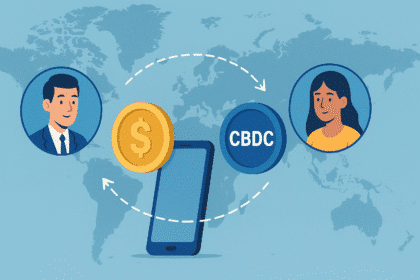





Money moves across borders every second. The old paths are slow and costly. A new rail has arrived. Stablecoins in Cross-Border Payments turn settlement into near real time at lower cost while keeping a one to one link to fiat.
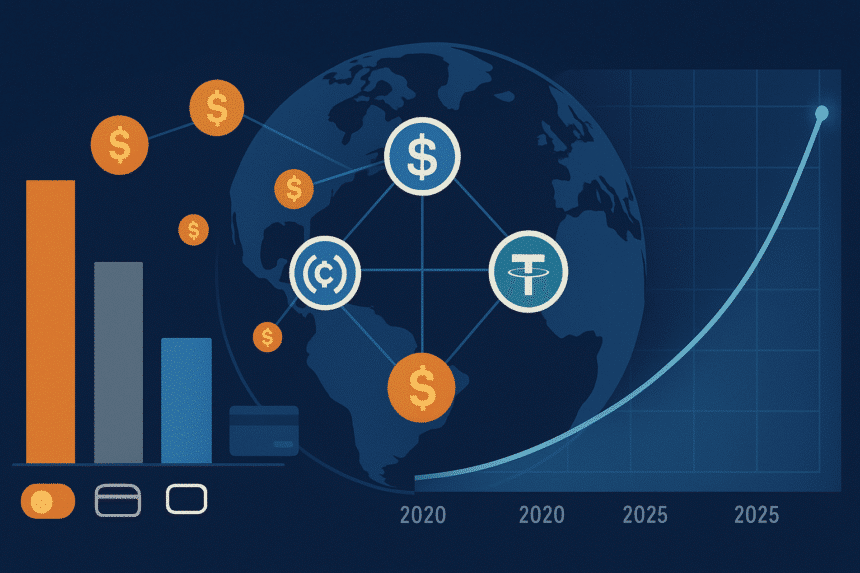
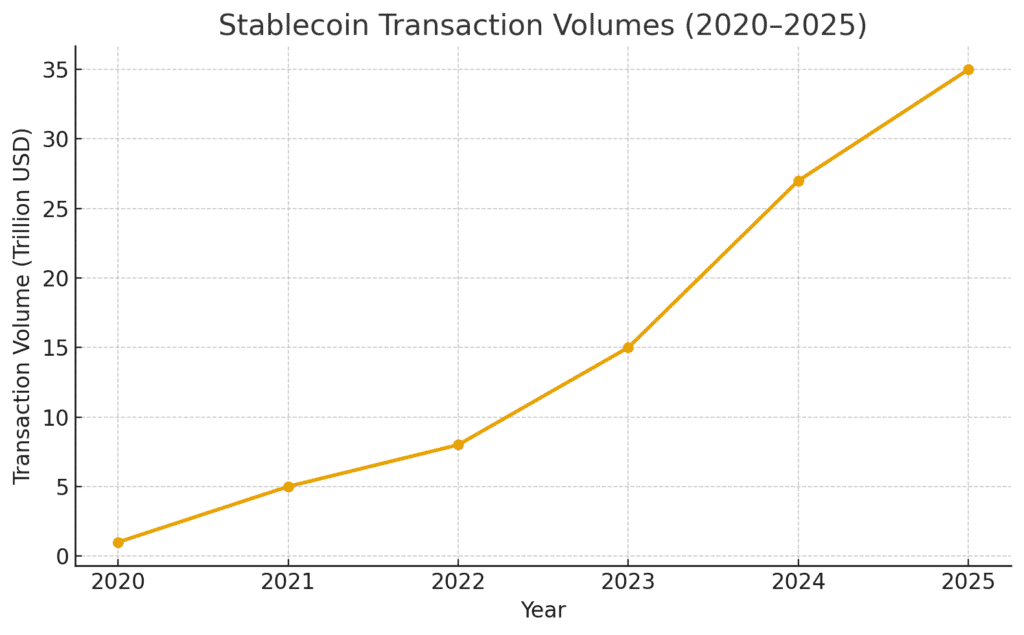
Volumes now rival card networks and the trend points up. Analysts and policy groups report that stablecoin transfer value topped twenty-seven trillion dollars in 2024, showing real use in trade, payroll, and remittances.
This guide explains how the rail works, where it saves money, what to watch, and how rules are evolving in the United States, Europe, and beyond. The goal is simple. Show a clear path to use stablecoins in cross border flows with strong controls and better outcomes.
Stablecoins in Cross-Border Payments Today
Stablecoins live on public blockchains. They represent fiat held in safe assets like cash, Treasury bills, and repos. Users move tokens wallet to wallet with finality on chain. That makes settlement fast and data rich.
Reports from McKinsey and FXC Intelligence point to rising supply and adoption across cross-border corridors in 2025. Supply doubled to roughly two hundred fifty billion to near three hundred billion this year, with forecasts calling for further growth as use cases scale.
Daily transfer activity now reaches tens of billions of dollars. This is not a niche. It is a new rail beside cards, wires, and mobile money. Banks, payment firms, and fintechs are testing live flows for trade payouts, marketplace settlement, and high value remittances.
How The Rail Works End-to-End
A cross border stablecoin transfer has four steps. First, an origin platform accepts local currency. Second, it buys or mints a token like USDC or USDT. Third, it sends the token on chain to the recipient wallet. Fourth, a destination platform redeems or swaps the token for local currency.
Each step runs on programmable rails, so invoices and references travel with the payment. Industry analysis highlights this data layer as a key edge over legacy cross border systems.
Firms can route on different chains. Solana offers low transaction fees and high throughput. Tron hosts a majority share of circulating USDT and is a common corridor rail.
Ethereum and its rollups add deep liquidity and broad developer support. Messari’s tracking shows a large swing of stablecoin activity to low fee chains, with Tron holding more than half of outstanding USDT supply.
Cost, Speed, and Transparency: A Quick Comparison
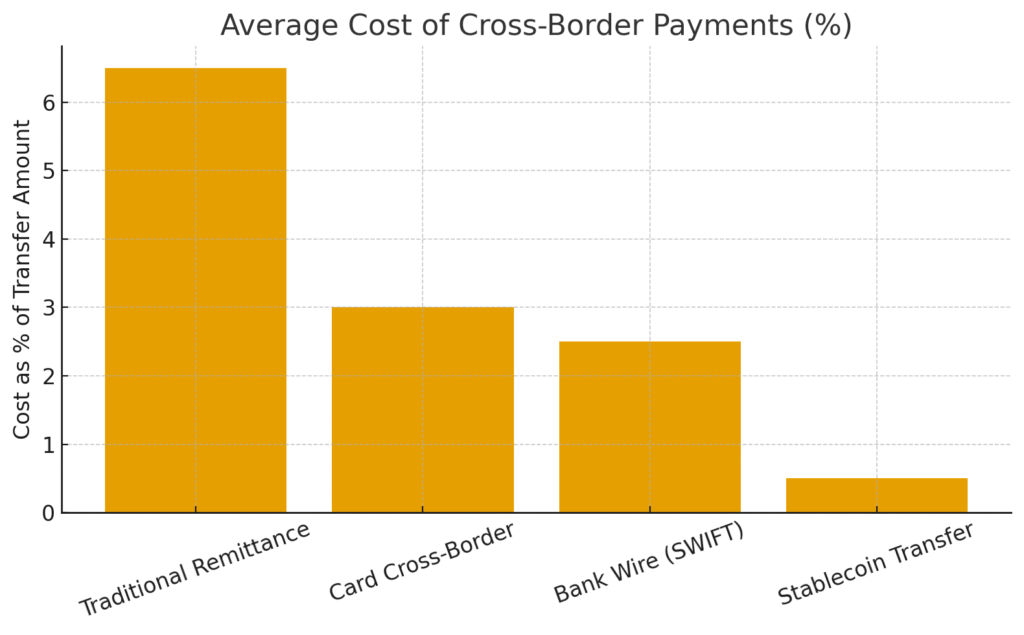
Card and wire systems include spreads, cross border fees, and correspondent charges. Public chain transfers add a network fee that is visible in real time. Solana and some rollups often clear for cents.
Recent network votes on Tron cut average fees further as tokens moved at higher coin prices. Cards can add one to three percent cross border charges on top of FX. Wires can add lifts and take days to settle.
Cross-border Payment Rails at a Glance
| Method | Typical total cost | Typical settlement time | Data visibility | Notes |
| Card cross border | One to three percent plus FX spread | Authorization is instant, funds settle in days | Limited invoice data | Networks and issuers set fees. Merchants bear most costs. |
| Bank wire SWIFT | Variable, often flat plus FX spread | One to three days or longer | Basic references | Dependent on correspondent banks and cutoffs. |
| Stablecoin on public chain | Often well under one percent plus small network fee | Near real time | Rich metadata on chain | Solana fees often cents. Tron reduced fees with a recent vote. |
These figures vary by corridor and risk controls, but the direction is clear. Stablecoins lower cost and time to value in many lanes.
Use Cases that Already Work
For businesses, stablecoin payroll and supplier payouts reduce working capital drag. A marketplace can settle cross-border seller balances many times per day, not once per week.
Banks and processors now publish roadmaps to support stablecoin rails next to wires and RTP. They call out faster settlement and simpler reconciliation as core benefits.
For remittances, the gap is clear. The World Bank reports a global average cost near six and a half percent for a two-hundred-dollar transfer, with a separate view showing four point two six percent average when sending five hundred dollars in the first quarter of twenty twenty five. Stablecoins can compress costs where on and off-ramps are efficient.
For treasury, dollar tokens act as twenty-four-seven working cash. They park in short dated funds or tokenize into yield-bearing forms in some regions. McKinsey notes tokenized cash and stablecoins are the first wave of next-gen payments.
Security and Regulatory Context with Real World Stats
United States: The GENIUS Act
Regulators now set clearer rules. In July 2025, the United States passed the GENIUS Act, the first federal framework for payment stablecoins. It requires redemption at par, strict reserve rules, and licensing for bank and nonbank issuers. Law firms and policy notes explain scope, oversight, and timelines. The White House released a fact sheet.
Europe: The MiCA Regime
Europe’s MiCA regime took effect in stages, with key dates from December 2024 and further transitions through 2026. It sets disclosure, issuance, and reserve standards for e-money tokens and asset-referenced tokens across the bloc.
United Kingdom: A Work in Progress
The United Kingdom is consulting on a domestic regime that stops short of bringing stablecoins fully into payments regulation for now, while building issuer and safeguarding rules.
Risks: Lessons from USDC
Risk is real. In March 2023, USDC fell as low as eighty-seven to eighty-nine cents after a bank in its reserve chain failed. Prices recovered as backstops and redemptions resumed. This event showed peg risk and the need for diversified reserves and clear disclosure.
Scale: Why It Matters
Scale is real too. Messari tracks hundreds of millions of users and a shift of flows to low fee chains. CoinDesk and other outlets report more than twenty seven trillion dollars in transfer value last year. Tether’s Treasury bill holdings exceed one hundred billion dollars per recent attestations, and academic work estimates a measurable effect on bill yields. These numbers underscore the link between stablecoin growth and public debt markets.
Choosing a Network: Cost, Reach, and Compliance
Tron supports a very large share of USDT in circulation and dominates some remittance corridors. A recent vote cut fees by sixty percent to restore low cost advantage after a coin price rally lifted network costs. Solana targets low fees by design and supports high throughput.
Ethereum and its rollups carry deep liquidity and broad custody support. Selection depends on corridor, partner banks, custody needs, and travel rule solutions.
Firms should model total cost to receipt in local currency. That includes network fees, spreads on fiat to token and token to fiat, and any platform charges.
Also model compliance cost. Jurisdictions now require screening, travel rule messaging, and record keeping on chain and off chain.
FXC Intelligence shows more earnings call mentions of stablecoins by public cross border firms, a sign that boards are asking for plans and controls.
Implementation Playbook for Banks, PSPs, and Marketplaces
Start with licensed on and off ramps in each corridor. Use guarded wallets with role based access and hardware backed signing. Add transaction screening for sanctions, wallet risk, and chain analytics.
Choose a travel rule provider and integrate messaging before turning on flows. Pilot low value corridors with clear user disclosures about token risk and redemption.
Banks and payment platforms are laying out roadmaps to mint, redeem, and route over stablecoin rails next to wires. They cite lower cost, faster settlement, and better cash control as key gains. They also stress the need to meet customer expectations on consumer protection and to avoid hidden complexity.
Add clear customer education. Explain that a payment stablecoin is not a bank deposit and not insured by the federal government, a point reflected in current bill texts. Communicate reserve backing, redemption timelines, and who the issuer is.
Policy and Public Sector Projects to Watch
Central banks test cross border CBDC platforms. The BIS mBridge project reached a minimum viable product stage in 2024 and continues to evolve.
Debate continues on the proper role of CBDCs versus private tokens. IMF notes show the policy goal to cut cross border costs toward three percent for remittances and lower for retail.
Commentary in major media now frames stablecoins as both a catalyst for modern payment rails and a source of policy risk if rules fall behind. Some economists warn about run risk and the chance of bailouts without robust oversight. That makes the new U.S. law and the EU regime important anchors.
The Business Case with Numbers
The gap between card cross-border fees and on-chain fees can add up fast for platforms with thin margins. EU rules cap some interchange levels but cross border e commerce can still face rate tiers that are above domestic caps.
Stablecoins cut the chain of intermediaries, reduce reconciliation delays, and can settle on weekends and holidays.
World Bank data shows the global average remittance cost remains well above the three percent target. Even a two-point drop in cost on a five-hundred-dollar transfer saves real money for families. At scale, this means billions in annual consumer savings if infrastructure and policy align.
Risks and How to Mitigate Them
Peg risk is the top concern. Diversify reserves and custodians. Favor issuers with daily or weekly disclosures and independent attestations. Monitor chain congestion and fallback paths across chains.
Operational risk matters. Use multi party controls on treasury wallets. Set per-transaction and per-day limits. Run proof of reserve checks on exchange partners.
Policy risk is dynamic. Track the GENIUS Act rulemaking and MiCA technical standards. Watch how the UK finalizes its regime. Keep records that map wallet owners to real customers with consent, and test travel rule messaging before production.
What the Next Five Years May Look Like
Most likely, stablecoins become a standard rail next to RTP, ACH, cards, and wires. Reports expect continued growth in supply and use, with some forecasts pointing at multi-trillion dollar market caps by the end of the decade. The payment stack blends tokenized deposits and regulated payment tokens behind user friendly front ends.
Governments will keep pushing for safer rails. The U.S. GENIUS Act sets a template that others may follow. Europe will refine MiCA through technical standards. Central banks will keep testing CBDCs for cross border use, but private tokens look set to carry much of the early load for business payments.
Conclusion
The path ahead is not about hype. It is about service levels. Stablecoins in Cross-Border Payments improve time to value, clarity, and control. The U.S. and the EU now define rules that reduce uncertainty. Costs can fall below legacy paths when on and off ramps are efficient. Risks exist, but they are manageable with sound reserves, strong controls, and clear disclosures.
Frequently Asked Questions About Stablecoins in Cross-Border Payments
What is a payment stablecoin?
A payment stablecoin is a digital token that tracks a fiat currency and is redeemable at par from its issuer. It moves on a public blockchain.
How do stablecoins lower cross border costs?
They remove layers of correspondent banks and card fees. The network fee is visible and often small, while FX can be routed more efficiently.
Are stablecoin payments instant?
They settle within minutes or seconds on chain. Off ramp to local cash depends on the partner bank or licensed exchange in the destination.
What did the U.S. GENIUS Act change?
It created federal licensing and reserve rules for payment stablecoin issuers. It requires redemption at par and sets oversight for banks and nonbanks.
What rules apply in Europe?
MiCA sets issuer and reserve standards for e-money tokens and asset-referenced tokens. It phases in across twenty twenty four to twenty twenty six.
What are the main risks?
Peg risk, reserve transparency, chain congestion, and compliance failures. A past depeg showed why diversified reserves and clear disclosures matter.
How do firms choose a chain?
Balance fees, speed, custody support, and corridor adoption. Solana is low fee. Tron carries large USDT flows. Ethereum and rollups bring deep liquidity. i
Glossary of key terms
- Payment stablecoin: A token that tracks a fiat currency and is redeemable at par from its issuer.
- On and off ramp: Services that convert fiat to tokens and tokens back to fiat.
- Travel rule: A rule that requires senders and receivers to share originator and beneficiary data for covered transfers.
- Tokenized deposits: Bank deposits issued as tokens on a ledger under banking rules.
- MiCA: The Markets in Crypto Assets regime for the European Economic Area that covers issuers and service providers.
- GENIUS Act: The U.S. federal law that sets a framework for payment stablecoins.
- Finality: A point when a transaction cannot be reversed on a blockchain.
- Attestation: An independent report on reserves held by an issuer.
- CBDC: A digital currency issued by a central bank used for retail or wholesale payments.
- Correspondent banking: A model where banks use other banks to reach foreign accounts, often adding time and cost.
Summary
This article explains how stablecoins reshape cross border money movement with faster settlement, lower visible fees, and richer data. It outlines how the rail works, compares costs to cards and wires, and shows where businesses already gain in payroll, marketplaces, and remittances. It then maps policy changes. The U.S. GENIUS Act sets a federal regime for payment stablecoins. MiCA does the same across Europe, while the UK develops its own rules. Real events like the USDC depeg show risks, while large reserve holdings and rising volumes show scale. The guide closes with a playbook for banks and fintechs and a realistic five year view. The takeaway is clear. Stablecoins can become a standard rail next to legacy systems when built with strong reserves and control