





The Orbs V5 upgrade has gone live on Ethereum and Arbitrum with a hybrid Layer 3 design. The system moves complex DeFi execution logic off-chain while keeping verification anchored to two major settlement networks.
The launch targets advanced DeFi automation. It focuses on order execution, liquidity routing, and trading tools that are often too costly or limited when handled directly on-chain.
Orbs V5 Upgrade Reduces Multi-Chain Verification Costs
The Orbs V5 upgrade introduces Committee Sync, a mechanism that shares committee state across EVM-compatible chains. It uses Guardian signatures instead of separate verification contracts on each network.
This structure aims to reduce cost and fragmentation. It also supports wider deployment for Orbs products across decentralized exchanges and EVM chains.
The upgrade supports dTWAP, dLIMIT, Liquidity Hub, Perpetual Hub, dSLTP, and Orbs Agentic. These tools need reliable off-chain computation with secure on-chain settlement.
Orbs operates as a Layer 3 execution layer for DeFi. It does not replace Ethereum or Arbitrum. Instead, it extends their smart contract systems with off-chain execution services.
Executors run trading logic outside the base chain. They check order conditions, routing paths, and execution triggers. After that, they create signed actions for verification.
The Guardian network verifies these actions. Smart contracts on destination chains then confirm them through signatures and registry rules.
Committee Sync Reduces Chain Fragmentation
Committee Sync is the main technical change in the release. It creates one authoritative committee state from the Orbs Layer 3 network.
That state can then move across supported EVM chains through signed messages. This avoids the need to recreate a full verification process on every network.
The Orbs V5 upgrade therefore addresses a key DeFi infrastructure problem. Many protocols face higher costs when they expand advanced trading tools across several chains.
Ethereum and Arbitrum Act as Security Anchors
Ethereum and Arbitrum are the first chains used in the rollout. They serve as primary security anchors for the root committee state.
This means cross-chain propagation begins from settlement layers with deep liquidity and strong DeFi activity. The model gives Orbs a base for wider EVM expansion.
The design also separates Orbs from standard Layer 2 systems. Layer 2 networks usually batch transactions. Orbs keeps execution logic with specialist off-chain nodes and verifies results on-chain.
Upgrade Targets Advanced Trading Tools
The Orbs V5 upgrade focuses on DeFi automation rather than simple token transfers. Its supported tools include advanced order types and liquidity systems.
dTWAP helps split large trades over time. dLIMIT supports limit orders on decentralized exchanges. Liquidity Hub and Perpetual Hub improve routing and execution options.
These functions require repeated checks and conditional logic. Running that process fully on-chain can be expensive. Off-chain execution can reduce that burden while keeping final verification on-chain.
User Funds Do Not Move During Synchronization
Orbs said the synchronization process moves signed state data only. It does not transmit user funds between chains.
That detail is important for risk management. Cross-chain systems can create custody concerns when assets move through bridges or middle-layer contracts.
In this model, smart contracts enforce settlement rules on the target decentralized exchange. User funds are not placed inside the synchronization process itself.
V4 Activity Provides Usage Context
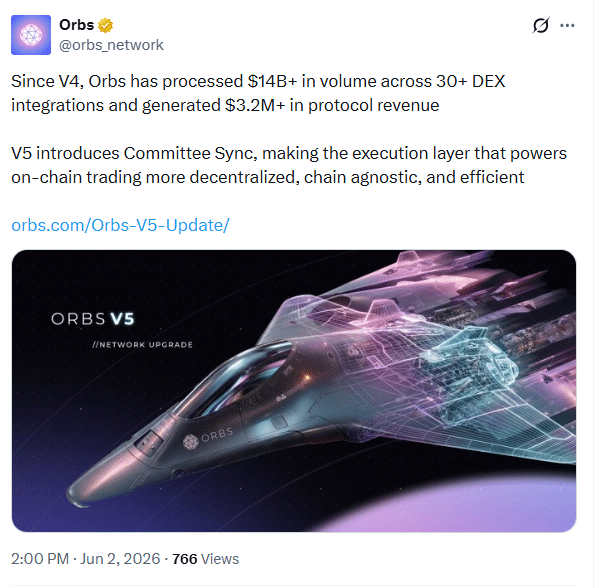
Since the V4 release, Orbs said its execution layer has processed more than $14 billion in trading volume. It has also supported more than 30 decentralized exchange integrations.
The network has operated across more than 10 blockchain networks. Orbs also reported more than $3.2 million in protocol revenue from the execution layer.
These figures give context to the Orbs V5 upgrade. The new version builds on existing DeFi integrations instead of starting from a new deployment base.
More EVM Chains Are Planned
The rollout starts on Ethereum and Arbitrum. Orbs plans to expand V5 to Base, Polygon, BNB Chain, Avalanche, Linea, Sonic, Berachain, and Monad.
That expansion map targets chains with active DeFi markets. It also reflects the growing spread of trading volume across Ethereum Layer 2 networks and alternative EVM ecosystems.
For DeFi protocols, the main test will be adoption. Lower verification costs must translate into better tools, deeper integrations, and practical trading use cases.
Conclusion
The Orbs V5 upgrade gives Orbs a larger role in DeFi automation infrastructure. It combines off-chain execution with on-chain verification across Ethereum, Arbitrum, and future EVM chains.
Its success will depend on real usage by decentralized exchanges and trading applications. If Committee Sync lowers costs at scale, Orbs could become a stronger base layer for advanced DeFi execution.
Appendix Glossary of Key Terms
Layer 3: A blockchain layer that adds specialized services above Layer 1 and Layer 2 networks.
Committee Sync: A mechanism that shares Orbs committee state across EVM-compatible chains.
Guardian signatures: Signed approvals used to verify actions across supported blockchain networks.
DeFi automation: Automated trading and liquidity functions used by decentralized finance protocols.
dTWAP: A tool that splits large trades into smaller orders over time.
dLIMIT: A decentralized limit order tool for automated trade execution.
EVM chains: Blockchains that support Ethereum smart contracts and developer tools.
On-chain verification: A process where smart contracts confirm actions directly on a blockchain.
Frequently Asked Questions About Orbs V5 upgrade
1- What is the Orbs V5 upgrade?
The Orbs V5 upgrade is a Layer 3 architecture update. It supports off-chain DeFi execution and on-chain verification.
2- Which chains support the launch?
The upgrade launched on Ethereum and Arbitrum. More EVM chains are planned in later phases.
3- What is Committee Sync?
Committee Sync shares Orbs committee state across chains through Guardian signatures. It helps reduce the need for separate verification systems on each network.
4- Does the upgrade move user funds across chains?
No. Orbs said only signed state data moves during synchronization. User funds are not transmitted through the protocol.
References