







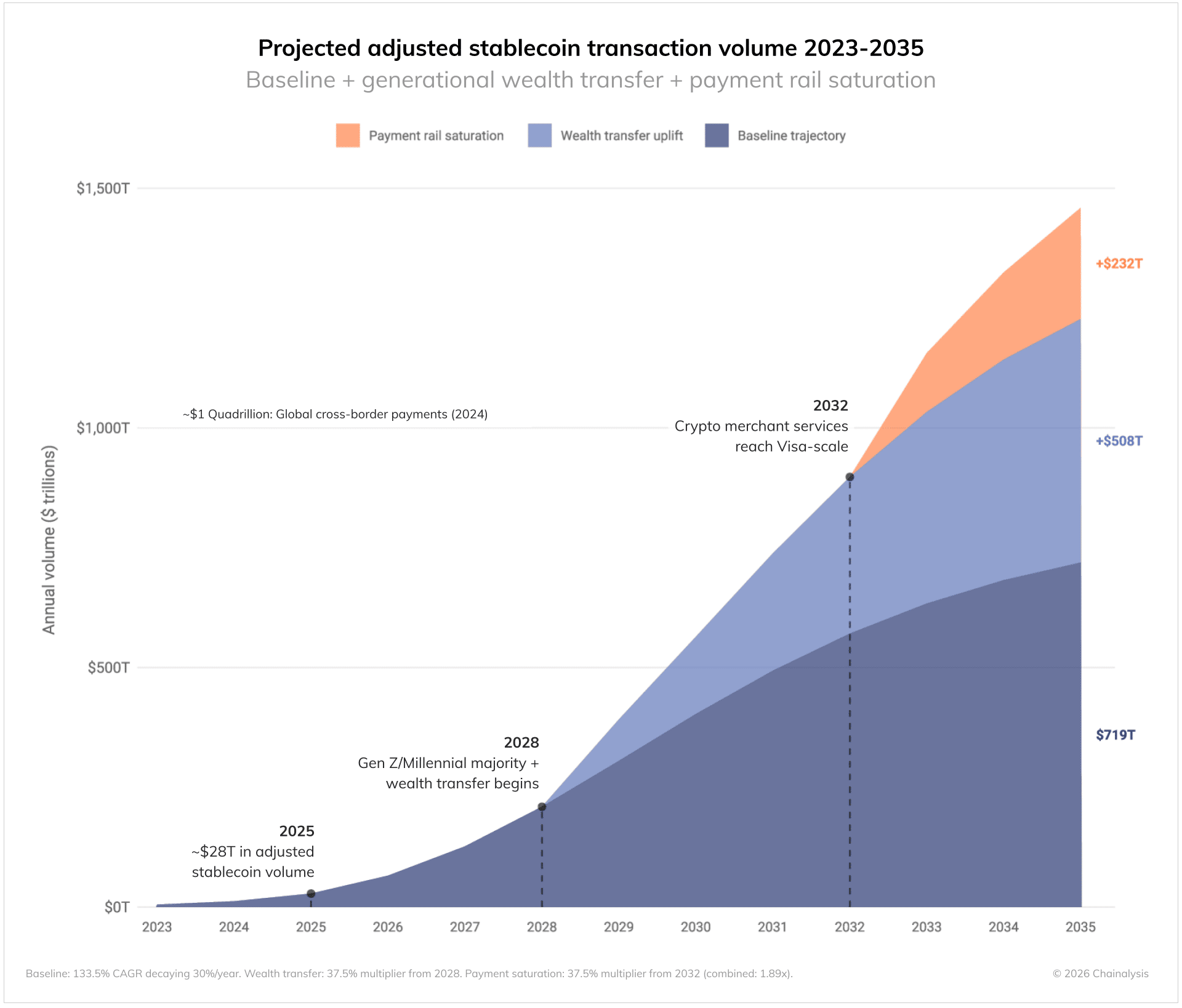
An expansion could be in store for the stablecoin market. According to Chainalysis, Stablecoin transaction volumes could grow from $28 trillion in 2025 to $719 trillion by 2035 just through organic growth, and potentially as high as $1.5 quadrillion under certain macro conditions.
This stablecoin volume forecast casts stablecoins as a limited crypto instrument and even the spine behind the global payment system.
A Strong Baseline Is Already Set With Organic Growth
To achieve $719 trillion in aggregate stablecoin volume within the coming decade, Chainalysis notes that it would require a sustained compound annual growth of approximately 133% per year.
Transaction volume, for example, differs from market capitalization in that it quantifies the extent to which funds exchange hands across different networks.
“Volume measures how many times money moves, not how much exists; the same dollar can settle dozens of transactions a day,” said Rachael Lucas, a crypto analyst at BTC Markets.
The baseline growth is fueled by growing utility. Stablecoins are now widely used for purposes beyond trading, including for payments, treasury operations and remittances. This indicates that the market is moving from storage of value to velocity.
Macro Catalysts Can Send the Market Up 100%
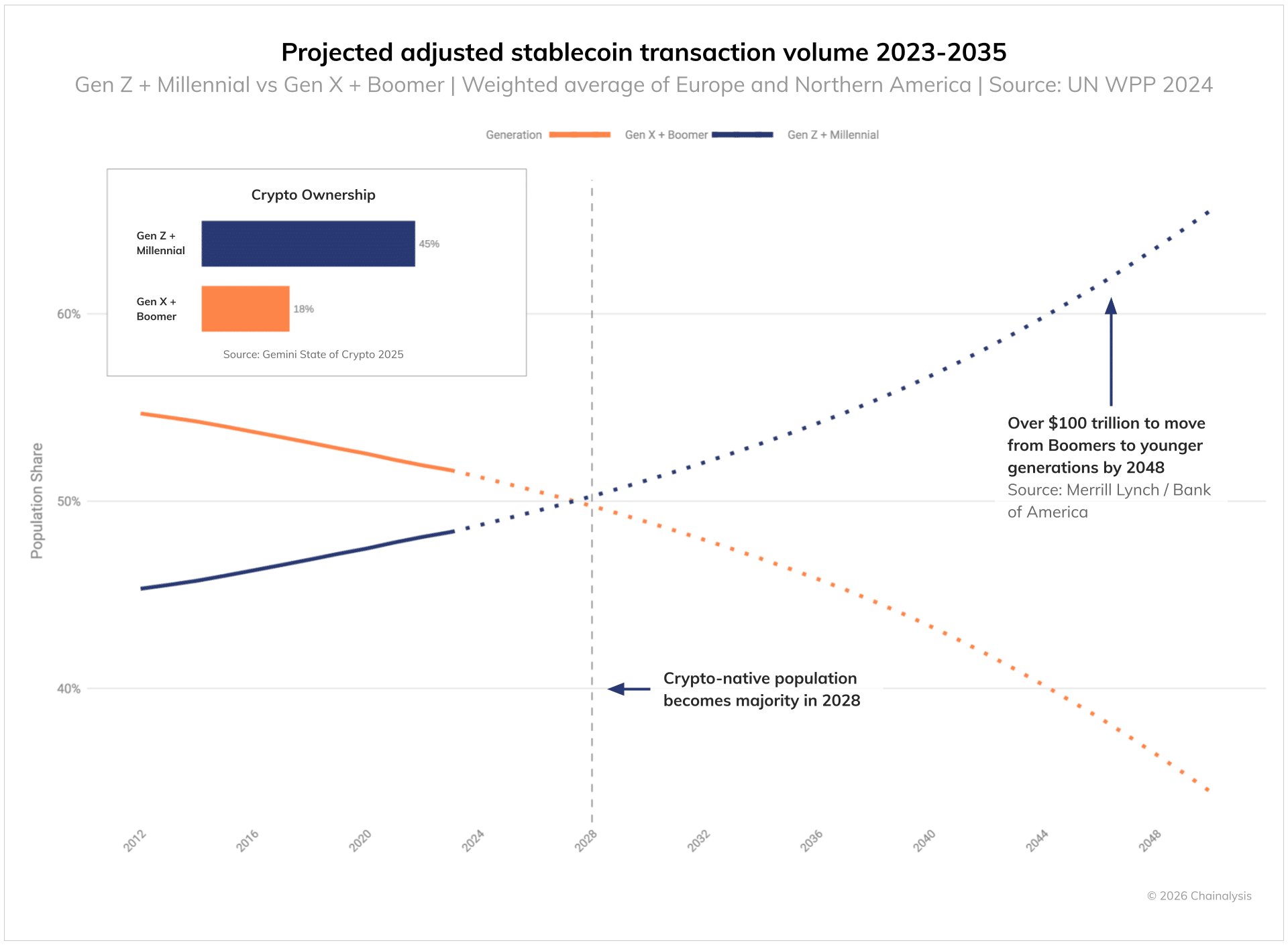
The increase from $719 trillion to $1.5 quadrillion stablecoin volume is the result of two fundamental causes. The first one is the transfer of generational wealth. An approximate value of $100 trillion is expected to move from baby boomers cohorts towards young crypto-native cohorts including Millennials and Gen Z, who view on-chain financial infrastructure as the default settlement method.
Secondly, stablecoins are ever ready to replace traditional payment rails. New partnerships like that of Stripe and Bridge, and Mastercard working with BVNK are continuing to incorporate stablecoins into traditional commerce.
“These are operational bets, not experiments,” Lucas remarked, indicating that regulatory clarity via actions like the GENIUS Act could push institutional adoption and create the infrastructure needed for project growth.
Adoption and Institutional Participation Strengthen the Outlook
Institutional adoption is already on the way. According to a report from EY-Parthenon in September 2025, globally 13% of financial institutions and corporates currently use stablecoins while 54% of the non-users anticipate adopting within the next twelve months.
Demographic engagement also supports growth. According to a general survey, 40% of Gen Z members and 36% of Millennials in the U.S. intend to act more actively on crypto this year, while only 11% of Boomers do believe that they are going into this direction.
This mix of generational adoption and corporate integration guarantees that stablecoin volumes will grow organically but also can reach unexpected heights should these trends continue.
Impact on Global Payments and Financial Architecture
According to World Population Review, if stablecoin volumes reach the $1.5 quadrillion ceiling scenario, they would surpass the current $1 quadrillion in global cross-border payments and approach the total estimated value of all global assets across banks, property, and cash, roughly $662 trillion.
This could mean that stablecoins have the potential to compete with old payment networks such as Visa and Mastercard for use cases focused on high-frequency settlement.
The industry is already seeing early stage signs of this in the market where corporate treasuries are testing their liquidity management on stablecoins and payment rails on-chain.
Conclusion
Chainalysis stablecoin volume prediction reveals the power of stablecoins to revolutionize the global financial system.
While the $719 trillion baseline scenario is already remarkable, incorporating macro catalysts such as wealth transfer and payment rail disruption could propel volumes toward $1.5 quadrillion by 2035.
These developments are pointing to a future where stablecoins are not merely an adjunct to crypto trading but emerging like an entire, infrastructural layer for both institutional and consumer financial activity.
Glossary
Stablecoins: Cryptocurrencies that are pegged to a fiat currency or assets, and designed to maintain a stable value.
CAGR: Compound annual growth rate; a metric for multiple-period growth.
On-chain: Transactions that are settled on the blockchain.
Payment Rail: A system that allows the movement of money between parties.
Frequently Asked Questions About Stablecoin Volume Prediction
What does $1.5 quadrillion in stablecoin volume mean?
It is an estimate of the total movement of money by stablecoins, which could be greater than current global cross-border payments volume of $1 quadrillion per year.
How do generational wealth transfers influence stablecoin growth?
Younger generations are more accustomed to on-chain transactions, and inherited wealth is thus likely to move through stablecoins instead of the old banking system.
Are these projections guaranteed?
No. The $1.5 quadrillion number is a high mark scenario; the baseline projection is $719 trillion in 2035. Yet it’s still a long way off to realization, dependent on adoption rates, regulatory clarity and infrastructure expansion.
References