






Cracking the Code: Market Capitalization in Crypto
Crypto market capitalization is a key indication in the digital asset universe. It gives traders, developers, and financial analysts an accurate view of a cryptocurrency’s size, value, and supremacy. Without it, investors would be unsure if a coin is a true leader or simply another pump-and-dump scheme.
Simply said, crypto market capitalization is computed by multiplying a coin’s current price by its total circulating supply. This statistic depicts the overall worth of a project at any particular period. It is define it as “the most reliable lens for sizing up crypto assets,” since it blends price performance with supply reality.
Why Crypto Market Capitalization Shapes the Leaderboard
Every time Bitcoin, Ethereum, or Solana are ranked in the world rankings, the placement is determined by crypto market capitalization. Bitcoin is at the top of the list, with a market value of more than $2 trillion, followed by Ethereum, which has more than $600 billion. Solana has also risen through the ranks, raising arguments on social media about whether it will one day rival Ethereum.
Traders sometimes use the term “altcoin season” to describe periods in which mid-cap currencies beat Bitcoin. However, without cryptocurrency market capitalization as a comparative tool, these storylines would be hard to follow. This one statistic distinguishes between hype and true rise in rankings.
Large-Cap, Mid-Cap, and Small-Cap: Risk in Numbers
One of the most valuable aspects of crypto market capitalization is its use in risk analysis. Large-cap currencies, like Bitcoin and Ethereum, symbolize stability, liquidity, and significant institutional interest. They travel slowly than smaller coins and have fewer shocks.
Mid-cap assets, such as Solana or Avalanche, strike a balance between risk and profit. Their cryptocurrency market value is large enough to indicate adoption, but tiny enough to cause dramatic price fluctuations. However, small-cap currencies are like the Wild West.
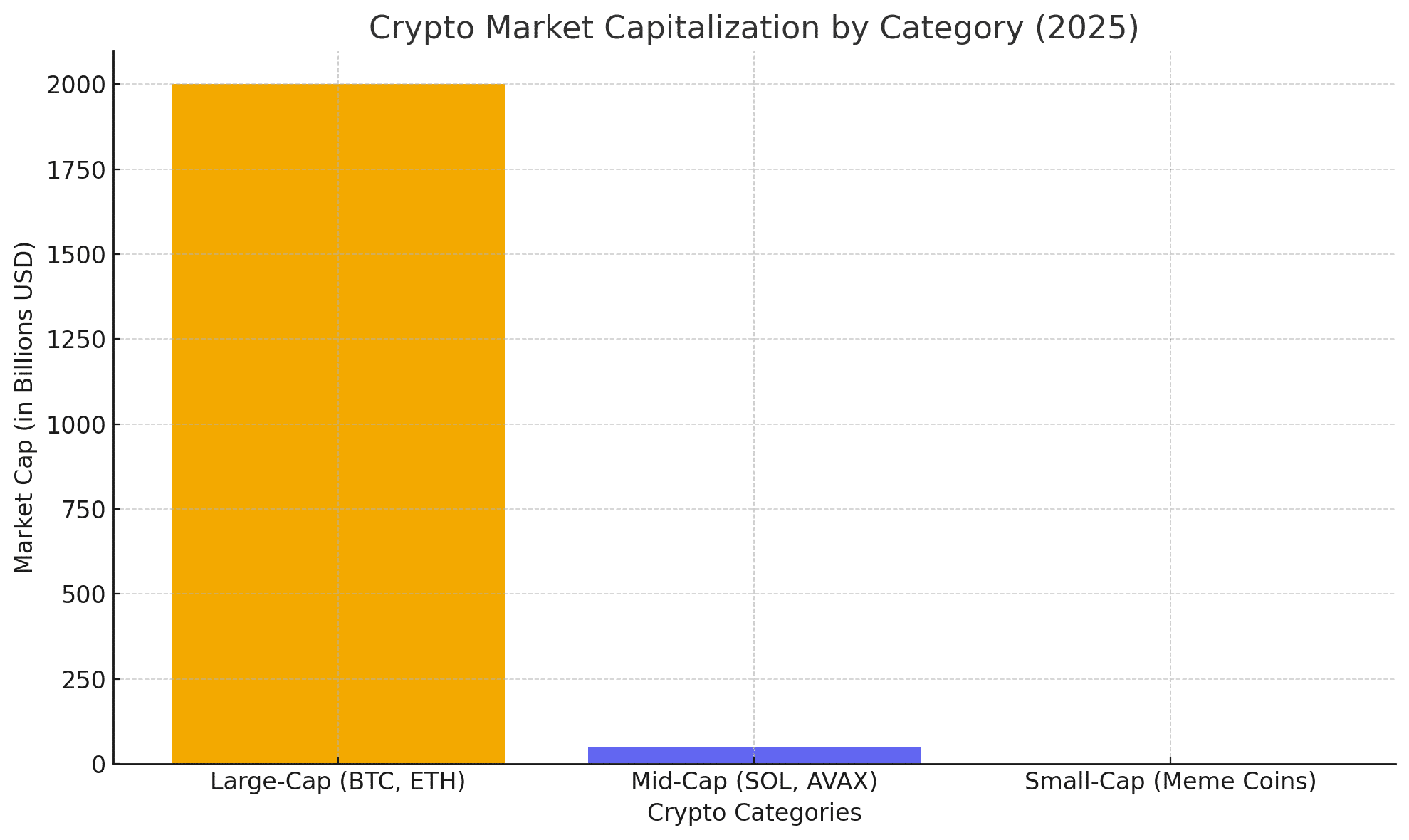
Lower market capitalization might result in big wins or wipe out traders overnight. Projects with smaller market values have a greater likelihood of fraud and manipulation, making this measure an important warning mechanism.
Crypto Market Capitalization vs Trading Volume
Some amateurs mistake cryptocurrency market capitalization with trade volume. They are different but complementary. Market capitalization represents the entire value of coins in circulation, whereas volume reflects how much of that asset is exchanged each day.
A cryptocurrency with a large crypto market valuation but low trading volume may lack liquidity. Meanwhile, a smaller currency with a large daily volume may be trading just for speculation. Analysts note that combining both data provides a more accurate view of market health.
Fully Diluted Valuation and Hidden Supply
Another aspect to consider is fully diluted value (FDV). FDV estimates a project’s worth if all tokens, including those locked for team incentives or staking, were in circulation. Messari’s 2024 research emphasized that disregarding FDV might lead investors to overestimate a project’s value.
This is where cryptocurrency market capitalization might be misleading. A token’s FDV may look robust now, but it might indicate future supply pressure that pushes down price. For traders, considering both metrics is like to checking the weather prediction before sailing—the sky may appear clear now, but storms may be on the way.
Real-World Case Studies on Crypto Market Capitalization
In 2021, meme currencies had incredible profits, but their market capitalizations remained small in comparison to Bitcoin. By 2025, several had fallen, demonstrating that a short-term boost does not ensure long-term success. The market cap revealed the fragility of the euphoria.

In contrast, Solana’s increasing cryptocurrency market value has been a popular subject in internet trading circles. Analysts disagree if its increase indicates genuine acceptance in decentralized finance. “If Solana keeps scaling, its cap will force institutions to take it seriously,” commented one researcher on X. This demonstrates how the crypto market capitalization influences narratives throughout the sector.
Institutional Gateways: Market Cap as a Filter.
Institutions do not enter the market unprepared. Many funds utilize crypto market capitalization as a screening before accepting an asset. Due to liquidity issues, a coin with a low cap may be ineligible for inclusion in an ETF or regulated portfolio.
This explains why Bitcoin and Ethereum dominate exchange-traded products, whereas smaller tokens struggle to acquire momentum. Regulators, like the SEC, frequently use crypto market capitalization to determine if an asset can maintain institutional exposure.
Why Every Trader Should Monitor Market Cap
Ignoring bitcoin market capitalization is akin to driving without a speedometer. This statistic is used by traders to assess opportunities, dangers, and market domination.
Bitcoin’s dominance, frequently expressed as a percentage of global crypto market capitalization, provides insight into whether money is pouring into altcoins or back into the safety of BTC. This indicator helps traders predict probable market cycles and rotations.
Conclusion: Market Cap as a Compass for Crypto Investment
In 2025, crypto market capitalization will be more than a ranking system; it will serve as a compass for all serious investors. It distinguishes long-term initiatives from short-term speculation, informs institutional tactics, and provides traders with a consistent signal in volatile markets.
From Bitcoin’s trillion-dollar supremacy to Solana’s rapid rise, crypto market capitalization reflects value, trust, and competitiveness. Traders who grasp it acquire more than just information; they obtain the clarity necessary to manage an unpredictable market.
This article is for informational purposes only and does not constitute financial advice. Readers should conduct their own research before making any investment decisions.
Glossary
Crypto Market Capitalization: The total value of a coin, calculated by price × circulating supply.
Circulating Supply: Number of coins currently available in the market.
Fully Diluted Valuation (FDV): The projected value if all tokens were unlocked.
Trading Volume: The amount of a token traded in a given period.
Liquidity: Ease of buying or selling an asset without affecting its price.
Altcoin Season: Period when altcoins outperform Bitcoin in percentage growth.
FAQs for crypto market capitalization
1. What is crypto market capitalization?
It is the total value of a cryptocurrency, determined by price × circulating supply.
2. Why does crypto market capitalization matter?
It signals risk levels, liquidity, and dominance among digital assets.
3. How is crypto market capitalization different from trading volume?
Market cap measures value, while trading volume measures daily trading activity.
4. What is the role of FDV in valuations?
FDV warns of potential supply dilution that could affect prices.
5. Can crypto market capitalization predict future growth?
Not directly, but it indicates scale and investor interest in a project.