
Robert Kiyosaki is once again predicting a worldwide economic crash and has said that the market crash expected between 2026-2027 could turn into depression-like events, while also presenting a rare opportunity for prepared investors.
The Rich Dad Poor Dad author shared via posts on social platform X that bear markets have always been his best performing moments. Instead of presenting the upcoming cycle as a threat, he presented it as an opportunity in which disciplined investors can stock up on assets at deeply discounted prices.
Kiyosaki’s 2026-2027 Crash Warning Builds on Longstanding Concerns
Although the Robert Kiyosaki market crash warning is not a new one, over the past several weeks it has become far more intensified. Specifically; he posited that the next downturn could be more like a Great Depression event than a standard cyclical correction.
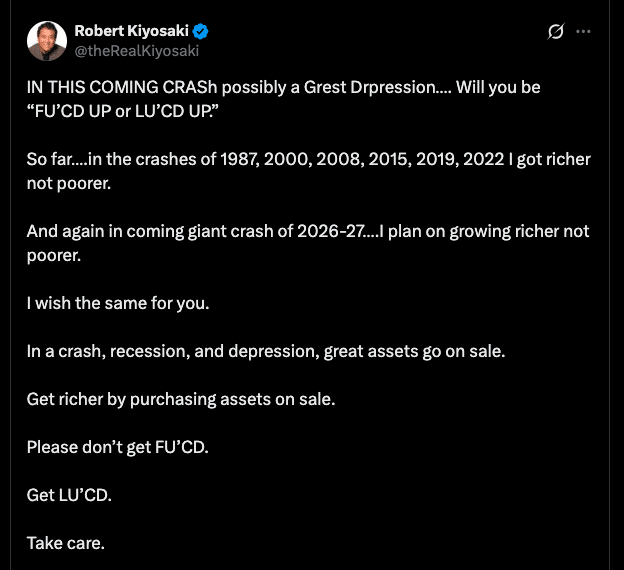
In his recent comments, Kiyosaki pointed to a consistent pattern across past crises; referencing market crashes in 1987, 2000, 2008, 2015, 2019, and 2022, all of which he claims increased his wealth rather than diminished it.
Following this pattern, he puts forward a question; “Will you be destroyed or will you take the opportunity?
His approach remains unchanged that downturns are not events to avoid entirely, but moments to deploy capital strategically.
Strategy Centers on Buying Discounted Assets During Panic
The Robert Kiyosaki market crash warning is based on one simple yet aggressive philosophy of investing; buy when others are forced to sell.
According to Kiyosaki, aggressive liquidations in times of crisis lead to undervaluation of strong assets. He calls this a sort of “sale” environment, where investors coming in with cash can buy long-term positions at discounted prices.
He has repeatedly stressed that:
Crashes reveal weak hands while rewarding diligent and well-prepared investors
Liquidity, not timing, determines success during downturns
Emotional reactions especially panic selling are the biggest risk
That view is consistent with his past patterns, using prior crashes to build positions rather than exit markets.
Debt and ‘Everything Bubble’ Drive Bearish Outlook
Kiyosaki has consistently described current conditions as an “Everything Bubble,” caused by: Excessive global debt accumulation; Years of loose monetary policy and Declining confidence in fiat currencies.
He argues that the financial crisis of 2008 was never really solved; but only delayed through increased borrowing and monetary intervention.
This buildup, in his view, increases the likelihood that the next downturn will be deeper and more widespread; potentially affecting equities, real estate, pensions, and government-backed systems simultaneously.
Recent reports also link his warning to macro stress signals; including rising oil prices and geopolitical conflict; which are adding pressure to already fragile markets.
Bitcoin, Gold, and Silver Remain Central to His Strategy
While the Robert Kiyosaki market crash warning is bearish, his portfolio allocation approach has not changed.
He still prefers scarce non-fiat assets, especially Bitcoin, Gold and Silver.
Kiyosaki said recently that he purchased more Bitcoin close to the $67,000 level and remains convinced by its long-term value.
In multiple statements; he has described these assets as alternatives to fiat-based systems, arguing they are less vulnerable to central bank policies and currency debasement.
Robert Kiyosaki has warned that the next recession likely won’t be limited to America alone, pointing to economic distress throughout Europe and Asia. Rising debt levels, tightening liquidity; and interconnected financial systems increase the risk of a synchronized global correction.
Conclusion
Another Robert Kiyosaki market crash warning reinforces a familiar but increasingly urgent narrative that a major downturn may be approaching; but it does not have to be destructive for everyone.
Using historical cycles in which he generated gains from declining markets as a guide, Kiyosaki presents the context of positioning over forecasting. He has focused on Bitcoin, gold and silver due to ongoing inflation, debt and whether fiat systems can survive.
Whether the 2026-2027 recession period unfolds as he expects, still remains uncertain.
Glossary
Everything Bubble: A term describing inflated valuations across multiple asset classes due to excessive liquidity.
Fiat currency: A government-issued currency that is not backed by a physical commodity.
Liquidity: cash or other assets that can be easily converted to spendable money for investment.
Safe-Haven Assets: Investments such as gold; Bitcoin that can weather market storms.
Frequently Asked Questions About Robert Kiyosaki Warning
What is Robert Kiyosaki predicting for 2026-2027?
He forewarns that a market crash is approaching that could look much like a depression-era situation.
Why does Kiyosaki look at crashes as opportunities?
He thinks downturns create opportunities to acquire quality assets for less.
What assets does Kiyosaki recommend?
He prefers Bitcoin, gold and silver as a hedge against the inflation risk.
What is the “Everything Bubble”?
It refers to inflated asset prices driven by excessive debt and monetary easing.
How should investors prepare according to Kiyosaki?
By holding liquidity, avoiding panic, and positioning to buy during market declines.
References