
This article was first published on The Bit Journal.
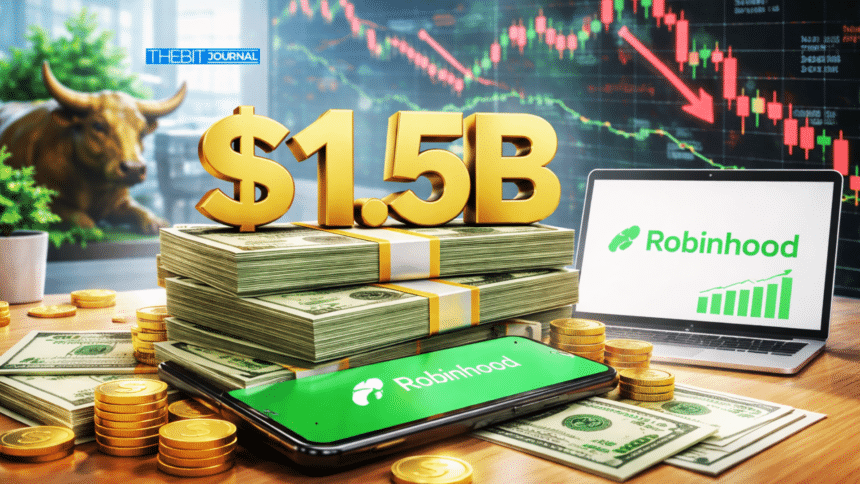
Robinhood share buyback takes center stage as per the company’s latest Securities and Exchange Commission filing, where the trading platform confirmed a $1.5 billion repurchase authorization amid a sharp decline in its stock performance in 2026. The announcement comes during a period of heightened volatility across crypto and technology markets, shaped by ongoing geopolitical disruptions.
Shares have faced consistent pressure this year, reflecting weakness in both equities and digital assets. The development places renewed focus on how the company plans to balance shareholder returns with long-term growth while navigating external risks.
What does the Robinhood share buyback reveal about its strategy?
Robinhood share buyback shows that the company’s leadership believes its current stock price does not fully reflect its true value, even as markets remain weak. The board has approved a $1.5 billion buyback plan, which will be carried out over the next three years. Out of this, $1.1 billion is new capacity, while the rest comes from an earlier program.
Shiv Verma, the company’s financial chief, said, “Robinhood is a generational company with a massive long-term opportunity.” He explained that the move reflects confidence in the company’s ability to keep building new products while also returning value to shareholders over time. In general, such buybacks suggest that management sees the stock as undervalued compared to its long-term prospects.
Why is the stock under pressure despite the Robinhood share buyback?
Robinhood share buyback comes when the company’s stock faces ongoing pressure from economic uncertainty and weak crypto markets. $HOOD shares dropped 4.7% on Tuesday to close at $69.08, the lowest this year. In after-hours trading, the stock edged up slightly to $70.90. The broader trend remains concerning.
The stock is down nearly 39% year-to-date and has declined 54.7% from its October peak of $152.46. Market participants have linked this downturn to geopolitical tensions, including the Iran war, alongside a wider sell-off in risk assets. Despite this, the stock has gained nearly 43% over the past 12 months, driven by expansion into prediction markets and banking services.
How does the Robinhood share buyback fit into its financial position?
Robinhood share buyback is backed by a stronger financial setup, with the company improving its access to funds. It confirmed that its unit, Robinhood Securities, has arranged a $3.25 billion revolving credit facility with JPMorgan Chase. This replaces the earlier $2.65 billion facility and also gives room for expansion by another $1.62 billion, taking the total possible limit up to $4.87 billion.
This access to capital provides flexibility as the company balances shareholder returns with operational and strategic investments. Market observers note that such financial backing is critical for executing large-scale buybacks without constraining growth initiatives.
What are analysts indicating about future price outlook?
The Robinhood share buyback has attracted attention from analysts, who maintain a measured outlook on the stock despite near-term volatility. As per TipRanks data, the 12-month average price target stands at $123.85, accompanied by a consensus “strong buy” rating from 16 Wall Street analysts.
This indicates meaningful recovery potential, although execution remains contingent on the company’s ability to navigate macroeconomic headwinds and persistent crypto market volatility. While analysts generally view buybacks as a constructive signal, they underscore that timing and execution pace will ultimately dictate shareholder value creation.
How is the company expanding beyond trading amid the Robinhood share buyback?
Robinhood share buyback is unfolding alongside continued expansion into new business segments, particularly in blockchain infrastructure and tokenization. The company recently launched its Arbitrum-based Ethereum layer-2 network testnet, with CEO Vlad Tenev confirming that it processed 4 million transactions within its first week of public activity.
This network, called Robinhood Chain, supports tokenized equities, exchange-traded funds, and other traditional financial instruments. Mainnet launch comes later this year. These moves show the company’s push to diversify revenue beyond regular trading, even with uneven crypto markets.
Conclusion
The Robinhood share buyback marks a defining moment for the company. As it faces market volatility and stays committed to its long-term strategy. A $1.5 billion authorization, stronger liquidity, and new product development help Robinhood deliver shareholder value while pursuing innovation.
While the buyback program and analyst outlook reflect underlying confidence, persistent macroeconomic pressures and crypto market weakness may constrain its near-term impact. The success of forthcoming initiatives including the Robinhood Chain mainnet launch will likely prove instrumental in shaping investor sentiment moving forward.
Glossary
HOOD Stock: Ticker symbol representing Robinhood shares in the market
Capital Return Strategy: Method of giving profits back to shareholders
Revolving Credit Facility: Flexible loan access that can be reused up to a limit
Share Repurchase Program: Planned buyback of shares over a defined period
Undervalued Stock: Shares priced below their perceived true worth
Frequently Asked Questions About Robinhood Share Buyback
What is the Robinhood share buyback?
Robinhood share buyback is a plan where the company buys back its own shares worth $1.5 billion.
Why is Robinhood buying back its shares?
Robinhood is buying back shares as it believes its stock price is lower than its true value.
How much money is included in the buyback plan?
The total buyback plan is worth $1.5 billion including both new and old funds.
Why is HOOD stock falling despite the buyback?
HOOD stock is falling due to weak crypto markets, economic uncertainty, and global risks.
How is Robinhood supporting this buyback financially?
Robinhood is using strong financial support. Which includes a large credit facility to manage the buyback.
Sources: