
21Shares has released a detailed report showing that Solana generated $2.85 billion in revenue between October 2024 and September 2025. The Solana revenue comes from a mix of DeFi, AI, trading tools, memecoins, DePIN, launchpads and DEX usage. Trading platforms alone accounted for 39%, or $1.12 billion, of that total, with apps like Photon and Axiom driving the numbers.
Compared to Solana; the report notes that at the same stage, Ethereum’s monthly revenue was under $10 million.
Solana’s $2.85B Breakdown
The 21Shares report shows that from October 2024 to September 2025, Solana averaged $240 million per month in revenue; with a peak month January 2025; of $616 million due to the meme coin boom (TRUMP coin).
During the hype months, revenue spiked, but even after the frenzy died down, monthly income stabilized between $150 million and $250 million. So while the meme coin surge added the fireworks; Solana revenue base was diversified and robust.
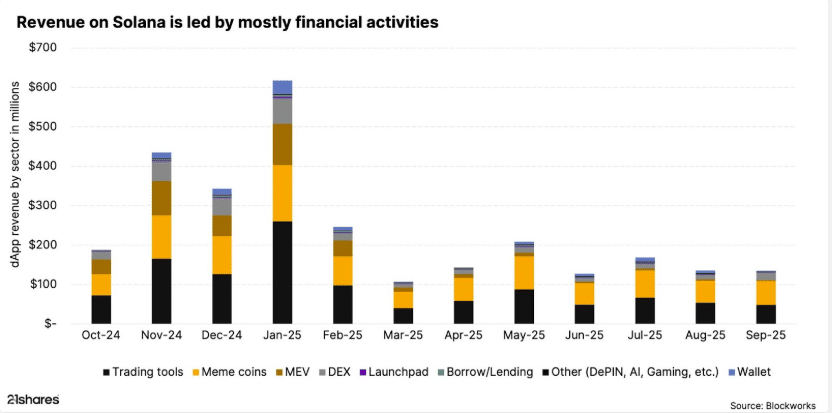
Fees collected by validators come from a wide range of on-chain activities: DeFi protocols, memecoins, AI-based apps, decentralized exchanges, DePIN infrastructure, launchpads and trading tools.
Of all these sectors, trading platforms are the biggest revenue generator with 39% or $1.12 billion over the year, driven by Photon and Axiom.
Also read: Ethereum vs Solana 2025: Which Blockchain Will Anchor the Future of Global DeFi?
Solana vs Ethereum
Experts have said some of this is due to Solana’s low fees and high throughput which attracts more users and developers. The report also notes that Solana has between 1.2 and 1.5 million daily active addresses which is three times Ethereum’s count at the same stage.
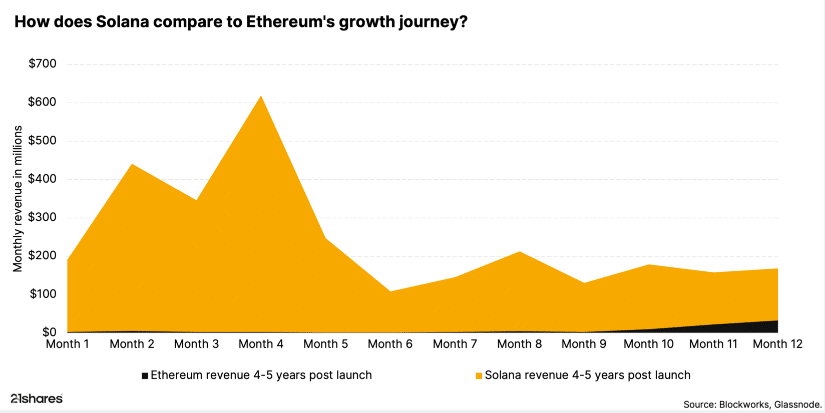
Hence Solana’s network economics, efficiency and growth dynamics are ahead of Ethereum in terms of early revenue accumulation.
Institutional Accumulation and SOL Treasury Growth
Beyond transaction fees, Solana’s ecosystem is seeing institutional capital flowing in via Solana treasury models. 21Shares reported that $4 billion in SOL is now held on public company balance sheets.
A notable example is Brera Holdings, a Nasdaq listed company, rebranded to Solmate and raised $300 million via PIPE to turn towards Solana focused infrastructure and treasury holdings.
Based on reports, 18 tracked entities hold a total of 17.8 million SOL tokens. Top holders include Forward Industries with 6.822 million SOL and Sharps Technology with 2.14 million SOL.
ETF Prospects and Regulatory Timing
Solana’s strong financials also come as spot Solana ETF applications are gaining momentum. Fidelity, VanEck, Grayscale, Canary, Franklin Templeton, 21Shares, and Bitwise have all filed for Solana ETFs, many with deadlines in October 2025.
Some report allegedly claim that 21Shares and Bitwise Solana ETFs have been delayed until Oct. 16.
The SEC has asked issuers to amend their S-1 forms, particularly around in-kind redemptions and staking mechanisms.
Polymarket and analyst sentiment suggest very high odds for Solana ETF approval. Since the SEC approved generic listing standards in mid-September, sentiment has shifted to certainty.
Ecosystem Outlook and Market Implications
The $2.85B Solana revenue proves it can grow beyond the hype cycle. As sources report, Matt Mena of 21Shares called the revenue “remarkably strong” in the midst of the memecoin cool down, attributing success to diversification.
The broad revenue base from DeFi, trading tools, DEXs, AI, DePIN, makes the ecosystem more resilient to sector downturns.
If one or more Solana ETFs get approved, it could attract more institutional money and bring regulated exposure to $SOL beyond exchanges.
Even with regulatory timing uncertain, the alignment between strong network fundamentals and institutional interest means Solana is in a good spot.
Also read: Solana vs Ethereum: The Power Shift in the Financial Sector
Conclusion
Based on the latest research; the $2.85 billion Solana revenue is quite remarkable in blockchain economics, way ahead of Ethereum’s early days. Trading platforms accounted for about 39% of that revenue, with other network sectors like DeFi and AI also contributing.
SOL treasuries with billions held by public companies further proves institutions believe in the network. As multiple spot Solana ETFs wait for SEC decisions in October and regulatory frameworks evolve; Solana is at a point where network performance meets institutional legitimacy.
For in-depth analysis and the latest trends in the crypto space, our platform offers expert content regularly.
Summary
Solana revenue generated $2.85B from Oct 2024 to Sept 2025, $240M/month and $616M in January. Trading platforms were 39% of that. SOL treasuries are $4B. Multiple Solana ETFs are pending SEC review in October.
Glossary
21Shares – Swiss asset manager and ETP/ETF issuer, author of the Solana revenue report.
Trading platform revenue – Fees generated by on-chain trading apps (e.g. Photon, Axiom).
SOL treasuries – SOL token holdings on public company balance sheets or institutional entities.
Spot ETF – Exchange-traded fund; aiming to track the market price of a crypto asset directly.
S-1 amendment – A revised SEC registration document; often required for additional disclosures or compliance.
Generic listing standards – SEC rules adopted to simplify ETF approval processes across assets.
Frequently Asked Questions About Solana Revenue
How much of Solana revenue comes from trading platforms?
Trading apps and tools made up 39%, or $1.12 billion, of the total.
How does Solana’s revenue compare to Ethereum at similar age?
At the same stage, Ethereum’s monthly revenue was under $10 million. Solana’s current revenue is 20–30× bigger.
What public companies hold SOL tokens?
18 companies hold 17.8 million SOL. Major holders are Forward Industries (6.822 million SOL) and Sharps Technology (2.14 million SOL).
Which companies applied for Solana ETFs and when will decisions be made?
Companies like VanEck; 21Shares, Bitwise, Fidelity, Canary, Grayscale,;and Franklin Templeton filed. Many decisions will be made in October 2025; with deadlines like Oct 10 and Oct 16 for several filings.
What did securities regulators ask issuers to change?
The SEC asked issuers to update their S-1 registration statements, especially around in-kind redemption mechanisms and staking inclusion.