

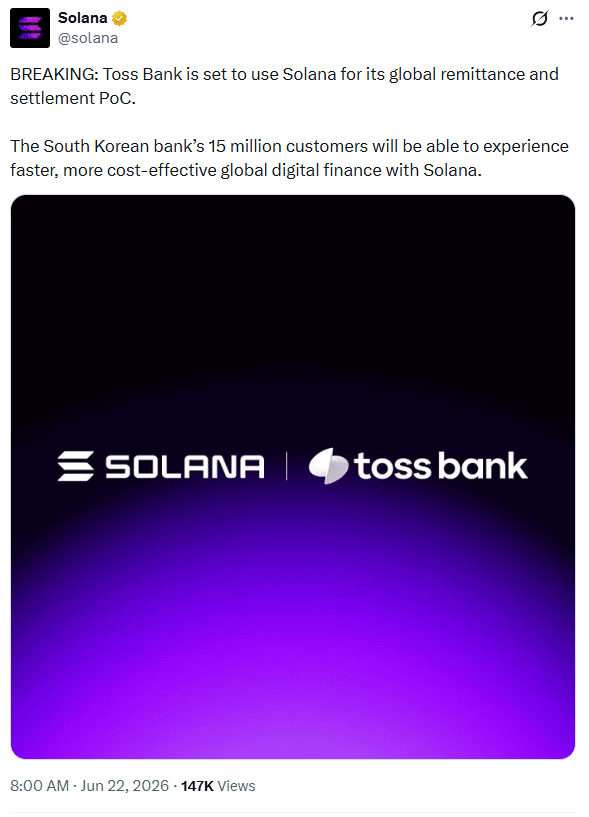
Toss Bank Solana deal has launched a blockchain remittance test in South Korea. The lender signed a memorandum of understanding with the Solana Foundation in Seoul on June 19. Digital Today reported it on June 22.
The project will examine overseas transfers, settlement, and digital asset services. Its first phase is a proof of concept. Toss Bank has not launched a public stablecoin remittance service.
Toss Bank Solana Deal Targets Cross-Border Payment Testing
Toss Bank called the MOU the first direct strategic partnership between a South Korean internet-only bank and the Solana Foundation. The Toss Bank Solana deal will study how Solana can support cross-border transfers, payments, and settlement.
The bank plans to test whether stablecoins can make foreign transfers faster. It also wants any model to remain close to existing banking flows. That could cover payments, currency conversion, and settlement.
The agreement gives Toss Bank a public blockchain route before it makes larger technology commitments. It does not require the bank to build its own network or confirm a stablecoin issuance plan.
Park Jin-hyeon, Toss Bank’s head of strategy, called the cooperation a starting point. He said it could apply blockchain-based infrastructure to bank services. The statement points to a staged review.
Remittance Pilot Takes Priority
Global remittance and settlement form the first task. The Toss Bank Solana deal will test whether stablecoin transfers can reduce delays in overseas payments. It will also assess whether the process remains simple for customers in practice.
Traditional transfers can pass through several intermediaries. Each step can add cost and time. Blockchain settlement could reduce delays, but a bank must keep strong controls.
The pilot will need identity checks, transaction monitoring, sanctions screening, and currency conversion.

South Korean Rules Shape the Timeline
South Korea is considering a licensing system for cross-border virtual asset transfers. The framework is due to take effect in December. It could define how banks and fintech firms provide blockchain-based overseas transfers and foreign exchange services.
The Toss Bank Solana deal arrives while policy discussions continue. Toss Bank said it will review its plans alongside stablecoin-related rules.
A live service would need to meet consumer protection, anti-money-laundering, and reporting requirements. Clear arrangements for stablecoin custody and settlement would also be required.
Stablecoin Tests Spread Across Asia
The project follows other bank-linked stablecoin tests in Asia. KB Financial has tested won stablecoin issuance, offline QR payments, merchant settlement, and remittances to Vietnam. One reported Vietnam transfer took under three minutes and cut fees by about 87%.
The figures show why banks are assessing new settlement rails. Yet results from one pilot do not guarantee the same outcome elsewhere.
Japan is also moving in this area. SBI Remit partnered with Fasset to build cross-border stablecoin infrastructure for remittances, payments, and settlement. These efforts show interest in regulated blockchain payment tools.
Toss Keeps Broader Blockchain Options
Toss has explored blockchain plans beyond remittances. Reports in April said the broader group was considering a custom Layer 1 or Layer 2 network. It was also weighing a native token for its “Money 3.0” stablecoin strategy.
The Toss Bank Solana deal gives the bank a route to test a chain. It could provide data on speed, reliability, costs, and compliance needs before a wider decision.
Solana Gains a Banking Use Case
For Solana, the agreement adds another financial institution to its payments and stablecoin work. Western Union launched USDPT on Solana in May. The product was tied to regulated payment settlement and customer services.
The Toss Bank Solana deal supports that wider push. Lily Liu, chair of the Solana Foundation, said the partnership could make global remittances faster and smoother.
What the MOU Does Not Confirm
The agreement does not confirm a customer-facing service. It does not say that Toss Bank will issue a stablecoin. It also does not name supported countries, currencies, transfer limits, or a launch date.
The work begins with technical reviews. The parties must determine whether the model can meet Korean standards, reduce friction, and fit Toss Bank’s current service structure.
Conclusion
Toss Bank Solana deal is an early step in the lender’s blockchain plans. The MOU focuses on testing, not deployment. Pilot results and regulatory clarity will determine whether it becomes a public service.
Appendix Glossary of Key Terms
Cross-Border Remittance: Money sent from one country to another.
Digital Asset: A value-based asset that exists in digital form, including cryptocurrencies and tokens.
Proof of Concept: An early test used to check whether a proposed system can work.
Settlement: The final completion of a payment or financial transaction.
Solana: A public blockchain network used for digital assets, payments, and smart contracts.
Stablecoin: A digital token designed to maintain a stable value, often linked to a fiat currency.
Tokenized Asset: A traditional asset, such as money or securities, represented on a blockchain.
Frequently Asked Questions About Toss Bank Solana Deal
1- Has Toss Bank launched a Solana remittance service?
No. The MOU covers testing and feasibility work only. Toss Bank has not announced a live service.
2- What will Toss Bank test?
It will study global remittance and settlement models. The work includes stablecoin payment flows and future digital asset services.
3- Why do South Korean rules matter?
The proposed framework could determine how banks and fintech firms offer cross-border blockchain transfers.
4- Does the agreement confirm a Toss Bank stablecoin?
No. The MOU does not confirm a stablecoin issuance. It only says the parties will review related service models.
References