






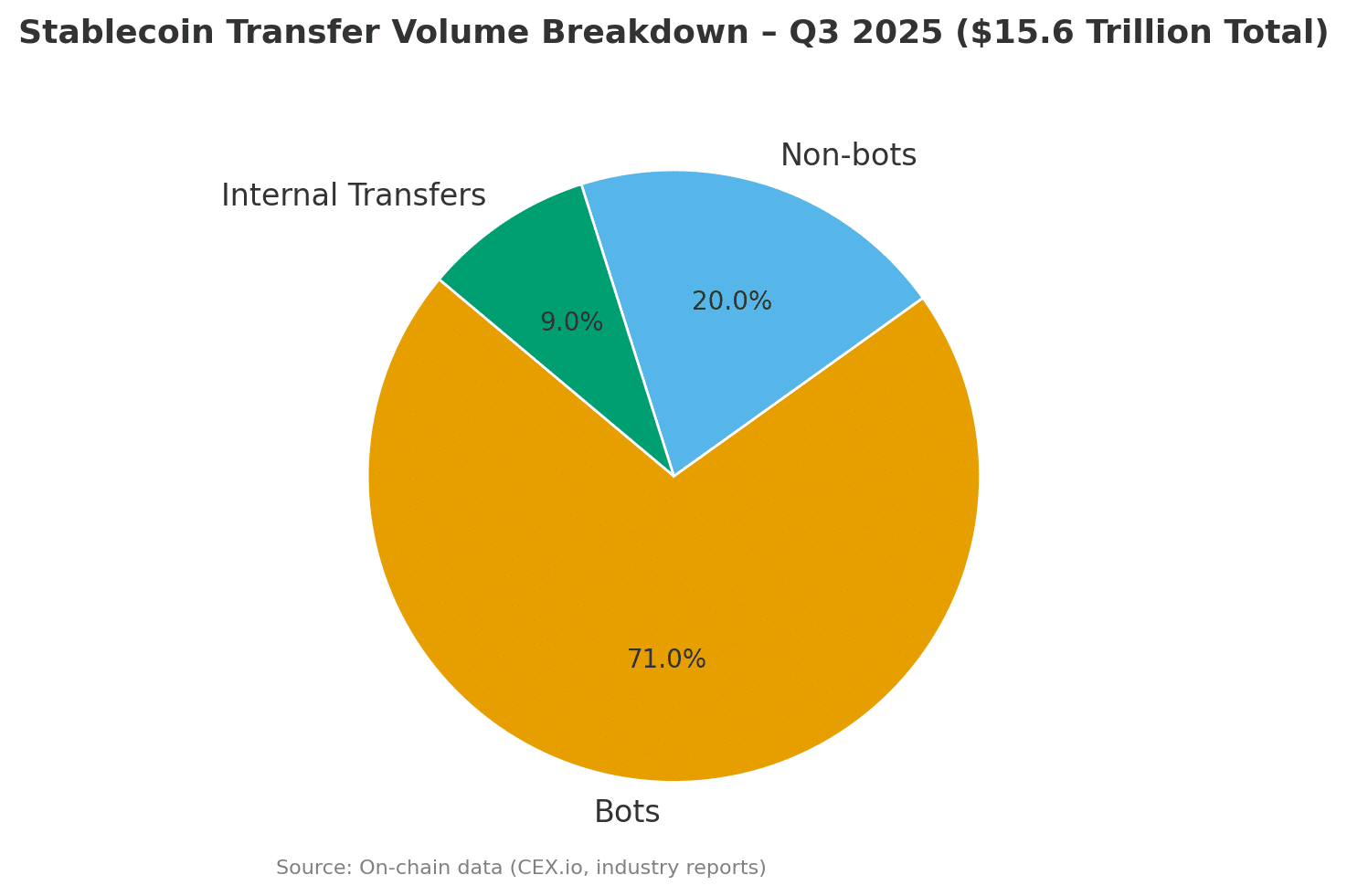
In Q3 2025, stablecoins reached a milestone: $15.6 trillion in on-chain transfer volume, pushing past previous records and raising fresh questions about usage. According to recent research, about 71 percent of that volume was driven by automated bots. Yet amid this algorithmic storm, retail activity, especially transfers under $250, also posted all-time highs.
This dual narrative, bot dominance vs. human uptake, is at the heart of what stablecoins are becoming.
Bot Engines Power the Bulk of Volume
When algorithmic systems siphon up most of the throughput, the result is both awe and alarm. In this quarter’s data, bots accounted for the lion’s share of activity, including high-frequency trading, arbitrage, wash trades, and MEV (maximal extractable value) operations.
CEX.io’s lead analyst, Illya Otychenko, explained that both high-frequency bots and manipulative transfers fall into that 71 percent figure. “They dominate especially when doing over 1,000 transfers a month and moving tens of millions,” he said.
The remaining volume broke down into roughly 20 percent non-bot activity (i.e. transfers that come closer to human or organic behavior) and 9 percent internal moves, smart contract calls or intra-exchange shifts.
Retail Transfers Under $250 Reach New Heights
Despite algorithmic overshadowing, the retail slice of the pie is growing, and fast. Transfers under $250 surged during the quarter, breaking records in September. Analysts now call 2025 “the most active year ever” for small stablecoin moves.
Most of those transfers, about 88 percent, were still tied to exchange activities (moving funds in/out, conversions, trading). But the interesting twist is that a growing share is crossing into remittances, payments, and fiat withdrawals, real-world flows beyond speculation.
Non-trading stablecoin usage rose over 15 percent in 2025, signaling that some users view stablecoins not just as a trading tool but as a digital bridge to commerce and finance.
Net Inflows and Token Leaders
It is not just volume that matters; supply dynamics are shifting too. In Q3, stablecoins saw $46 billion in net inflows, capturing the gap between issuance and redemption.
The heavy hitters: USDT led with nearly $20 billion in new inflows. USDC followed with $12.3 billion. Meanwhile, USDe (a synthetic stablecoin) made headlines with $9 billion in growth.
Why This Quarter Matters
We ought to see Q3 as a turning point. The record $15.6 trillion in transfer volume adds weight to stablecoins as plumbing for crypto markets, but the retail uptick demands attention.
From a market-structure view, bot dominance heightens fragility. Algorithmic flows can vanish or reverse in a flash, leaving real users exposed. It also raises the bar for distinguishing motion from meaning.
Regulators and policy makers now face a sharper challenge: how to differentiate noise from meaningful adoption. Should stablecoins be regulated more like trading instruments or payments utilities? The answer may rest on separating bot churn from human demand.
Reading the Key Crypto Indicators
To understand stablecoin dynamics, there are a few yardsticks worth flagging:
Transfer volume: absolute sum of on-chain movement. Shows scale, but is noisy if bots drive it.
Non-bot share: volume filtered to more likely human/user transfers. Helps gauge real adoption.
Net inflows: issuance minus redemption. Reflects new capital entering the stablecoin ecosystem.
Retail transfer slices: especially under $250. Tracks micro-user growth, remittance or payment use.
Token share & dominance: which stablecoins are capturing the new flows (e.g. USDT, USDC, USDe).
Conclusion
Q3 2025 was a banner quarter: stablecoins moved $15.6 trillion, with bots steering most of the ship, while retail users quietly pushed upward in parallel.
The dance between algorithmic volume and human demand is becoming central to how this corner of crypto evolves. Whether stablecoins can truly transition from market rails to everyday financial pipes depends on how transparent, resilient, and trusted they become.
Frequently Asked Questions
Q: Why do bots drive so much stablecoin volume?
Bots excel in high-frequency trading, arbitrage and MEV strategies. They slice risk and exploit inefficiencies across pairs and chains. High throughput helps them scalp small margins repeatedly.
Q: How reliable is non-bot volume as a metric?
It is imperfect, but filters help identify organic flows. Analysts segment by transfer sizes, repetition, patterns, and exclusion of known exchange addresses.
Q: Do high net inflows mean price or peg risk?
Not necessarily. Net inflows show demand, but issuer backing, reserve quality, and redemption confidence are still critical for price stability.
Q: Can retail growth outpace bot dominance?
It is possible. If stablecoins find solid footing in payments, remittances, and everyday cash flows, human demand may gradually shift proportions.
Glossary of Key Terms
Stablecoin
A cryptocurrency pegged to a fiat asset (often USD) to minimize volatility relative to other tokens.
Bot / Algorithmic Transfers
Automated trading systems, bots performing trades, arbitrage, MEV, wash trades, that generate high volumes without human timing.
Net Inflow
The difference between stablecoins issued and stablecoins redeemed in a given period.
Non-Bot Volume
Portion of transfer activity more likely to represent human or organic behavior rather than algorithmic systems.
High-Frequency Trading (HFT)
Automated trading that executes many small trades per second, exploiting small price differences.
MEV (Maximal Extractable Value)
Value captured by a miner or validator by optimizing transaction order or insertion, often in DeFi contexts.