













This article was first published on The Bit Journal.
Following a stunning turn of events in the crypto-ETF space, XRP seems to be becoming the top altcoin choice by institutional flows.
According to recent data, U.S. spot XRP ETFs logged roughly $587 million in cumulative inflows in less than ten trading days, surpassing the $568 million gathered by Solana (SOL) ETFs over a longer period.

This unanticipated edge upends the expectations for non-Bitcoin, non-Ethereum assets and how altcoins are being viewed by traditional finance.
Now with industry heavyweights like Grayscale and Franklin Templeton on the scene, XRP is quickly becoming an institutional allocators’ choice altcoin vehicle.
XRP ETF Inflow Spike: What the Numbers Say
The inflow stats since the mid-November debut of spot XRP ETFs have been impressive.
As much as $164 million of combined net inflows were recorded from the four major U.S.-listed spot XRP ETFs, one of the highest totals seen for a single day in the altcoin ETF space.
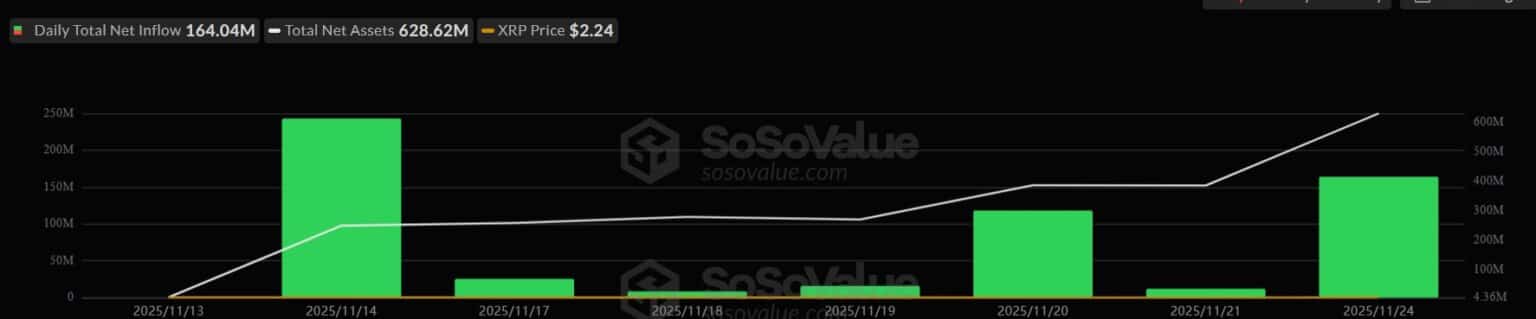
The largest of which was Grayscale’s GXRP at around $67.36 million and Franklin Templeton’s XRPZ with a staggering $62.59 million.
Previously, the first U.S. spot XRP ETF, XRPC by Canary Capital, saw an impressive debut with $58 million on its opening day from trading volume.
In less than ten sessions, XRP ETFs raised approximately $587 million, outpacing the $568 million of Solana, which took about one month to develop.
Analysts observe that on a “capital intensity” basis, the daily inflow average for each dollar of fund supply, XRP is sucking up institutional money at nearly twice the rate of its nearest competitor, SOL.
Why XRP Is Beating the Institutional Inflow
The surge of inflows is no coincidence, and there are a number of structural factors that are making XRP an attractive pick for institutions
Many of the new ETFs have extremely aggressive, even zero-cost fee structures at launch.
For instance, XRPZ from Franklin Templeton charges a 0.19% fee and gives investors the entire waiver on the first $5 billion it manages through at least May 31, 2026.
Grayscale’s GXRP also extended the same fee waiver for its initial launch window. This “race-to-zero” on fees is drawing large portfolios, where basis-point savings add up and can make a difference to investment performance.
XRP’s recent price action has also been positively receptive to institutional flows. With the ETF momentum in place, $XRP reportedly surged over 7%, suggesting that a new uptrend may begin.
Cash flowing in is soaking it up from holders higher on the curve, which helps reverse supply-demand dynamics in XRP’s favor.
Market mentality also appears to be shifting away from Bitcoin-heavy positions to holdings of altcoins.
With both BTC and ETH experiencing outflows in several funds, XRP (and SOL) ETFs represent a new, regulated channel for crypto exposure.
Future Outlook: The Possible Trajectory of XRP ETF Flows
At this rate, the XRP ETF cluster could get close to $1.5B AUM by the end of 2025. The more optimistic scenarios set out $2 billion as possible, notably if fee waivers help crowd in registered investment advisors and big institutions.
In the short-run, continued inflows could drive XRP’s spot price higher and draw yet more capital into the relative futures and derivatives markets for said asset.
Conclusion
XRP is swiftly repurposing from a contentious altcoin to the forerunner of this new altcoin ETF wave.
With inflows of $587 million in under 10 trading days, aggressive fee waivers and newfound price momentum, there is a new yardstick for institutional demand and how altcoins are considered by traditional finance
Either for better or worse, XRP currently lies at the heart of one of 2025’s biggest altcoin stories.
Glossary
Spot ETF: A fund that owns the real crypto assets, not derivatives or futures.
Inflows: Capital coming into a fund, which can be calculated as net new purchases less redemptions.
AUM (Assets Under Management): The total value of market assets a fund is managing.
Fee waiver: Refers to a temporary or contingent waiving of management fees in order to secure initial investments.
Capital intensity: The speed at which money is being poured into a fund, as measured by capital flowing into the fund relative to its size.
Frequently Asked Questions About XRP ETF Inflows
What are the ETFs with the highest contribution into XRP?
Key contributors have been spot ETFs from Grayscale (GXRP), Franklin Templeton (XRPZ) and Canary Capital’s product (XRPC) which all printed notable inflows on launch days.
What is XRP’s inflow rate compared to Solana?
XRP’s inflows rose to about $587 million in less than 10 days of trading, while Solana ETFs attracted only about $568 million over a month, making XRP’s capital intensity close to double.
Is the urgency to create XRP ETFs all about low fees?
Aggressive fee waivers are a big factor. For instance, Franklin Templeton waived fees on the initial $5 billion in assets for XRPZ through mid-2026, rendering it a nearly “zero cost” entry for big investors.
Can the inflows elevate XRP’s price?
Early signs suggest so. XRP surged 7% as ETFs went live by breaking the key resistance and confirming that institutional demand is driving this price action:
References