






A Capitol Hill negotiation meant to set federal rules for payment stablecoins has hit a blunt obstacle: returns. The argument is about whether a cash-like token should deliver stablecoin yield, and whether that return can show up as interest or as rewards that feel the same.
The draft aims to treat these tokens as payment tools, backed by reserves and redeemable at par. Critics say a token that pays becomes a deposit substitute. Supporters say it is a competition.
Why the stablecoin yield question matters
Banking groups warn that allowing payouts could pull deposits away from community and regional banks, especially when Treasury bills offer attractive short-term rates. Some advocates have floated stress-case estimates for how large that migration could become if rewards programs scale.
Industry-aligned lawmakers respond that issuers already earn on reserves. If the spread stays with the issuer, consumers fund the system without sharing the benefit. In that view, stablecoin yield is a transparency issue, and a flat ban mainly protects incumbents.
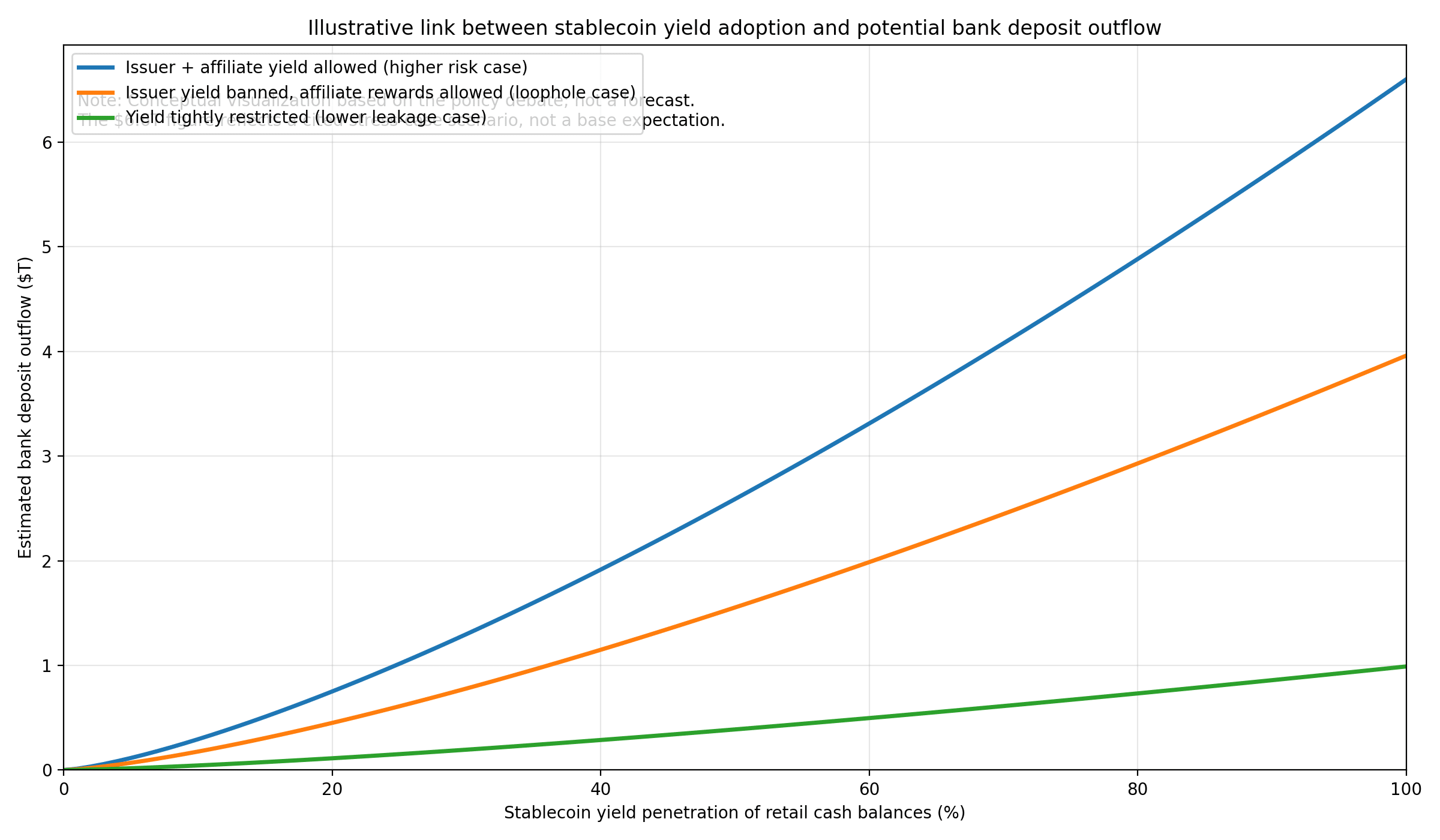
The loophole problem
Even if a bill bars issuers from paying interest directly, connected parties can still imitate it. An exchange, wallet, or affiliate can offer points, rebates, or bonus payments funded by its own revenue or distribution deals. In practice, that can keep stablecoin yield alive while the issuer stays compliant on paper.
That is why the language has become surgical. Negotiators are debating not only what the issuer does, but what intermediaries can advertise while pushing the same token.
What the standoff means for crypto markets
The policy fight lands in a rate-sensitive market. Stablecoins are the bridge between fiat rails and on-chain activity, so rules that affect demand can ripple into liquidity across exchanges and DeFi. Clear guardrails could improve institutional comfort. A prolonged stall keeps uncertainty high and pushes innovation offshore.
If talks slide into 2026, the market may treat issuance trends as a proxy for confidence. When supply grows, it often signals risk appetite. When supply stalls, it can hint at caution, tighter compliance filters, or weaker demand.
Key indicators to watch
Traders track stablecoin supply by chain, exchange reserves, and net flows between wallets and platforms. Stablecoin yield promos can distort those flows, especially around new listings. Traders also watch spot volume and order-book depth, because thinner liquidity can magnify swings. Perpetual futures funding rates matter too, since overheated positioning tends to unwind fast. On-chain activity, such as active addresses and transfer counts, helps confirm whether moves are real.
Regulatory momentum is an indicator as well. Headlines about stablecoin yield restrictions can shift sentiment across DeFi, exchanges, and issuers, even before a vote happens.
Conclusion
The bill is close enough to shape expectations, yet the yield question forces a philosophical choice. Banning stablecoin yield may protect bank funding, but it can push users toward riskier substitutes. Allowing it may improve competition, but it raises consumer expectations and raises questions of risk. Until the wording settles, crypto markets will price policy as a moving target.
Frequently Asked Questions
What is the main sticking point?
Lawmakers disagree on whether stablecoin yield should be allowed on payment tokens.
Why does the banking sector oppose it?
They argue that returns could pull deposits away and raise bank funding costs.
Can rewards programs bypass restrictions?
Yes, intermediaries can replicate stablecoin yield through promotions and rebates.
When might legislation move forward?
Negotiations continue, and delays could extend into 2026.
Glossary
Stablecoin yield: A return paid to holders, as interest or rewards tied to a stablecoin.
Payment stablecoin: A token designed for transactions, backed by reserves and redeemable 1:1.
Funding rate: A periodic payment in perp markets that keeps prices aligned with spot.
Order-book depth: The amount of buy and sell liquidity near the current price.
References