






Bitcoin vs stablecoins sounds like a simple either-or choice, as in reality, it shows how two very different forms of digital money now work side by side. Bitcoin behaves like digital gold. It moves in powerful cycles, with sharp rallies and painful drawdowns. Stablecoins behave more like digital cash. They try to hold steady at 1 USD while the value moves between exchanges, wallets, and countries in seconds.
Understanding the Bitcoin vs stablecoins debate
In 2025 this debate sits at the center of the market. Global crypto capitalization is close to 3.2 trillion USD, and stablecoins account for around 300 billion USD of that value and roughly 10 percent of the total market. Daily trading volume often runs above 100 billion USD. On many large venues, stablecoins dominate trading pairs, while Bitcoin still holds close to 60 percent market dominance and sets the tone for overall risk appetite.
This explains why Bitcoin vs stablecoins now appears in policy speeches, research reports, and regulatory hearings. When Bitcoin drops 20 or 30 percent in a short window, traders frequently rotate into stablecoins instead of cashing out to bank accounts. Recent market swings have shown Bitcoin falling from peaks above 120000 USD into the 80000 USD range, before recovering back toward the 90000 USD area, which underlines how violent these moves can be.
At the same time, on-chain analytics show that stablecoins processed more than 4 trillion USD in value in the first seven months of 2025 as users relied on them for liquidity, settlement, and cross-border payments. The question is no longer which asset is better. The question is how each one fits into a wider strategy.
Bitcoin as a macro style asset
From a market behavior point of view, Bitcoin now acts like a macro risk asset rather than a simple payment token. It has a fixed supply of 21 million units, a transparent ledger, and a decentralised network of miners and nodes. These traits support the idea that Bitcoin can hedge against high inflation, currency debasement, or loss of trust in policy makers. The cost of that thesis is extreme volatility.
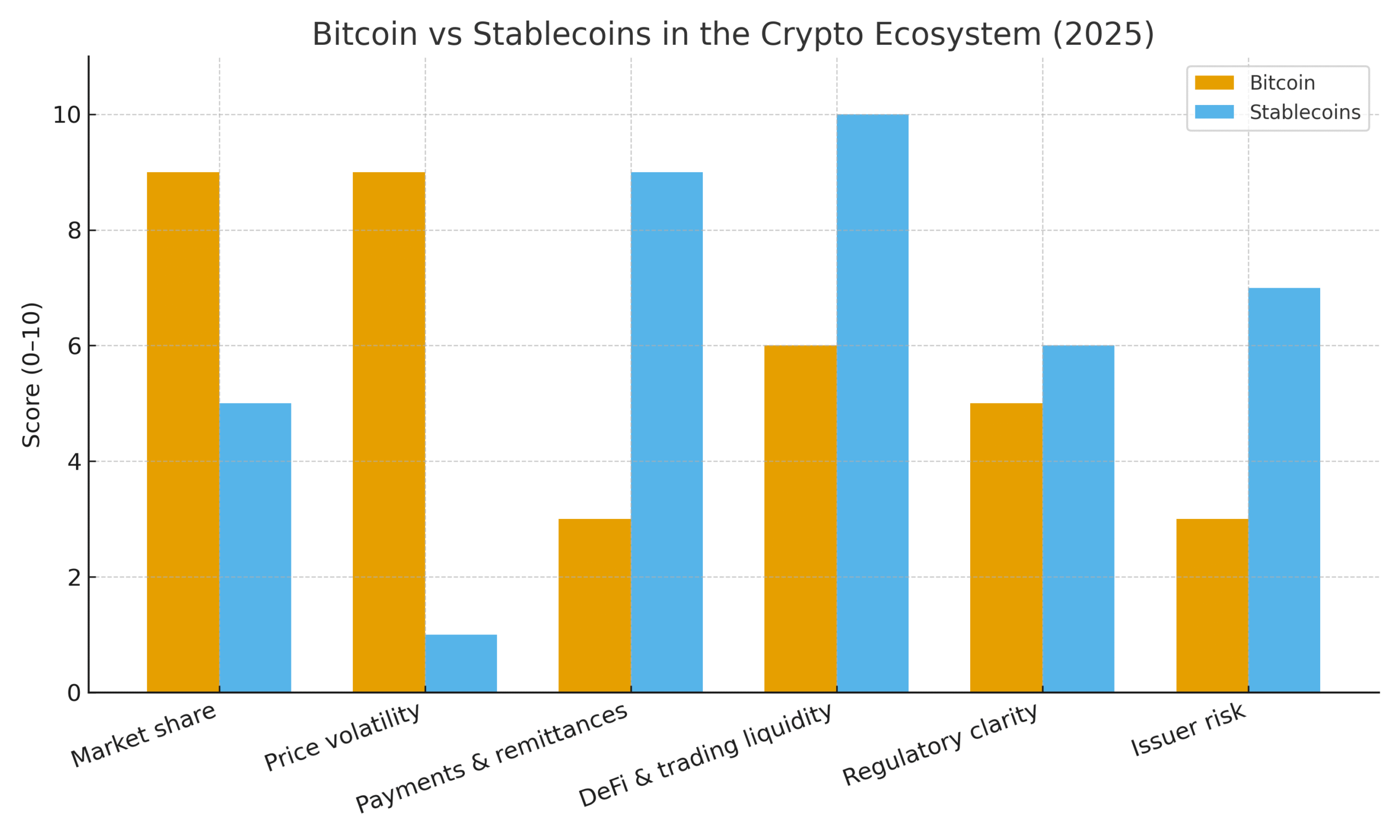
A steep slide can wipe out hundreds of billions of USD in market value and trigger waves of liquidations across derivatives platforms. For long-term holders, this is part of the journey. For merchants and workers who think in fiat terms, such swings make it very hard to treat Bitcoin as a stable unit of account or a safe short term store of value.
Stablecoins as the plumbing of digital finance
Stablecoins sit on the other side of the Bitcoin vs stablecoins spectrum. They were created to solve a practical problem. Traders needed a way to park dollar-linked value on the chain without wiring money in and out of every venue. Most major stablecoins are fiat-backed. Issuers hold reserves in cash, short term government debt, and other liquid assets in order to keep each token close to 1 USD. A smaller slice of the market uses crypto-backed or algorithmic models where over-collateralisation and on-chain incentives aim to defend the peg. Market studies show that fiat-backed designs still hold the vast majority of stablecoin market cap, while crypto-backed tokens remain a much smaller niche.
By late 2025 the combined stablecoin market cap sits around the 300 billion USD mark, even after a modest pullback in recent weeks. Stablecoins dominate many DeFi lending pools and act as the base currency for a large share of spot and derivatives trades. International bodies and research groups note that stablecoins are increasingly used for cross-border transfers and remittances, especially in regions where banking access is fragile or capital controls are strict.
At the same time, scrutiny has intensified. Recent rating actions against large issuers highlight worries about reserve quality, the share of higher risk assets such as corporate bonds, gold, and Bitcoin inside portfolios, and the clarity of custody and segregation arrangements. Central banks and regulators warn that a sudden run on a major stablecoin could force rapid sales of short-term government debt and spill stress into traditional money markets.
Key indicators in market analysis
For anyone trying to make sense of this landscape, a few indicators stand out. The first is dominance and market share. With Bitcoin near 57 to 60 percent of total crypto market capitalization and stablecoins near 10 percent, the two sides together define most of the sector liquidity. The second is volatility. Bitcoin shows a long track record of double-digit monthly swings and large intraday moves, while stablecoins are designed to keep volatility near zero relative to the peg.
When a widely used stablecoin trades away from 1 USD for more than brief stress periods, that move usually signals concern about reserves, governance, or market depth. The third indicator is regulation. Guidance from international organisations now focuses on full reserve backing, strong disclosure, redemption rights, and direct supervision for stablecoin issuers, while Bitcoin sits in a framework that focuses on trading rules, taxation, and investor protection.

How investors use both assets together
In portfolios, the most realistic way to frame Bitcoin vs stablecoins is to treat them as complementary tools. Bitcoin usually sits in a high-risk, high-conviction bucket. It can play the role of a long term speculative asset for investors who accept deep drawdowns in a small allocation in exchange for the chance of outsized gains. Stablecoins usually live in the cash and liquidity sleeve.
They allow users to move funds between venues, post collateral, manage margin, or wait on the sidelines without leaving the blockchain environment. They can also generate yield through lending or liquidity provision, although every extra unit of return brings added counterparty, smart contract, or leverage risk.
Risk, transparency, and trust on both sides
Trust and transparency look very different on each side of this story. Bitcoin relies on mathematics, open source code, and distributed consensus. Anyone can verify the supply, follow major transactions, and confirm that the rules cannot be changed by a single institution. There is no central issuer that can mint extra coins or freeze balances. Stablecoins depend on legal structures, auditors, custodians, and supervisors.
Users need confidence that reserves truly exist, remain liquid under stress, and sit in segregated accounts instead of being mixed with issuer funds. Global standard setters warn that poorly managed stablecoins could amplify stress during market shocks, especially if reserve portfolios hold significant slices of lower quality credit.
No digital asset is free of risk. Both Bitcoin and stablecoins require careful research and, where appropriate, guidance from qualified professionals. For individuals, companies, and institutions, the point is not to pick a single winner in the Bitcoin vs stablecoins discussion. The point is to understand how each asset behaves under pressure and to build a plan that fits clear goals, realistic time horizons, and personal tolerance for loss.
Conclusion: two roles, one ecosystem
The clearest lesson so far is that digital gold and digital cash tend to grow together. When Bitcoin rallies and reaches new highs, more users arrive and later look for stability in tokenized dollars. When markets cool, stablecoins help traders de risk without fully leaving crypto. Over time the Bitcoin vs stablecoins story looks less like a conflict and more like a division of labour inside the same ecosystem.
Bitcoin expresses a long term view on technology, scarcity, and monetary independence. Stablecoins carry value across platforms and borders with speed and relative price stability. For anyone who takes modern digital finance seriously, understanding both sides of this relationship has become basic literacy rather than a niche hobby.
Frequently Asked Questions
What does Bitcoin vs stablecoins really describe?
It describes how Bitcoin acts mainly as a volatile long term store of value and macro risk asset, while stablecoins focus on price stability, payments, and liquidity inside the crypto ecosystem.
How does volatility affect the choice between Bitcoin and stablecoins?
Bitcoin can experience large price swings in short periods, which creates both opportunity and deep drawdowns. Stablecoins aim to stay near 1 USD, which suits payments, short term balances, and risk management.
Are stablecoins automatically safer than Bitcoin?
Stablecoins reduce day to day price swings but introduce issuer, reserve, and regulatory risk. Bitcoin avoids issuer risk but exposes holders fully to market moves, so safety depends on design, oversight, and personal risk tolerance.
Glossary of key terms
Bitcoin dominance
Share of total crypto market capitalization represented by Bitcoin.
Stablecoin
Crypto token that aims to maintain a stable value relative to a reference asset such as USD.
Peg
Target exchange rate between a stablecoin and its reference asset, often 1 token for 1 USD.
Volatility
Measure of how much an asset price changes over time.
DeFi
Decentralized finance, a group of blockchain based protocols that provide financial services without traditional intermediaries.
References/Sources
The price predictions and financial analysis presented on this website are for informational purposes only and do not constitute financial, investment, or trading advice. While we strive to provide accurate and up-to-date information, the volatile nature of cryptocurrency markets means that prices can fluctuate significantly and unpredictably.
You should conduct your own research and consult with a qualified financial advisor before making any investment decisions. The Bit Journal does not guarantee the accuracy, completeness, or reliability of any information provided in the price predictions, and we will not be held liable for any losses incurred as a result of relying on this information.
Investing in cryptocurrencies carries risks, including the risk of significant losses. Always invest responsibly and within your means.
For advertising inquiries, please email . [email protected] or Telegram