






This article was first published on The Bit Journal.
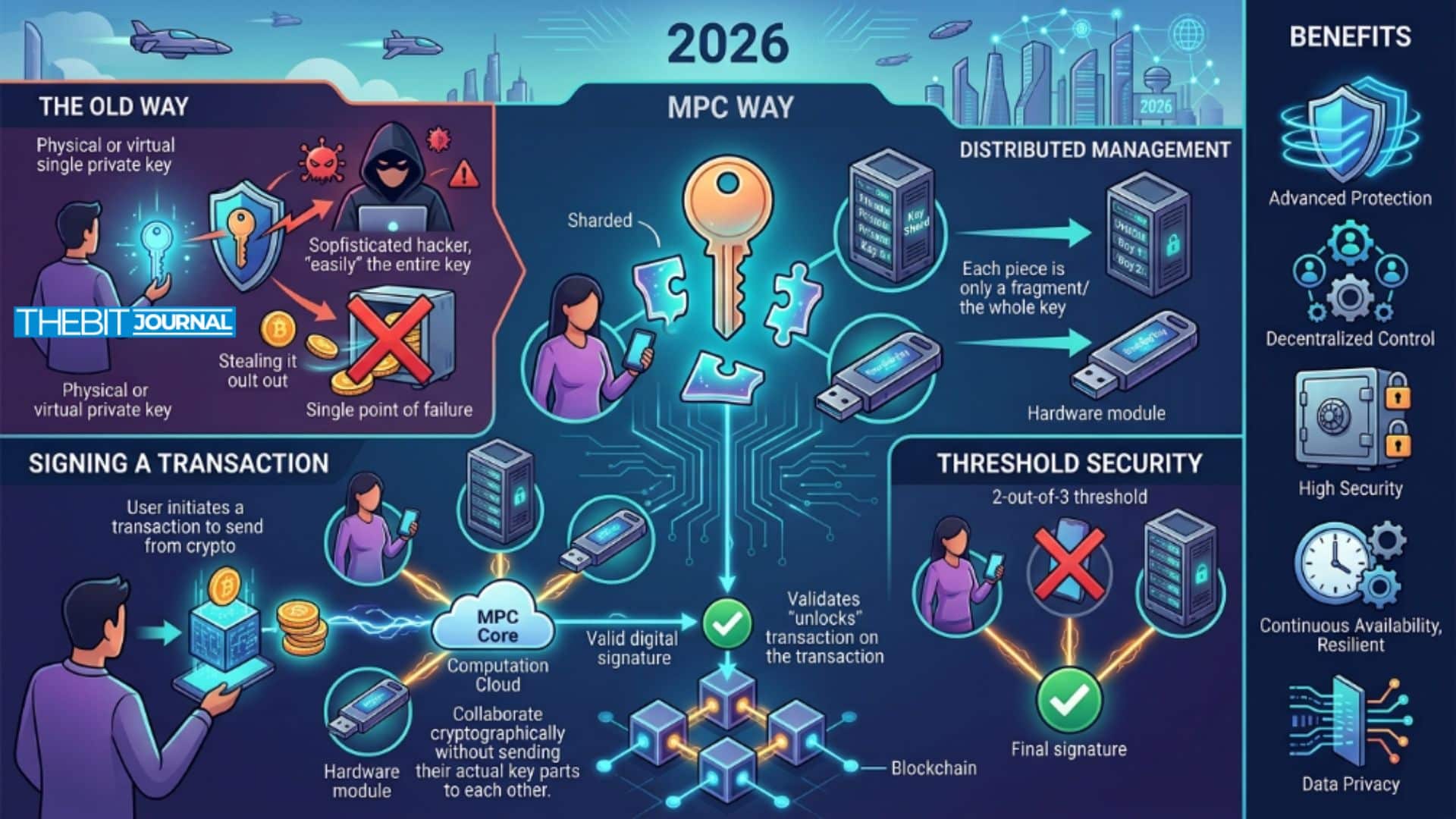
MPC wallets have become the new security standard when it comes to crypto custody. This is because instead of relying on a single private key just like with traditional wallets, an MPC wallet splits the key into multiple pieces known as shares which are held by different people or servers.
This means no single person or server ever has the whole key at a time, eliminating the risk of a single point of failure. Leading crypto custodians now use MPC to protect trillions of dollars of digital assets.
How MPC Wallets Work
The main point of an MPC wallet (Multi-Party Computation Wallet) is ensuring that no single point has control over wallet keys.
When you create a new wallet, the key is never generated in one single place. Instead, each of the parties involved (say your own device, a cloud server and a backup device) generates its own key share using cryptographic protocols like Shamir’s Secret Sharing or threshold signatures.
Each bit is a tiny piece of the overall key, and even though they’re all mathematically linked to the full key, they’re never actually combined.
Even the wallet’s blockchain address (public key) is computed jointly without any single party seeing the entire private key.
When you try to send some crypto, the MPC protocol makes sure that all the required parties work together to sign it off. Each one uses its share to compute a partial signature, and you only get a valid signature when enough partial signatures are combined.
The private key is never reconstructed or exposed. For instance, in a 2-of-3 scheme, any two of the three shares will authorize a transfer, but one share alone is useless. This means an attacker who compromises a single device or server gains no access to funds.
MPC wallets often get run inside special secure hardware (like Intel SGX or AWS Nitro enclaves) to keep the computation isolated and safe. For example, Coinbase’s on-chain wallets are designed to run in a special trusted execution environment so that the unencrypted key material never leaves the secure hardware.
Once the transaction is signed, it goes on as normal. Because all the hard work happens off-chain, MPC wallets work just fine on any blockchain that uses ECDSA or EdDSA signatures. The same MPC setup can secure Bitcoin, Ethereum, Solana, and others without change.
MPC Wallets vs. Other Wallet Types
| Feature | Single-Key Wallet | Multi-Sig Wallet | MPC Wallet |
| Key Management | One private key/seed; one compromise loses all. | n full keys controlled by different parties on-chain. | Private key split into shares held by parties; no full key exists. |
| Single Point of Failure | Yes; seed phrase or key. | Lower; need M-of-N keys, but on-chain script points exist. | No; shares alone are useless; no single storage of full key. |
| Blockchain Dependency | Works on any chain (key-based). | Depends on chain’s multisig support; script specifics vary by chain. | Chain-agnostic; signing happens off-chain so one setup covers all ECDSA/EdDSA chains. |
| Transaction Signing | Direct single signature. | Multi-signature on-chain (higher fees, visible on-chain metadata). | Distributed threshold signature; appears as normal single signature on-chain. |
| Quorum Changes | N/A (one key). | Changing threshold requires redeploying contract and migrating address. | Flexible; can add/remove shares or change threshold without changing wallet address. |
| Audit & Privacy | Simple (one key). | All signers and rules are visible on-chain (transparent but leaks metadata). | Signing structure is private; on-chain view is one signature (better privacy). |
In a nutshell, MPC wallets take the best of both custodial and self-custody models and blend them. They achieve multi-party approval like multisig, but off-chain and transparently..
They avoid the limitations of on-chain multisig (which varies by blockchains) and there’s no need for a hard fork to change the thresholds.
Benefits of MPC Wallets
Better Security: By design, MPC wallets eliminate the single point of failure that comes with other wallets. For an insider or hacker to steal your funds, they’d need to get their hands on all of your threshold shares at the same time. If one key share gets lost or compromised, none of the others will be affected.
MPC lets institutions keep digital assets safe without ever storing a complete private key in one place, reducing the risk from phishing, key-logger malware, or lost devices. Even if one participant’s device is breached, the attacker cannot transact.
No Seed Phrases or Single Keys: Users don’t have to worry about remembering or backing up long phrases to get back into their wallet. For example, ZenGo’s MPC wallet splits the secret shares into two across the user’s phone and their own server, so there’s “no single point of failure” and “only you can access your crypto”.
If you lose a device, you can recover your funds by regenerating the shares using the backup ones all without needing to use a seed phrase. Recovery flow can feel like just resetting your password, with a few emails or trusted contacts, making it a lot more user friendly for non-technical users.
Customizable Policies: MPC wallets have built-in policy engines, which makes them useful for institutions. They can enforce multi-step approvals, make a list of allowed addresses, set transaction limits and do other compliance checks before anyone can sign anything. For example, Fireblocks’ MPC platform is so strict it even enforces rules inside hardware enclaves so even insiders can’t override them.
This “separation of duties” is just like banking. Developers can also build in their own agents with their own rules. For example, a trading bot can have one share, but only be able to sign trades that fit within a strict set of smart-contract limits.
Works Across All Blockchains: MPC works across multiple blockchains without needing different architectures. Because all parties just agree on a signature math, the same wallet can hold Bitcoin, Ethereum and more, all without needing to write separate multisig contracts for each one.
Changing quorum sizes (e.g. 3-of-5 to 4-of-6) doesn’t force a new wallet address. Signing also incurs no on-chain gas overhead beyond a normal single-sig transaction. Fireblocks reports that its advanced MPC protocol completes a signature in one communication round, making signing up to 8× faster than older MPC methods.
Less Stress and More Scalability: Because key shares can be updated or changed independently, MPC wallets can recover from lost shards or personnel changes. It is possible to refresh shares without changing the public address which is a big operational advantage over multisig (where any key loss usually means you need to move to a new blockchain).
MPC systems can also scale. Adding more participants or nodes doesn’t increase the attack surface because the core protocol logic stays the same.
Risks and Challenges
While MPC wallets have plenty of power, they bring a lot of complexities. MPC signing requires communication between parties, so it is inherently slower and more technically involved than a single-key wallet.
In fact, Coinbase has warned that MPC wallets can slow things down and require more back-and-forth compared to the simpler ones. High-frequency or real-time trading systems might find the delay just too long to put up with.
MPC protocols need to be implemented with care & then audited too. The cryptographic algorithms like GG18, Lindell, GG20 and OT-based schemes are complicated. If the implementation isn’t perfect, then it could cause a problem.
Users have to trust the provider to get it right. Security depends on the code being bug-free, secure enclaves and the choice of MPC scheme being strong. If a wallet provider doesn’t have a dedicated crypto team or hasn’t open-sourced the protocol, then it is a cause for worry.
There’s also the theoretical risk of collusion. If enough participants (say 3 out of 5) were malicious and worked together, they could sign transactions.
Wallet providers help mitigate that by putting shares on isolated hardware and enforcing policies that check and balance things. Institutions should make sure they check out how key shares get stored, rotated and recovered.
Finally, MPC wallets rely on existing signature schemes like ECDSA.This means they will also need to transition to post-quantum cryptography in the future. In response, firms like BitGo and Silence Labs are already developing quantum-safe MPC schemes. Still, true quantum computers are not yet here, so this is a forward-looking consideration.
Adoption and Use Cases
Custodians and wallet providers alike have been quick to adopt MPC. Coinbase’s developer platform even offered MPC based wallets for on-chain accounts at one point and many exchanges use MPC for key management for their hot and warm wallets.
Institutional services like Fireblocks, BitGo, Anchorage, Copper, Qredo and Gemini Custody are all using MPC or threshold signatures under the hood too. Fireblocks platform alone secures “trillions of dollars” of cryptocurrency assets using MPC.
MPC is ideal for big institution custodians and fintech companies. Banks and payment companies that handle a lot of crypto cash use MPC for the audit trail and key control.
Fintech companies can use MPC to create programmable agent wallets. For instance, Fystack has noted that an MPC wallet can let a bot manage one key share while a secure server enforces strict rules on transactions. Crypto exchanges use MPC to automate sweeping funds, their deposit wallets sign transactions without actually needing to get the key together on a hot machine.
On the consumer side, MPC is growing too. ZenGo for example, a popular self-custody mobile wallet, uses MPC so users never have to deal with seed phrases. This appeals to beginners who find traditional wallets a bit intimidating. Other consumer wallets are exploring with MPC for social recovery and multi-device setups (like storing shares across a user’s phone, cloud backup and friend’s device). Even crypto cards (like BitGo’s TradeFi m) use MPC to keep things secure.
Any scenario needing real institutional-grade security or agent-based control can use MPC wallets. Analysts now call MPC the “gold standard for institutional crypto custody”.
Its adoption is driven by regulations. For example, Europe’s MiCA and other frameworks demand strong key controls and proof of self-custody and MPC easily ticks those boxes. Institutions are rapidly building MPC into custody solutions because they meet both compliance and risk management goals head on.

Expert Analysis: The Future Of MPC Wallets
Industry experts almost all agree that MPC is the future of crypto security. BitGo’s CEO, Mike Belshe, points out that quantum computing has stopped being a theoretical discussion and is now a priority for the digital asset industry.
This reveals why firms are now investing in the development of post-quantum MPC wallets, to stay one step ahead of the security threats that come with it.
BitGo actually partnered with a team of cryptographers to simulate a post-quantum MPC signing in May 2026, showing just how MPC wallets can evolve .
Cryptographers are also working on standardizing MPC. Fireblocks is part of a cross-industry push to ask NIST to formalize the standards for threshold signature schemes. Standardization could eventually make MPC schemes more compatible and easier to audit.
Meanwhile, wallet developers are focusing on making MPC wallets more user friendly. For example, building MPC wallet apps that feel just as easy to use as ordinary wallets, hiding the complexity of key shares from the user.
Looking at the market, the demand for secure custody means that we can expect to see steady growth for MPC technology over the next decade.
Research firm Future Market Insights projects that the crypto security market (which includes MPC wallets) is going to expand rapidly in the years to come. Big crypto players are positioning themselves accordingly, Fireblocks acquired Dynamic in 2025 to bundle MPC wallets with Web3 login technology, and Coinbase actually integrated MPC into its developer wallet product.
This implies that MPC wallet capabilities could become a standard offering in exchanges, wallets, and custody platforms.
Looking ahead, MPC wallets may also merge with emerging trends like account abstraction and smart contract wallets. Some projects are actually experimenting with combining MPC key management with on-chain smart contract logic for the best of both worlds.
For now, MPC stands out as a strong off-chain solution that bridges self-custody and enterprise controls.
Conclusion
MPC wallet technology has completely changed how crypto wallets keep assets secure. Unlike a single-key wallet, an MPC wallet never creates the full private key in one place but splits and manages key shares across multiple devices or servers using multi-party computation.
This makes single points of failure a thing of the past and enables flexible approval policies, making MPC wallets far more secure for high value holdings.
Institutions are using MPC wallets more, however, they also come with complexity and you need to have some trust in the cryptographic implementation. Users should make sure the provider is audited and follows best practices.
Looking forward, MPC protocols will keep getting faster and will evolve to resist future threats like quantum attacks. All in all, MPC wallets represent a step forward in crypto security, offering a powerful blend of self-custody and institutional-grade controls.
Glossary
Private Key: A secret number that allows spending of crypto assets; typically derived from a seed phrase in standard wallets.
Key Share: A fragment of the private key, used in MPC.
Threshold Signature: A cryptographic scheme that lets a group of t-of-n people jointly create a signature without anyone else knowing their private key.
Multi-Signature (Multi-Sig) Wallet: A wallet that needs you to sign a transaction on-chain using multiple different private keys, all held by different people. This is different to MPC, which does things off-chain.
Trusted Execution Environment (TEE): A secure little enclave (like Intel SGX or AWS Nitro) that runs sensitive computations like MPC protocols totally isolated from the rest of the system.
Post-Quantum Cryptography: Cryptography that’s designed to resist attacks from quantum computers. Future MPC wallets are incorporating PQ-safe algorithms to guard against quantum threats.
Frequently Asked Questions About MPC Wallets
What does MPC stand for in a wallet context, anyway?
MPC stands for Multi-Party Computation. In an MPC wallet, your private key gets split up into smaller, cryptographic pieces and nobody has the whole key to themselves.
How is an MPC wallet different from a multi-signature wallet?
Both need multiple people to sign off, but it’s two different approaches. A multi-sig wallet uses all the full private keys on the blockchain to authorize a transaction, whereas an MPC wallet splits one key into separate parts, and uses a threshold signature. That means MPC works on any blockchain and doesn’t slow things down with each signature.
Why are institutions using MPC wallets?
Institutions want more security and control. With an MPC wallet, you can enforce different rules and policies, like needing multiple people to approve a transaction, or making sure nobody has too much control.
Can an MPC wallet ever lose my funds?
MPC wallets do a lot to reduce the risks, but nothing is 100% foolproof. If enough key shares and the algorithm were compromised (for example, through a complex attack), funds could be at risk. That’s why reputable MPC services use secure hardware enclaves, regular audits, and allow key rotation. Users should also keep recovery plans (new devices with shares) in place.
How do I recover an MPC wallet if I lose the seed phrase?
A lot of MPC wallets have recovery built right in. For example, ZenGo’s wallet lets you recover by just authenticating and setting up the shares again on a new device, no seed phrase needed. Institutional MPC systems usually use backup devices or have multi-party recovery protocols built in.
References
Disclaimer: This article is just for general info and not financial or investment advice.Don’t take anything as a guarantee. As always, do your own research, talk to professionals before making any financial decisions.