




Stablecoins are now the pillars of digital currency. They combine the reliability of the dollar and the rapidity of blockchain, and they are not a niche concept at all. By 2025, no one can ignore their impact as the overall market value exceeds 270 billion dollars, and the amount of transactions in a month is more than 700 billion dollars.
These tokens are not only used by crypto traders but are now a significant piece of the financial infrastructure around the world.
This article highlights the top stablecoins to watch in 2025, drawing on data from leading industry research. Other coins are more singular because of large size, decentralization, regulation, or regional adoption.
Traders are using them as safe havens, families depend on them to send remittances and companies use them to transfer money in real time. Even Visa, Mastercard, and PayPal are in the game now. So here is the question: what are the most significant stablecoins in the future of money?
What is a Stablecoin?
A stablecoin is a type of cryptocurrency that targets to be indexed to a stable currency and mostly tends toward dollar. Unlike Bitcoin or Ethereum which may vary in price tens of percent per day, stablecoins are designed to be considerably more stable.
Each coin has a normal value of a dollar and is therefore much easier to use in payments, savings or even traded.
Stablecoins are of various types. There are those supported by cash or Treasuries in banks (as is the case with USDT and USDC). Others are supported by crypto assets like Ethereum (like DAI). While some are based on more experimental models, such as those using algorithms or synthetic hedging.
Whatever the design, the intent is similar to provide users with a dependable digital dollar that can be transferred as fast as crypto.
How Stablecoin Work?
In order to do this, stablecoins maintain a peg to the value that they are meant to track- most commonly that value is 1 dollar. When a user requires one stablecoin, then an issuer has one dollar in reserves or they are collateralled out by more than a dollar worth of assets. Other coins, such as USDC have a monthly audit to indicate their backing is strong. Others, such as DAI, lock up Ethereum or other assets in smart contracts in order to assure stability.
Assuming that there are sufficient reserves or collateral, more stablecoins may be created when demand increases. As demand declines, coins can be sold back at a price of its underlying assets, which reduces supply. This perpetual minting and redeeming along with transparency and auditing, makes the peg very strong. This practically implies that you are able to exchange, deposit or store stablecoins with the confidence that they will not lose their worth as traditional crypto has been known to do.
- Tether (USDT): The Giant of the Market
Tether, or USDT, continues to dominate with a market cap of about $164 billion. It is the largest stablecoin by far and serves as the default currency pair across most exchanges. Billions of dollars in Bitcoin, Ethereum, and altcoin trades are measured against Tether each day. Its dominance is built on liquidity: anyone entering or exiting the crypto market almost always interacts with USDT.
The coin is backed primarily by U.S. Treasuries, with some reserves in Bitcoin and gold. Over the years, questions have been raised about its transparency, yet it has maintained its peg through market crashes and bull runs alike. In 2025, Tether remains essential. Its sheer scale secures its place among the Top Stablecoins to Watch in 2025, even as regulators demand more oversight.
- USD Coin (USDC): The Institutional Favorite
With a market cap of around $65 billion, USDC has become the most trusted stablecoin for institutions and fintech firms. Issued by Circle, it is fully backed by cash and Treasuries, with monthly audits ensuring transparency. After Circle’s public listing in 2025, confidence in USDC grew further, making it a natural choice for banks, payment companies, and DeFi protocols.
USDC is widely deployed across blockchains such as Ethereum, Solana, and Avalanche. Its reputation for compliance has made it the go-to stablecoin in the United States and Europe. While smaller than Tether in raw numbers, USDC’s credibility ensures its place in the Top Stablecoins to Watch in 2025 as the “safe” stablecoin of choice.
- Dai (DAI): The Decentralized Anchor
Dai is specifically different with a market cap of about 3.5 billion, which is not distributed by a firm rather controlled by the community of MakerDAO. It is over-collateralized with assets like Ethereum and USDC, that is, each unit in circulation is secured with more than a dollar. This organizational structure renders it very robust even in a turbulent market.
Since 2017, I has been at the center of decentralized finance. It fuels lending protocols, decentralized exchanges and staking platforms. Because its issuance and management are decentralized, it is particularly appealing to users who wish there was a stablecoin that could not be blocked by a power or company. DAI’s longevity and resilience guarantee its position among the top stablecoins to watch in 2025.
- Ethena USDe: Synthetic Stability
Ethena’s USDe, with a market cap of about $9.3 billion, represents a new breed of stablecoin. Instead of being backed only by reserves, it uses a synthetic model. The strategy involves going long on ETH while shorting derivatives, balancing exposure and generating yield for holders. This design allows USDe to remain stable while offering returns, something traditional fiat-backed coins cannot do.
Its complexity is both a strength and a weakness. While innovative, it carries counterparty risk and depends heavily on market conditions. Nonetheless, its rapid growth and adoption across DeFi platforms make USDe one of the most fascinating entries in the Top Stablecoins to Watch in 2025.
- PayPal USD (PYUSD): Mainstream Adoption
PayPal’s PYUSD may be smaller, with a market cap under half a billion dollars, but its significance lies in reach. PYUSD, as part of PayPal and Venmo, is available to the hundreds of millions of users of PayPal and Venmo all over the globe. It will also be the first stablecoin that many individuals get to use whether in online shopping, peer-to-peer remittances or saving in digital dollars.
PayPal has written a new era of adoption by bringing in stablecoins into everyday payments. PYUSD’s ability to bridge traditional and blockchain finance ensures it belongs on the list of Top Stablecoins to Watch in 2025.
- First Digital USD (FDUSD): Asia’s Rising Player
With a market cap of 1.3 billion, DUSD has concentrated on Asia. Licensed in Hong Kong it is more than set to adhere to stringent regulations locally and is set out as a regional leader. It also has programmable features that are offered to businesses and developers, unlike most of its competitors who do not offer such services.
Its combination of regulatory clarity and regional adoption has put FDUSD firmly in the spotlight. As Asia pushes to become a hub for digital assets, FDUSD’s growth secures its role in the Top Stablecoins to Watch in 2025.
- World Liberty Financial USD (USD1): Politically Backed Dollars
Launched in 2025, USD1 quickly grew to a market cap of $2.2 billion. It is issued by World Liberty Financial, a firm with political connections in the United States, and it is fully backed by Treasuries and cash. Unlike many other stablecoins, USD1 allows zero-cost minting and redemption, making it cheaper to use at scale.
USD1 has already been involved in multi-billion-dollar deals, including with major exchanges. While controversial due to its political ties, it demonstrates how stablecoins are expanding into new realms of influence. This prominence ensures USD1 is counted among the Top Stablecoins to Watch in 2025.
- Binance USD (BUSD): A Cautionary Tale
A stable coin that used to have tens of billions in circulation is the dollar-backed, USDC. By the year 2025, its market cap is down to circa U.S. 1.6 billion following a decision by regulators in the U.S. to make issuer Paxos stop further issuance. The fact that BUSD is not doing so well enough is a reminder of just how fragile stablecoins can be as well as how powerful they can become.
It is instructive in terms of the significance of regulatory compliance. While BUSD is shrinking, its historical significance keeps it in discussions of the Top Stablecoins to Watch in 2025.
- TrueUSD (TUSD): Regional Utility
TrueUSD, with a market cap around $500 million, has carved out a space in Asian markets. It is often paired with major tokens on regional exchanges. However, it has faced scrutiny regarding its reserves and issuer transparency.
Despite these challenges, its continued use in specific markets ensures that TUSD stays relevant enough to be included in the Top Stablecoins to Watch in 2025.
- Pax Dollar (USDP): Regulated but Modest
USDP is emitted by a regulated firm in the United States called Paxos, also the publisher of PYUSD. It has a relatively small market cap of approximately 300 million, though, compared to USDT or USDC. Nonetheless, it is quite compliant, so it has become a reliable provider of payments based on the blockchain among companies that test such a strategy.
Although adoption is limited, its regulatory strength gives it an important niche, earning it a place in the Top Stablecoins to Watch in 2025.
- Gemini Dollar (GUSD): The Compliant Outlier
GUSD, issued by Gemini and regulated in New York, has a market cap of only about $150 million. It is not widely used, but its compliance framework is one of the strictest in the industry.
Its survival highlights how smaller, regulated coins can play a role in supporting crypto ecosystems, even if they lack scale. For that reason, it deserves mention among the Top Stablecoins to Watch in 2025.
- Frax (FRAX): Hybrid Resilience
Frax, with about $670 million in circulation, blends collateralization with algorithmic balancing. It managed to survive the chaos of TerraUSD’s collapse in 2022, proving that hybrid models can work if designed carefully.
Its steady growth and continued innovation have kept Frax relevant, earning it a spot in the Top Stablecoins to Watch in 2025 as a survivor of the algorithmic experiment.
- Liquity USD (LUSD): Ethereum Backing
Liquity USD, or LUSD, has a market cap of about $230 million. It is fully decentralized, backed only by Ethereum, and runs on immutable smart contracts. Its design makes it resistant to censorship and central intervention.
Though relatively small, its principles appeal to those who want a pure decentralized stablecoin. This ideological strength keeps it among the Top Stablecoins to Watch in 2025.
- Origin Dollar (OUSD): Auto-Yield Innovation
Origin Dollar is unique in that it automatically earns yield for its holders by routing funds into DeFi strategies. With a smaller market cap around $50 million, it remains experimental, but its approach represents a future where stablecoins generate passive income.
As a pioneer in yield-bearing stablecoins, OUSD adds innovation to the Top Stablecoins to Watch in 2025.
- PAX Gold (PAXG): Linking to Commodities
PAX Gold is about 500 million in market capitalization and it is not gold-pegged but rather backed by physical gold. The tokens are which are a symbol of ownership of a chunk of gold located in vaults. It offers investors an opportunity to own gold in the digital form but still leverage on blockchain.
In an age of inflation and uncertainty, PAXG shows how stablecoins can expand beyond fiat, making it one of the Top Stablecoins to Watch in 2025.
Stablecoins and Their Impact on the Market
Taken together, the Top Stablecoins to Watch in 2025 illustrate how diverse and influential this asset class has become. The fiat-collateralized leaders- USDT and USDC command most of the liquidity and are the main on-ramps to retail and institutional users. They are the digital analogs of reserve currencies on the crypto economy due to their size.
The ongoing success of decentralized alternatives to stablecoins, such as DAI and LUSD, demonstrates that there remains appreciation in the community-owned, decentralized and censorship-resistant stablecoins that are not controlled by banks. More experimental designs like the USDe of Ethena or a hybrid like Frax go even a step further with experiments in not only synthetic, but yield-bearing strategies. Regional tokens like FDUSD, Hong Kong, show the degree to which local regulatory factors are influencing adoption, whilst tokens like PAX Gold (PAXG) are paying their stablecoins in real-world goods and services by being pegged to commodities.
The effect of such stablecoins can be observed well beyond trading. They have grown into very important rails of cross-border remittances, corporate settlements, DeFi lending markets and day to day payments. Indeed, according to industry reports, on-chain volume in stablecoins was passing Visa card transactions by the end of 2024, a telling measure of the importance of stablecoins as financial infrastructure.
To understand this growth, it helps to look at the numbers. In 2019, the total stablecoin market cap was just $5 billion. By 2020, it had jumped to $28 billion. The explosion came in 2021, with the market swelling past $150 billion. After a brief pullback in 2023, the sector surged again, hitting $273 billion in 2025.
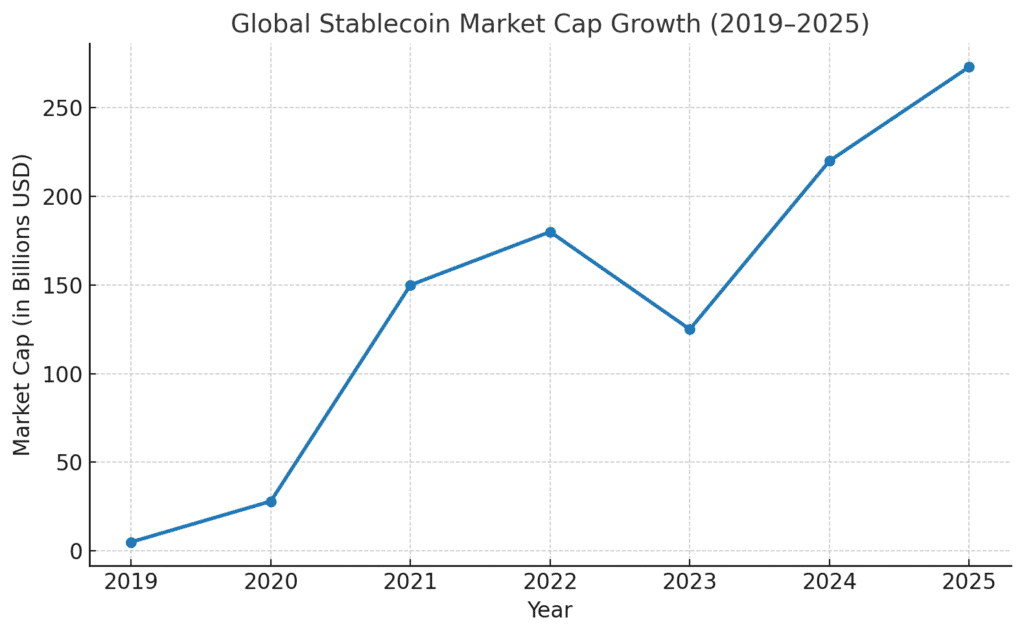
Global Stablecoin Market Cap Growth (2019–2025). The chart shows stablecoins rising from $5 billion in 2019 to more than $270 billion in 2025.
This meteoric rise underscores why the Top Stablecoins to Watch in 2025 are not just relevant to crypto enthusiasts. They are shaping liquidity flows across the world, powering new financial services, and redefining how money moves in a digital age.
Risks and Regulation
Stablecoins, even the largest ones, face risks such as de-pegging, transparency issues, and regulatory crackdowns. The TerraUSD collapse in 2022 remains a reminder of the dangers of poorly designed tokens. That is why regulators have stepped in. In the U.S., the GENIUS Act of 2025 now requires 1-to-1 backing and audits. Europe’s MiCA law enforces strict rules across the EU, while Hong Kong and Singapore have launched their own frameworks. These moves aim to ensure stability and protect users as adoption grows.
Conclusion
Stablecoins have become the largest segment of crypto. They fuel exchanges, DeFi, payments and remittances. The Top Stablecoins to Watch in 2025—from giants like USDT and USDC to decentralized options like DAI and innovative designs like USDe—show the breadth of this sector. The presence of regional leaders (FDUSD and politically-connected USD1) and experimental assets (like OUSD) indicate the globalization of stablecoins, and future possibilities.
Stablecoins are more than digital dollars as regulation tightens and as they are increasingly popular. They are changing the face of money in the world.
Frequently Asked Questions
Which stablecoin is the most widely used in 2025?
USDT remains the largest and most widely traded stablecoin, with a market cap of about $164 billion and dominance on global exchanges.
Why is USDC considered more trusted than USDT?
USDC is fully backed by cash and U.S. Treasuries, with monthly audits and regulatory compliance. This transparency makes it the preferred stablecoin for institutions.
What is the difference between fiat-backed and crypto-backed stablecoins?
Fiat-backed stablecoins, like USDT or USDC, are backed by traditional currency reserves. Crypto-backed coins, like DAI or LUSD, are secured by cryptocurrencies such as Ethereum.
Can PayPal’s PYUSD compete with USDT and USDC?
PYUSD is smaller in market cap, but PayPal’s massive user base gives it unique access to mainstream consumers, making it a strong candidate for real-world payments adoption.
What risks do stablecoins face despite regulation?
Stablecoins face risks such as de-pegging, lack of transparency in reserves, over-reliance on centralized custodians, and potential liquidity issues during financial stress.
Glossary of Key Terms
- Stablecoin – A cryptocurrency designed to maintain a fixed value, often pegged to the U.S. dollar.
- Fiat-backed – A stablecoin backed by traditional currency reserves held in banks.
- Crypto-backed – A stablecoin supported by digital assets like Ethereum or Bitcoin.
- Synthetic model – A design that uses derivatives or hedging strategies to maintain stability, as in USDe.
- Hybrid model – Combines collateral with algorithmic mechanisms, as in Frax.
- Commodity-backed – Pegged to real-world assets like gold (e.g., PAXG).
- Market capitalization – The total value of a stablecoin’s circulating supply.
- Liquidity – How easily an asset can be traded without affecting its price.
- De-peg – When a stablecoin loses its intended value (e.g., $1).
- Run risk – A risk where many holders try to redeem at once, causing instability.
- DeFi (Decentralized Finance) – Financial applications built on blockchain without intermediaries.
- Transparency – Public verification of reserves through audits.
- Collateralization – Holding extra assets to secure the issued stablecoins.
- CBDC (Central Bank Digital Currency) – A government-issued digital version of national currency.
- Audit – Independent verification of a stablecoin’s reserves.
Summary
The Top Stablecoins to Watch in 2025 include USDT, USDC, DAI, Ethena USDe, FDUSD, USD1, PYUSD, BUSD, TUSD, USDP, GUSD, FRAX, LUSD, OUSD, and PAXG. Together, they represent the diverse ways stablecoins are shaping the future of money. USDT leads with $164 billion in liquidity, while USDC follows with $65 billion and is favored for its transparency. DAI and LUSD maintain decentralized models, while USDe and FRAX explore synthetic and hybrid designs. FDUSD and USD1 highlight regional and political ambitions, and PYUSD brings stablecoins into mainstream payments via PayPal. PAXG expands into commodity-backed assets. Although stablecoins face risks such as de-pegging, lack of transparency, and regulatory pressure, new laws like the U.S. GENIUS Act and Europe’s MiCA provide stability. These tokens are more than trading tools—they are now key financial instruments bridging blockchain and traditional systems.