












This article was first published on The Bit Journal.
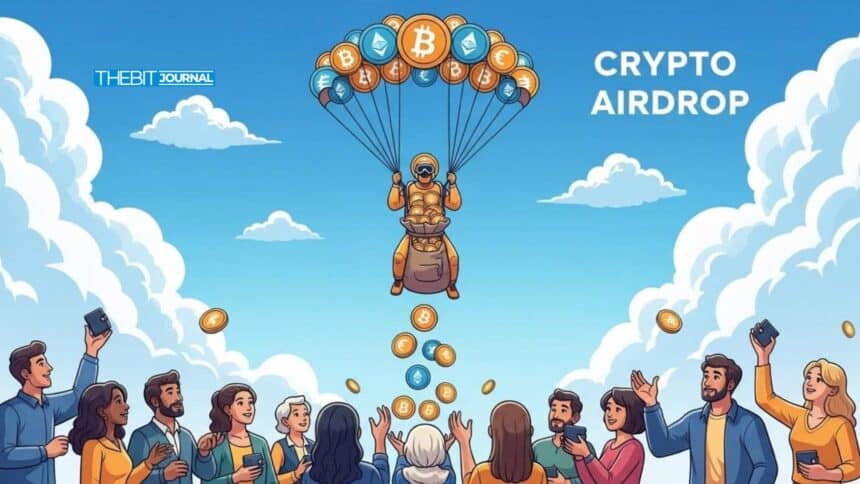
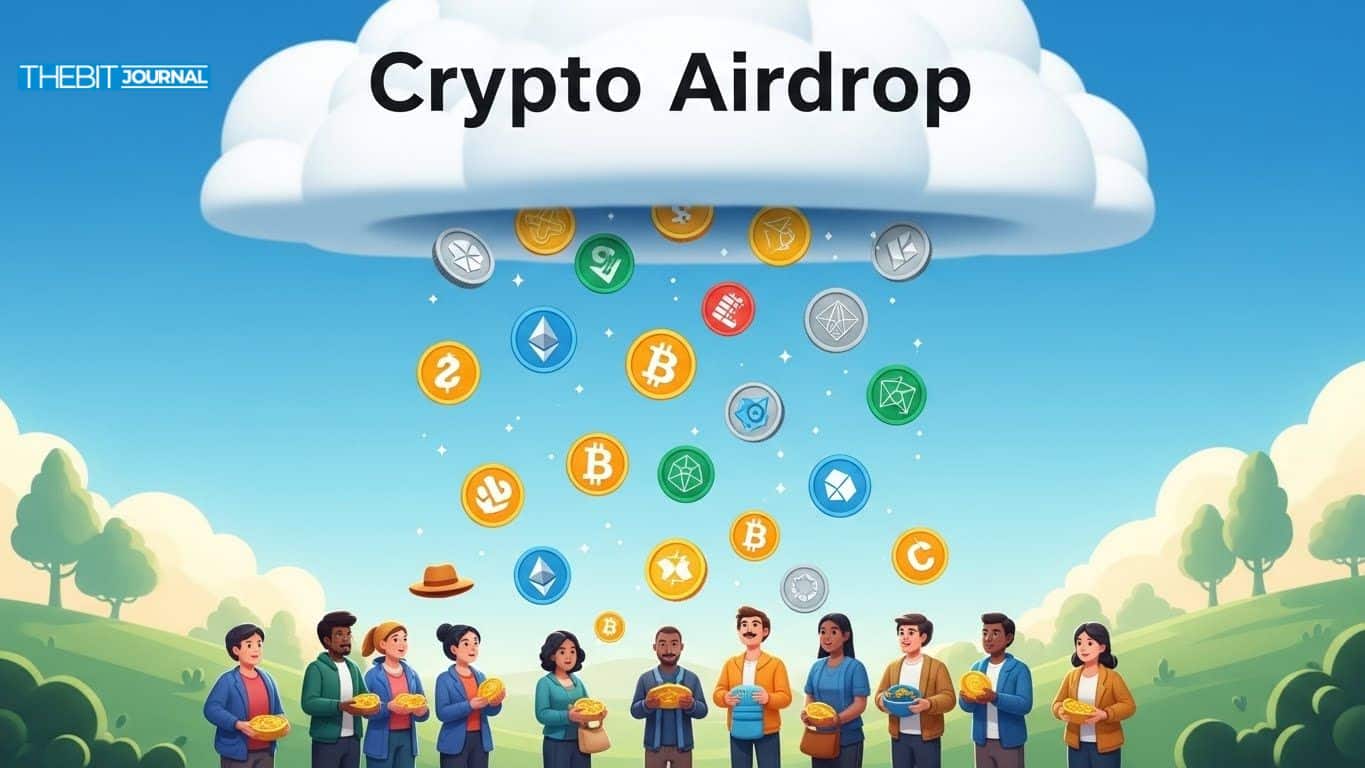
A crypto airdrop is a promotional activity where a blockchain company or project shares free coins or tokens to various wallet addresses.
It is basically a marketing strategy as projects give away little bits of their tokens to existing or potential users in order to drum up interest and bootstrap usage.

Airdrops can incentivize early adopters, distribute token ownership, and spur community engagement without the recipient needing to invest anything at all.
For instance, blockchain companies frequently publish future airdrops on their websites or social-media channels and incentivize crypto enthusiasts to link their wallets or perform simple tasks (such as re-posting a post) in order to earn them.
Unlike initial coin offerings (ICOs), airdrops are free and distributed for nothing instead of giving or selling tokens to investors.
With blockchain, distributions can be automated by leveraging smart contracts to ensure fair and timely delivery.
Why Crypto Projects Use Airdrops
Airdrops are launched by crypto projects for strategic reasons. The main target is to raise awareness and build a community around a new kind of cryptocurrency.
Projects create buzz by giving away free coins. The recipients then become evangelists, spreading word of the project in social media channels and on message boards.
This natural viral adoption can quickly grow the project’s user community.
Airdrops assist in distributing tokens widely rather than being hoarded by founders or investors. Many also airdrop tokens to owners of pre-existing cryptocurrencies, distributing the token in such a way as to minimize centralization.
Decentralized platforms onboard new users into a shared decision-making system by way of governance token airdrops.
For instance, the Uniswap 2020 airdrop retroactively rewarded anyone who had used the DEX with UNI tokens and thus voting rights in protocol governance.
Airdrops can be used to complement fundraising (ICOs/IDOs) and promote token launches. Airdrops, by fostering a vibrant token community and increased liquidity right off the bat, drive better token sales after launch.
To sum up, airdrops have a couple of purposes: as a strategic addition to increase user engagement, decentralize ownership, and reward community loyalty.

How Crypto Airdrops Work
Joining a crypto airdrop is easy and usually requires only few simple actions:
First, a project establishes who is eligible: this may be as simple as “hold token X” or the need to “register wallet and sign up.”
Most airdrops have what they refer to as a snapshot or an instance in time when all coin holders’ balances are recorded.
For example, a project could take a snapshot of all Ethereum addresses that held a specific coin, then issue new tokens to all those holders in proportion.
With other airdrops, users might be required to carry out menial tasks including joining a Telegram group or tweeting about the project to be eligible.
Once eligibility is established, the distribution is carried out through smart contracts. New tokens are typically sent straight to the recipient’s wallet in many cases after providing an address.
In some instances, users need to “claim” the tokens themselves by going to the project’s website within a given timeframe.
Most exchanges allow users to claim their tokens by connecting their accounts and accepting the airdrop.
Participating usually requires a self-custodial wallet (think MetaMask) that the user is in full control of, exchange wallets mostly do not accommodate airdrops due to the holder not having his or her private keys.
Projects can also use airdrops to include KYC or identity checks for regulatory reasons. Like any other blockchain transaction, token recipients can pay a small gas fee to claim or send tokens.
The overall process is automated and scalable, when users satisfy a certain threshold, smart contracts disburse the free tokens across thousands or potentially millions of addresses.
Types of Crypto Airdrops
There are different Airdrop programs. Some of the popular forms of crypto airdrop are as follows:
Standard Airdrop: When recipients agree to it, they get tokens. The project caps the maximum number of tokens per address and they are distributed on a first-come, first-served basis.
All that one needs to do is enter their wallet address and they’re good to go! These are easy to sign up for, but can become competitive because one individual might create several wallets.
Airdrop for Bounty or Task: Tokens are received by users in reward for completing tasks. Common tasks are posting about the project on social media, telling friends about it or blogging about it. For instance, a project could pay points (or tokens) for every tweet or referral, users who collect enough points get the airdrop.
Holder or Loyalty Airdrop: The project snaps a blockchain balance and sends coins to people who hold at least a certain amount of an approved token. For example Stellar’s foundation distributed XLM tokens to Bitcoin holders based on their Bitcoin holdings.
Retro or Governance Airdrop: Early adopters of the platform are airdropped tokens later. A project could say “everyone who interacted with our platform up until date X receives coins.”
Uniswap’s well-known airdrop in 2020 provided anyone who had ever used the exchange with 400 UNI. Likewise, Optimism and Arbitrum have conducted “retroactive” airdrops tied to previous network usage.
Exclusive / Raffle Airdrop: It’s a type wherein limited winners are randomly selected from a pool of registrants or qualifiers. Projects can allocate a pool and draw lottery, ensuring that all registrants have at least some potential to win and leaving the rest of supply untouched.
Each kind of crypto airdrop has slightly different aims. Standard and bounty airdrops are about inclusive marketing while Holder and retroactive airdrops benefit current supporters or holders of the token.
Famous Crypto Airdrops
A handful of crypto airdrops have made headlines by giving away huge value to participants. Notable cryptocurrency airdrop examples include:
| Project (Token) | Year | Distribution Details | Recipients |
| Uniswap (UNI) | 2020 | 400 UNI tokens to each eligible address ($1,200-$1,500 worth at launch) | Every wallet that had ever used Uniswap exchange (≥1 swap) |
| ENS (ENS) | 2021 | Tokens based on .eth domain ownership and activity | Ethereum Name Service domain holders (amount proportional to domain history) |
| Arbitrum (ARB) | 2023 | Tokens allocated by airdrop, accounting for transaction volume and bridging activity on Arbitrum | Users of the Arbitrum network (bridging assets and usage) |
| Optimism (OP) | 2022-23 | Periodic “OP Drops” of governance tokens based on governance participation and ecosystem usage | Active Optimism community members (e.g. past voters and token holders) |
| Auroracoin (AUR) | 2014 | 31.8 AUR to every person registered in Iceland (50% of total supply) | All residents of Iceland (by government records) |
| Stellar (XLM) | 2016-17 | Total 19 billion XLM (19% supply) given to BTC holders in stages (3B in 2016, 16B in 2017) | Bitcoin holders (via participating exchanges) |
| El Salvador (BTC) | 2021 | $30 worth of BTC per person ($75M total) distributed via the Chivo wallet | 2.5 million Salvadorans (government initiative on Bitcoin launch) |
All of these programs have shown the incredible efficacy of airdrops. For example, Uniswap’s 2020 airdrop sent out more than $350 million in UNI to 250,000 addresses. The ENS airdrop also rewarded long-term domain holders and Layer-2 networks like Arbitrum and Optimism, converted users to token holders via an airdrop.
Even governments have experimented with airdrops for adoption: When El Salvador adopted Bitcoin as legal tender, it issued $30 worth of BTC to every citizen as an incentive to use the asset.
Expert Take: Impact of Crypto Airdrops
When done right, experts say crypto airdrops can significantly accelerate the reach of a project. In Dragonfly’s analysis of sample projects, 11 crypto airdrops (2019-2023) together delivered $7.16 billion total value to around 1.9 million recipients (median $4,600 each). That speaks to how much value airdrops can drive directly into users’ hands.
The same report notes regulatory barriers. By geo-blocking U.S. participants, some projects left an estimated $1.8-$2.6 billion on the table for American users between 2020-2024.
In other words, holders in the U.S. missed out on billions of airdropped tokens because of prohibitions. There is already some professional debate over whether lifting these restrictions (e.g. via “safe harbor” provisions) will be good for users and the economy as a whole, because it could lead to airdrops that drive business growth, increase tax revenues, and stimulate job creation.
From a tokenomics view, crypto airdrops also serves as a way to bootstrap liquidity. By dropping coins to lots of people, a project can create an instant market of token holders who are able to trade them or provide liquidity on exchanges.
Experts say that even if recipients sell tokens suddenly which is what usually happens, many of them keep at least a portion or reinvest in the ecosystem.
Analysts who’ve been around the block see crypto airdrops as a tried and tested growth method, albeit one that’s most effective when supported by a strong project and regulatory direction.
Considerations and Risks
While airdrops in crypto provide opportunities, participants need to be careful. Airdrops distribute token without any cost and that tempt some fake project to practice scam by acting like airdrops.
Real airdrops don’t require recipients to send payment. Scammers may instead ask for private keys, or attempt to “dust” wallets (sending small amounts to collect public addresses) which can lead to exposure of holders via phishing or hacking.
Users must only collect airdrops from legitimate sources and refrain from entering wallet seed phrases at unfamiliar sites.
Jurisdiction plays a role in how taxes are collected and therefore structured. As a general matter, getting an airdrop is considered taxable income at the fair market value of the tokens when users have control over them.
If recipients sell those airdropped coins as soon as they receive them, they could be subject to capital gains tax or even income tax. It’s important to monitor these tokens and report them correctly.
Users are encouraged to check current tax laws and rules in their respective jurisdictions.
Finally, value can fluctuate. Even if you recipients get a free token, the value of that token could still plummet to zero if the project does not take off.
Even the most prominent airdrops resulted in early recipients selling tokens for low prices (many UNI holders sold immediately too) though those who held on made out handsomely.
In other words, crypto airdrops are not guaranteed profit, but a free way to gain access to a project’s ecosystem.
Conclusion
Crypto airdrops have been used as an important tool of marketing and distribution. Industry reports and experts concur that airdrops can greatly enhance a project’s profile, decentralize ownership of its token network and jumpstart network effects.
However, their success also depends on the original project being strong and compliant; regulatory limitations may exclude users from such giveaways.
When crafted and deployed correctly, crypto airdrops have been able to add value for both projects and recipients, as demonstrated by groundbreaking events such as the Uniswap and Stellar airdrops.
Still, investors should remain informed and vigilant as they navigate risks such as scams and tax considerations.
Glossary
Crypto Airdrop: The disbursement or marketing of free cryptocurrency tokens in wallets. Airdrops is another method projects use to encourage mass adoption, they typically would giveaway free tokens to loyal users.
Blockchain A decentralized digital ledger that logs transactions in indelible “blocks.” Cryptocurrencies run on a blockchain and can be exchanged for goods or services, much like traditional money.
Token: A value or an asset on a blockchain. Tokens can be used as currency, the right to vote on some decision or access a service. In an airdrop, the “token” is simply the various cryptocurrency being given away.
Wallet: A software address (and its private key) that contains cryptocurrency. To receive the airdropped tokens, one will need a self-custodial wallet (i.e., MetaMask).
ICO (Initial Coin Offering): A method of raising funds for a new cryptocurrency venture in which developers offer coins to investors. ICOs are different from airdrops in that ICOs require funds, airdrops distribute tokens for free.
Governance Token: A token that lets holders make decisions in a decentralized protocol. Numerous projects airdrop governance tokens in order to provide users a say in how the platform is run (e.g. UNI on Uniswap).
KYC (Know Your Customer): Regulation process that ensures a customer is who they say they are. Laws have also made it so that now some airdrops must firm up KYCs before they can offer tokens to individual recipients.
Frequently Asked Questions About Crypto Airdrops
What is a crypto airdrop?
It’s a blockchain project giving away free tokens. Airdrops are used as a marketing or distribution tool to release new coins and get them into circulation.
Why would projects do crypto airdrops?
Airdrops also bring attention and interaction. By giving coins to many people, projects generate buzz and grow their communities. They accomplish a diffusion of token ownership and an early benefaction.
How does one join a crypto airdrop?
One would usually be required to offer a supporting wallet address and fulfill the project’s requirements. One might have to sign up, own a particular token or do simple tasks (such as sharing on social media). One then gets sent the tokens by the project’s smart contract.
Are airdropped tokens taxable?
In many countries, yes. In most cases, an airdrop is considered to be received as income when it’s “distributed.” In the United States, for example, airdropped coins are considered taxable income for fair market value. Be sure to always verify local tax rules.
Can crypto airdrops be scams?
Yes. Some may also be scammers creating fake airdrops to collect valuable information. A genuine airdrops will never request payment or private keys. Please always check the announcements from official project channels and be wary of phishing attempts.
References