
This article was first published on The Bit Journal. EMURGO has announced that it is stepping away from its role in Pentad, the five-member group responsible for coordinating Cardano’s infrastructure funding, as it shifts attention toward recovering funds lost in the recent Cardano wallet exploit involving SecondFi.
SecondFi Exploit Triggers Cardano Wallet Concerns
The move comes after a security breach in which 374 wallets were impacted by an exploit in SecondFi’s wallet address generation process on Cardano. The exploit caused the loss of an estimated 16 million ADA worth of around $2.4 million, which led to EMURGO’s focus on recovery, wallet migration, and on-chain restitution.
In addition to financial losses, this incident has drawn concerns as the compromised Cardano wallet is part of Cardano’s governance ecosystem. The users depend on the compatible wallets to delegate voting power to others, vote on treasury decisions, and engage in decentralized governance functions implemented during Cardano’s Voltaire period.
Cardano Governance Depends on Secure Wallets
As per Yoroi’s governance document, ADA holders are able to assign a vote to Yoroi’s Delegated Representative (DRep) as well as choose another DRep, abstain or register a no-confidence vote directly on the Cardano wallet interface. The rewards also align with the governance participation, which makes it more vital than ever that Cardano wallet security becomes a priority for all users.
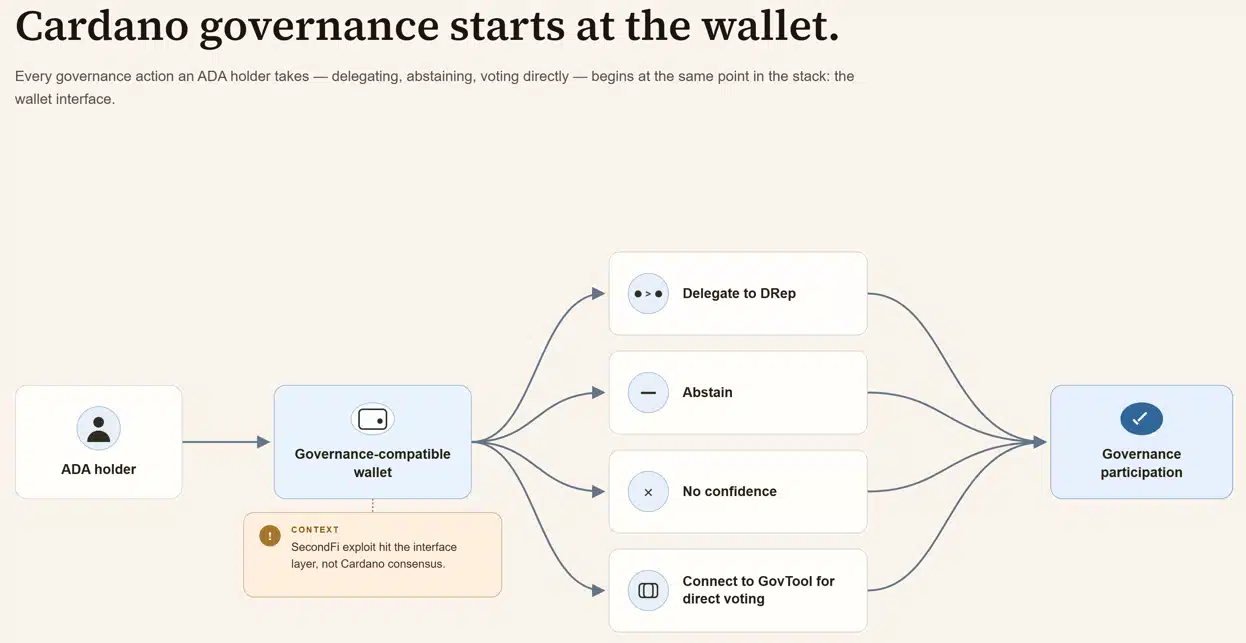
The Cardano governance model as specified in CIP-1694 brings together all ADA holders, DReps, stake pool operators and the Constitutional Committee into a decentralized decision making process. As participation in governance starts through a governance compatible Cardano wallet, any vulnerability in a wallet layer could impact user confidence, even if the blockchain is secure.
Pentad Continues Cardano Infrastructure Funding
Pentad was founded by the Cardano Foundation, Input Output, EMURGO, Intersect and the Midnight Foundation to help coordinate infrastructure spending across the Cardano ecosystem from the Cardano treasury.
The group has been responsible for significant funding programs, such as the 70 million ADA Critical Integrations Budget that was approved at the end of 2025 to support new stablecoins, institutional custody of ADA, cross-chain bridges, pricing oracles, and analytics tools.
Recently, the Cardano Foundation made a proposal to disburse an additional 3 million ADA as Year 2 support for various integrations like Circle USDCx, LayerZero, Pyth, Dune, and Fireblocks. The remaining four organizations will continue to coordinate the second funding round as EMURGO exits.
Bitquery Traces Cardano Wallet Exploit

Bitquery, a blockchain analytics firm, found that the exploit was caused by the poor randomness of SecondFi’s private key generation process, not due to any vulnerability in the Cardano blockchain. All transactions were carried out as intended by the network, thus emphasizing that the entire failure was at Cardano wallet layer.
Bitquery also found over 129 million ADA in swept funds as part of its wider forensic investigation, but investigators highlighted that this amount should not be interpreted as 16 million ADA stolen from impacted users.
EMURGO Focuses on Cardano Wallet Recovery
The average loss equates to roughly 42,800 ADA per compromised wallet, representing a significant financial setback for victims and highlighting the importance of using a secure Cardano wallet.
EMURGO has not said whether its move from Pentad will be permanent, saying that its immediate focus is with those who have been impacted to assist them in recovery, migration and restitution efforts. Meanwhile, the Cardano governance system is still working as it should, and observers are keen to see whether participation via the Cardano wallet ecosystem and DRep activity will continue to hold up despite the security incident.
Conclusion
After the SecondFi exploit, EMURGO’s future in Pentad is not clear, but the immediate priority is to rebuild the trust of users. The incident is likely to reinforce a push for safer Cardano wallet solutions, enhanced auditing protocols, and network resilience within its growing governance framework as recovery efforts persist.
Follow us on Twitter and LinkedIn, and join our Telegram channel to be instantly informed about breaking news!
Summary
- EMURGO left Pentad after the SecondFi Cardano wallet exploit.
- The exploit hit wallets, not the Cardano blockchain.
- EMURGO now focuses on recovery and wallet security.
Glossary of Key Terms
Bitquery: Blockchain analytics firm.
Cardano Wallet: Wallet for storing ADA and governance.
CIP-1694: Cardano’s governance framework.
DRep: Governance representative for ADA holders.
EMURGO: Cardano founding organization.
Pentad: Cardano infrastructure funding group.
SecondFi: Wallet project hit by the exploit.
Voltaire Era: Cardano’s governance phase.
Frequently Asked Questions about Cardano Wallet
1. Why did EMURGO leave Pentad?
EMURGO stepped back to focus on recovery after the SecondFi Cardano wallet exploit.
2. Was the Cardano blockchain hacked?
No, only SecondFi’s wallet software was exploited.
3. How much ADA was stolen?
Around 16 million ADA from 374 wallets.
4. Why does wallet security matter?
It protects governance participation and user funds.
References
Disclaimer
The article is purely informational and it is not a financial, investment, or a trading advice. Cryptocurrencies are extremely risky and volatile. Before investing, the readers are to conduct personal research and seek the advice of a qualified financial expert.